
died 20 August 535 (also reported 537)·Feast August 19
St. Mochta
Last Surviving Disciple of Saint Patrick and Abbot of Louth
Overview
Mochta — his name variously written Mochtae, Mahew, Mochteus or Maucteus — died on 20 August 535, or by another annalistic report in 537, and was the last surviving disciple of Saint Patrick. Like Patrick, he was a native of Britain; his very name is British, and Adomnán's Life of Columba introduces him as a holy stranger out of Britain formed in Patrick's own school. Brought to Ireland as a child, he studied in Rome, was consecrated a bishop by the Pope, and returned with twelve companions. After founding a first church at Kilmore he settled at Louth, where he established a monastery that won a nationwide reputation on a site once sacred to the god Lugh. A scholar of real attainment, in Scripture above all, he composed a rule for his monks that is now lost, while the annals he set going at Louth were carried on by those who came after him under the title Book of the Monks. When he was old, Patrick came to spend time under his roof, and after Patrick's death Mochta governed Armagh briefly before handing it to Benignus. Scholars reckon that he died at about ninety years of age, the last of Patrick's disciples then alive.
The Complete Life
A British Child in Louth
Mochta belonged, like Patrick himself, to the Christian population of Britain, and the testimony on this point is unusually firm: his name is British in form, and Adomnán, writing of him in the Life of Columba, presents a holy stranger out of Britain whose formation was in the school of the holy bishop Patrick. The same early author preserves the claim that Mochta foretold the birth of Colm Cille, linking him in legend to the greatest figures of the Irish church. One account tells how he first reached Ireland: as a small child he was ferried over the sea with his parents by the druid Hoam, who made his home in County Louth and raised the boy as one of his own household. The detail is a striking one — a future bishop raised under a druid's roof — and Irish storytelling made much of it, for the same Hoam appears later in the legends of Mochta's miracles. Whatever the exact circumstances of his crossing, his upbringing in Louth bound him permanently to that corner of Ireland, and it was there, among the family of the druid, that the child from Britain first encountered the faith he would spend his life serving.
§ Life
Rome, Episcopate, and Patrick's School
When he was grown, Mochta went to Rome to continue his studies, following the path of an Irish churchman who sought his formation at the centre of western Christendom. There the Pope gave him consecration as a bishop and despatched him homeward with twelve companions, a mission party whose number echoed the apostolic band and marked him out from the first as a planter of churches. His standing in the Irish church, however, rested above all on his place in the school of Patrick: he was the last surviving disciple of Saint Patrick, the final living link at his death to the apostle of the Irish. That distinction gave everything he afterwards did its weight, for he embodied the memory and the practice of the founder's generation. Among his contemporaries his reputation stood equally high as a scholar — an accomplished student especially learned in Sacred Scripture — and the completeness of that formation, Roman and Patrician at once, made him a natural head for the communities entrusted to him. The blend of foreign training and first-hand discipleship to Patrick defined his authority for the rest of a very long life.
§ Life
Kilmore and the Monastery of Louth
The first church Mochta founded was at Kilmore. When he left that place he gave everything he owned to the monks, keeping nothing for himself but, as the story has it, the fountain at the door; and following the stream — or, in the version of his Life, followed by it — he came to Louth, the water on his path becoming the river Fane. At Louth he established the monastery for which he is remembered, on ground that had borne an older sacredness still: the site was originally a shrine of the Celtic god Lugh, and the Christian house that rose there succeeded, in place and in name, to a cult far older than itself. The monastery won a nationwide reputation, drawing notice from every part of Ireland. Mochta proved a scholar of real accomplishment, deeply read in Sacred Scripture, and his literary work outlasted his own century in influence if not in survival: he composed a rule for monks, of which no trace remains, and began at Louth a series of annals that his successors continued year after year until the whole undertaking bore the title Book of the Monks, a chronicle of many hands rooted in his own practice.
§ Life
Wonder-Worker and Servant of the Poor
The stories told of Mochta's sanctity gather around two poles: radical detachment from possessions and power over death itself. The first appears in his departure from Kilmore, where he stripped himself of every belonging for the sake of the monks he left behind, retaining only the spring at the gate — a poverty freely chosen that the tradition found as eloquent as any sermon. The second appears in the tale of the daughter of the druid Hoam, the man in whose household he had been raised: one story relates that Mochta restored the young woman to life. The miracle completes a circle begun in his childhood, for the family that had taken in the British orphan now receives back its daughter through his prayer. The story continues beyond the raising, for the restored woman entered religious life and sewed vestments and altar linens, turning her second life to the service of the liturgy. Whatever the historical weight of such narratives, they show how the Irish church remembered him: not as a warrior or a princely founder, but as a gentle, learned priest through whom life and livelihood returned to the people of his first home.
§ Life
Armagh and a Long Death
In his old age Mochta received a visit that the tradition treasured: Patrick himself came and spent some time with his last surviving disciple, an evening of the apostle's life passed in the house of the man who would outlive him. When Patrick died — a death the Annals of Ulster date to 493 — the burden of the primatial see fell for a moment on the old man's shoulders, for Mochta governed Armagh for a short season and then yielded it to Benignus, content to hold what he had not sought and to hand it on when a successor stood ready. His own end came long afterward. The Annals of Ulster report his death twice, in 535 and again in 537, a doubled entry that scholars read as proof that he was considerably younger than Patrick, whose death the same annals place in 493; on their reckoning the last of Patrick's disciples died at about ninety years of age. The 535 entry sets his death at the 13th of the Calends of September — 20 August — and keeps the opening words of a letter of his, in which a sinful priest and disciple of Saint Patrick greets his readers in the Lord. Neither the rest of that letter nor any other writing of his has survived.
§ Life
The House That Endured
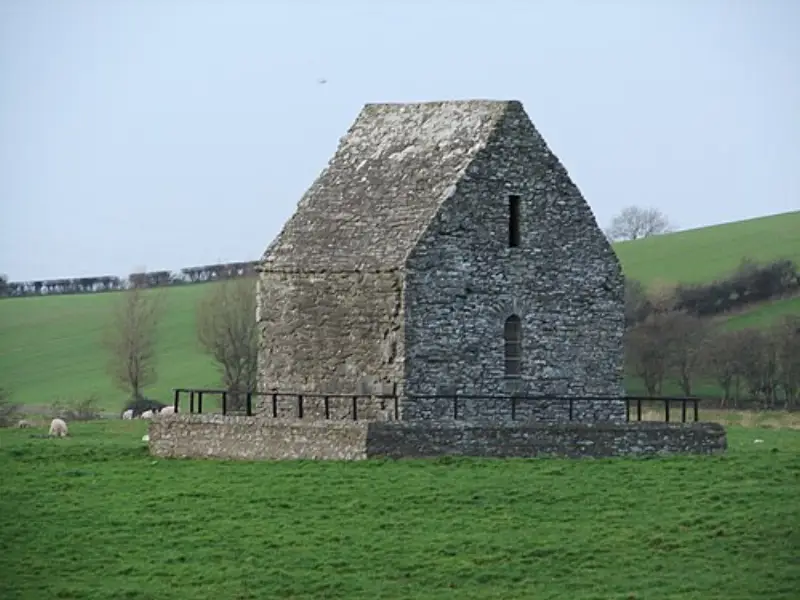
The monastery Mochta founded at Louth outlived him by centuries, though not in peace. Danes burned and plundered monastery and village alike, over and over, across the years from 829 to 968, the price of the house's wealth and fame; and the round tower built for the community's protection was itself blown down in 981. That a foundation required a tower at all shows what Mochta's name had made of Louth: a place worth attacking, a centre of national rather than merely local consequence. The annals he began at Louth were carried on by those who came after him until the whole work bore the title Book of the Monks, so that his literary habit bore fruit in a chronicle kept alive by the generations after him. His remains rested in County Louth from the twelfth century onward in the building known as St. Mochta's House, which still stands as the most tangible memorial of his cult. The feast of his commemoration is kept on 19 August, and under the many shapes of his name — Mochtae, Mahew, Mochteus, Maucteus — the last disciple of Patrick has never quite left the calendar of the Irish church.
§ Life
Timeline
- 493
On Patrick's death, as recorded by the Annals of Ulster, took charge of Armagh for a short time before surrendering it to Benignus
§ Life
- 20 Aug 535
Died at Louth on 20 August, the date the Annals of Ulster give as the 13th of the Calends of September
§ Life
- 537
Is the subject of a second death entry in the Annals of Ulster, dated two years after the first and taken to show he was much younger than Patrick
§ Life
In Their Own Words
a certain British stranger, a holy man and a disciple of the holy bishop Patrick
Mauchteus, a sinner, priest, disciple of St Patrick, sends greetings in the Lord.
The Record
- Major works
- A rule for monks (lost)·A series of annals begun at Louth, continued by his successors as the Book of the Monks·A letter, of which only its opening line survives
- Canonization
- Pre-congregation; venerated as a saint from the early Irish church
Prayer
Bibliography
Show 4 sources
- Anderson, Alan O. & Majorie O. Anderson (eds.). Adomnan's Life of Columba. Edinburgh, 1961.
- Ó Crónín, Dáibhí. Early Medieval Ireland: 400-1200. Longman, 1995.
- Ó Crónín, Dáibhí. "Hiberno-Latin Literature to 1169". In Dáibhí Ó Crónín (ed.), A New History of Ireland vol 1: Prehistoric and Early Ireland, Oxford University Press, 2005.
- Mac Carthy, B., ed. (1895), Annala Uladh: Annals of Ulster (in Irish), Dublin.
Profile text adapted from the Wikipedia article, licensed CC BY-SA 4.0.
Pray with this saint every day
Save St. Mochta to your favorites, read the full profile, and get feast-day reminders in the Saints app.
Get the Saints AppFree on the App Store for iPhone and iPad