
died 288-295·Feast May 11
St. Mocius
Priest-Martyr of Amphipolis Under Diocletian
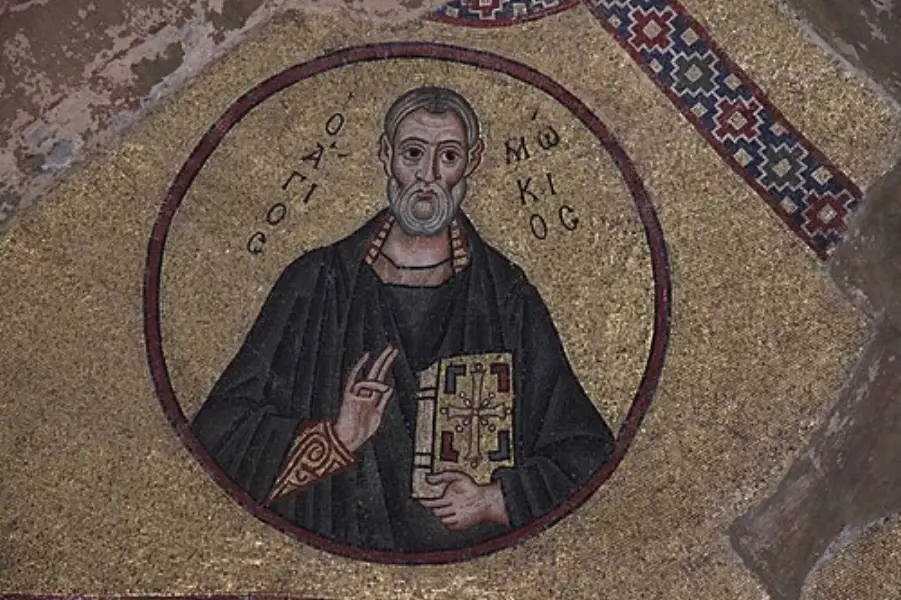
Overview
Mocius, a Christian priest of Roman stock settled at Amphipolis in Macedonia, died a martyr at Byzantium between 288 and 295, in the persecution waged against the Church by the emperor Diocletian. His lone public act began at a pagan festival: as the crowds gathered for the celebration of Dionysus, he stood before them and called them away from the rites of the feast, to repentance, to conversion to the Christian faith, to baptism. At the temple of Dionysus he destroyed the statue of the god, and for this he was seized and arraigned before Laodicea's governor. Torture failed to move him; cast into a red-hot oven he emerged unharmed while the flames scorched the governor himself, and given to wild beasts he was left untouched, the lions lying down at his feet. Seeing such things, the people demanded his release, but the governor ordered him sent to Perinthus and from there to Byzantium, where he was beheaded. His feast is kept on 11 May in both the Catholic and the Orthodox Church, and Constantinople afterwards honoured his name with a great church, a monastery, and the largest cistern in the city.
The Complete Life
A Priest at Amphipolis
Mocius served as a Christian priest in the Macedonian city of Amphipolis, a man of Roman ancestry living in a Greek world, at the moment when the Roman empire turned its whole weight against the Church. The persecution he faced was that of the emperor Diocletian, whose reign ran from 284 to 305 and whose final assault on Christianity set out to extirpate the faith by law, torture and spectacle. A priest in such a city held his office under a sentence deferred: the altars he served were illegal, the assembly he led was a target, and the festivals of the old gods filled the public spaces around him. It was in exactly this setting that his character declared itself, for Mocius was not a Christian who kept his faith private while the storm passed. The later tradition remembers him first and foremost as a man who walked toward the crowd rather than away from it, a presbyter whose conviction about the living God outweighed every calculation of safety. That disposition, settled long before his arrest, is what carried him through the ordeal that followed and made his name endure in the church's memory.
§ Life
The Festival of Dionysus
The act that set his passion in motion took place at a feast. As the people of Amphipolis assembled for the pagan festival of Dionysus, Mocius came before the crowd and urged them to abandon the customs that accompanied the celebration; he called them to repentance, to conversion to Christianity, and to baptism. It was a singular gesture — one unarmed priest confronting a city at its most festive in honour of its god — and he pressed the challenge to its limit: at the temple of Dionysus he destroyed the statue of the god. Whatever the crowd made of his words, the destruction of the image was an outrage no authority could overlook, and Mocius was seized and arraigned before the governor at Laodicea. The record of what followed belongs to the stock episodes of martyrology, yet the tradition tells it with its own details: torture produced no surrender; a red-hot oven received him and left him unharmed while the flames bursting from it scorched the governor; wild beasts refused to touch him, and the lions laid themselves down at his feet. Watching such things, the people took his side and clamoured for him to be set free.
§ Life
To Byzantium and the Sword
The governor's answer to the miracles was neither release nor immediate death but removal: he ordered the saint sent away from the city whose people had turned in his favour, first to Perinthus and from there to Byzantium. The journey reads like an attempt to break a spectacle by dispersing it, moving the prisoner from forum to forum until a verdict could be secured somewhere the wonder had not been seen. It failed in its object only in the long run, for the place of his execution became the place of his greatest honour. At Byzantium the sentence was carried out and Mocius was beheaded, dying between the years 288 and 295, one of the host of nameless and named Christians who sealed the confession with blood in Diocletian's persecution. The church counted him among its martyrs from the first, keeping his feast on 11 May in both the Catholic and the Orthodox tradition, and the menologion painters placed him beside other martyrs of the era. The priest of Amphipolis thus ended where the empire's new capital would rise, his blood sown into ground that Constantinople would later build upon and pray in for a thousand years.
§ Life
Cistern, Church, and Monastery
Constantinople remembered Mocius in brick and water on a scale few martyrs enjoyed. The emperor Anastasius I, reigning from 491 to 518, constructed an open-air reservoir for the city's water — the third of the Late Roman cisterns and the largest in Constantinople — and gave it the martyr's name, for he was venerated in a church that stood nearby. The Turks called the reservoir Altı Mermer Çukurbostanı; it is now the Fatih Educational Park, though its ancient walls still stand. Close by rose the church of St Mokios, said to have been built by Constantine himself on top of a temple of Zeus, and rebuilt more than once in its long life — by Pulcheria, by Marcian, or possibly by Justinian I — before Basil I restored it again in the ninth century. It stood between the Theodosian and the Constantinian walls, near the monastery of Theotokos ta Mikra Romaiou, which kept a hospital and a xenodochium for the sick and for travellers. Learning lodged there too: it is possible that the eleventh-century physician Ibn Butlan composed The Physicians' Banquet there while resident in Constantinople. Water, worship, healing and scholarship — the martyr's name gathered them all.
§ Legacy
Timeline
- 295
Suffered martyrdom by beheading at Byzantium, after trial, torture, the oven and the lions left him unharmed; his death is placed between 288 and 295
§ Life
- 491
Received his greatest architectural memorial when the emperor Anastasius I, reigning from 491 to 518, built an open-air cistern at Constantinople named after him
§ Legacy
The Record
- Canonization
- Pre-congregation martyr; venerated in the Catholic Church and the Eastern Orthodox Church
Prayer
Bibliography
Show 6 sources
- "Hieromartyr Mocius the Presbyter of Amphipolis in Macedonia", Orthodox Church in America.
- Martirologio Romano (PDF). Libreria Editrice Vaticana. 2004. pp. 242-244.
- Ὁ Ἅγιος Μώκιος ὁ Ἱερομάρτυρας. 11 Μαΐου. ΜΕΓΑΣ ΣΥΝΑΞΑΡΙΣΤΗΣ.
- "Mocius Cistern", Istanbul.
- Halsall, Paul (1996). "Life of St. Thomais of Lesbos". Holy Women of Byzantium: Ten Saints' Lives in English Translation. Dumbarton Oaks. p. 319. ISBN 978-0-88402-248-0.
- Oltean, Daniel (2021-02-01). "From Baghdad to Antioch and Constantinople: Ibn Buṭlān and the Byzantines". Byzantinische Zeitschrift. 114 (1): 362-363. doi:10.1515/bz-2021-9015. ISSN 1868-9027.
Profile text adapted from the Wikipedia article, licensed CC BY-SA 4.0.
Pray with this saint every day
Save St. Mocius to your favorites, read the full profile, and get feast-day reminders in the Saints app.
Get the Saints AppFree on the App Store for iPhone and iPad