
6th century·Feast February 4
St. Modan
Irish monk, missionary along the Forth, and hermit
Overview
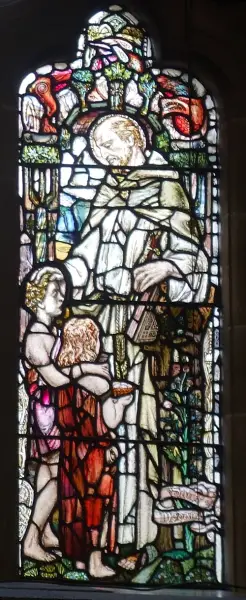
Saint Modan was the son of an Irish chieftain who left his father's world for the monastic life and became one of the Celtic church's missionaries in what is now Scotland. He built a chapel at Dryburgh in 522 and used it as a base for several years; that ground later became the site of Dryburgh Abbey, one of the great religious houses of the Scottish Borders. From Dryburgh he preached for the Celtic church through the districts of Falkirk and Stirling and along the waters of the Forth, carrying the Christian message to the settlements of central Scotland. His reputation for holiness brought him unwelcome honour: he was elected abbot, a post he accepted only reluctantly. After a number of years in office he resigned and withdrew from leadership altogether into the solitude of a hermit in the country around Dumbarton, where his life came to its close. His remains were placed in a shrine in Saint Modan's church at Rosneath, on the peninsula of that name, where his memory was kept alive. The church keeps his feast on 4 February, honouring him in the Roman Catholic communion and in the Eastern Orthodox alike.
The Complete Life
From a Chieftain's Hall to the Cloister
Modan came from the highest rank of early Irish society, the son of a chieftain, yet nothing in his life turned upon that inheritance. He became a monk, exchanging the standing of a warrior family for the discipline and poverty of the religious life, and crossed from Ireland to Scotland in the age of Celtic monastic expansion. In 522 he built a chapel at Dryburgh, in the valley of the Tweed, and made it his base for several years. That chapel was the first Christian settlement on ground that would later carry one of Scotland's most celebrated abbeys: the monastic house that grew on the site became Dryburgh Abbey, and the founder's first enterprise was remembered in its story. For a man of his birth, the choice of the monastic habit represented a decisive renunciation, and the pattern of his whole career — building, preaching, refusing power, and finally retiring into solitude — suggests a temperament that sought God rather than position. The chapel at Dryburgh remains the fixed point from which the rest of his activity in Scotland can be traced.
§ References
Preaching in Falkirk, Stirling, and Along the Forth
Out of Dryburgh Modan carried the preaching of the Celtic church into the Falkirk and Stirling districts and down the Forth. That corridor of country formed a corridor between the kingdoms and peoples of early medieval Scotland, and his work belongs to the great movement by which Irish monks and their disciples carried Celtic Christianity through central Scotland. He continued this missionary activity until he was elected abbot, an honour that his conduct of life had drawn upon him but which he received with reluctance. The office of abbot in a Celtic monastery joined spiritual fatherhood with administrative command, and Modan bore it, as the tradition records, unwillingly — a reluctance that itself became part of his witness. He accepted the post only after election and held it for a number of years, discharging its duties while his inclination ran toward the missionary and contemplative work he had known before. His reluctance did not become disobedience; he served until the time came when he could honourably resign, and the memory of an abbot who governed without ambition preserved itself among the churches of the region.
§ References
Hermit at Dumbarton
After a number of years as abbot, Modan resigned the office and withdrew from public life altogether, becoming a hermit. He settled in the Dumbarton area, on the Clyde, where the rock fortress and the surrounding country offered the solitude he sought. There the missionary of the Forth ended his days in prayer and penitential discipline, dying in the obscurity he had chosen — an ending in keeping with a life that had twice refused elevation, first the hall of an Irish chieftain and then the easy continuance of abbatial authority. His body did not remain long without honour: his relics were enshrined at Saint Modan's church in Rosneath, on the Rosneath Peninsula across the Clyde from Dumbarton, where a church bore his name and kept his memory before the congregation of the district. The translation of his remains to Rosneath joined the two shores of his final years, Dumbarton and the peninsula, into a single sphere of devotion, and made the church at Rosneath a centre where the faithful could honour the hermit who had preached to their forefathers.
§ References
Remembered at Dryburgh and Rosneath
Modan's most visible monument is indirect: the chapel he built at Dryburgh in 522 became, in the course of time, the site of Dryburgh Abbey, and the abbey's ground thus preserves the place where the Irish chieftain's son first settled in Scotland. His cult survived in the churches of the west as well, above all at Saint Modan's church in Rosneath, where his relics were enshrined and where his name continued to be honoured on the peninsula. The church's memory of him was strong enough that a history of the Rosneath peninsula recorded his story for later generations. In the wider church his cult passed into the calendars of both the great communions: his feast is kept on 4 February, and his cult is honoured in the Roman Catholic communion and the Eastern Orthodox alike, with modern Orthodox calendars and the Romanian Orthodox Archdiocese of Great Britain and Northern Ireland commemorating Saint Modan of Dryburgh on that date. A saint of few recorded deeds but enduring buildings and shrines, he stands among the missionary monks who gave central and western Scotland its Christian foundations.
§ References
The Record
- Major works
- Chapel at Dryburgh, on the later site of Dryburgh Abbey
- Canonization
- Pre-congregation; venerated in the Roman Catholic Church and the Eastern Orthodox Church, feast kept on 4 February.
Prayer
Bibliography
Show 3 sources
- "Church history and St. Modan". rosneathpeninsula.org.uk. Archived from the original on 7 October 2006.
- "Orthodox Calendar - February 17 / February 4". Holy Trinity Orthodox Church, Baltimore, Maryland. Retrieved 20 June 2026.
- Valesecanu, Pr Vasile (4 February 2026). "Saint Modan of Dryburgh, Scotland (†4 February)". Romanian Orthodox Archdiocese of Great Britain and Northern Ireland. Retrieved 21 June 2026.
Profile text adapted from the Wikipedia article, licensed CC BY-SA 4.0.
Pray with this saint every day
Save St. Modan to your favorites, read the full profile, and get feast-day reminders in the Saints app.
Get the Saints AppFree on the App Store for iPhone and iPad