
died c. 680·Feast November 4
St. Modesta
Founder and first abbess of Oeren at Trier
Overview
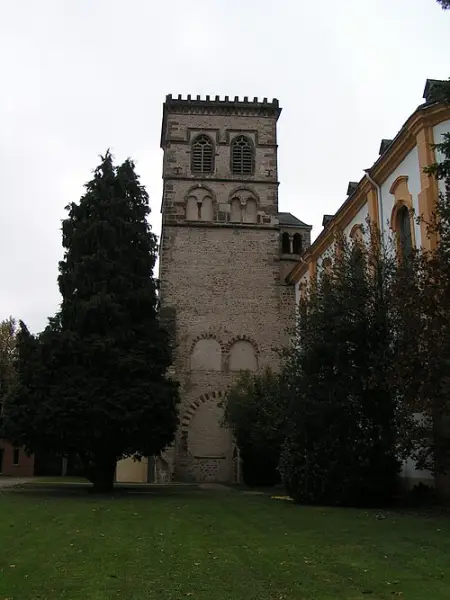
Saint Modesta, who died around 680, was the founder and first abbess of the monastery of Oeren at Trier in Germany, the religious house later known as St Irminen Abbey. She belonged to the most influential noble family of the Frankish church: she was the niece of Itta of Metz, the cousin of Saint Gertrude of Nivelles, and the kinswoman of Saint Modoald, who appointed her to the office she made famous. Modesta became a Benedictine nun, and her uncle Saint Modoald named her the first abbess of the convent of Oeren at Trier. The abbey was built upon the Roman horrea, the ancient granaries that still remained on the site, and from that origin the house took the many forms of its name — Öhren, Ohren, Øhren, Oehren, Oeren, Herren, or Horreum. Under her leadership the convent took its place among the great seventh-century houses of Austrasia, alongside Nivelles and the other foundations of her family. After her death the abbey was dedicated to the patronage of Saint Irmina of Oeren, its second abbess, but Modesta remained its founder in memory. Her feast is kept on 4 November, and she is venerated in the Catholic Church and the Orthodox Church.
The Complete Life
A Daughter of the House of Metz
Modesta was born into the noble kindred that dominated the church of seventh-century Austrasia. She was the niece of Itta of Metz, the matriarch who founded Nivelles, and through that connection the cousin of Saint Gertrude, Itta's celebrated daughter, who lived from about 626 until 659. The family circle extended further: her uncle was Saint Modoald, and the family tree in which she appears places her alongside Grimoald the Elder, Begga, and the line that ran on through Pepin of Herstal and Charles Martel to Charlemagne. To be born into this house was to be born into responsibility: its women founded monasteries and governed them, its men held office under the Merovingian kings, and its members were counted among the saints of the region. Modesta's contemporaries and kin — Gertrude at Nivelles, Begga at Andenne, Modoald at Trier — set the pattern of sanctity that she herself would follow. The sources record nothing of her childhood, but the shape of her life was surely determined by this environment, in which the founding of a convent was both an act of piety and an establishment of the family's presence in a great city.
§ Family
Benedictine Nun and First Abbess
Modesta became a Benedictine nun, taking upon herself the rule of prayer, reading, and labour that Benedict of Nursia's teaching prescribed for the monasteries of the West. Her vocation, however, led not to obscurity but to government: her uncle Saint Modoald appointed her the first abbess of the convent of Oeren at Trier. Modoald, who served as bishop in that city until his death in 645 or 648, entrusted the new foundation to a kinswoman he could trust to establish it firmly. The appointment made Modesta the founding superior of a house destined to endure for centuries. As first abbess she bore the whole weight of beginning: forming the community, ordering its liturgy and property, and setting the observance that her successors would keep. The office she assumed placed her among the abbesses of her family's tradition — Itta and Gertrude in the previous generation, and after her the second abbess, Irmina — through whom the noble women of the House of Metz shaped the religious life of the Meuse and Moselle lands. In that company Modesta's own administration of Oeren won her the veneration of the church of Trier.
§ Biography
The Monastery on the Roman Granaries
The house that Modesta founded and governed was built upon an inheritance far older than the Franks: the abbey of Oeren rose on the Roman horrea, the ancient granaries that still remained on the site at Trier, reusing the vast storage halls of the imperial city for the service of a Christian community. From these granaries the abbey took its name, which appears in the sources as Öhren, Ohren, Øhren, Oehren, Oeren, Herren, or Horreum — every form a memory of the storehouses beneath it. Under Modesta the convent became a settled and enduring institution in one of the oldest cities of German Christendom. Founding and governing such a house required all the qualities her family had bred in her: command of property, skill in the ordering of communal life, and persistence in a task whose fruits she would not see completed. The abbey she established outlived her by more than a thousand years, and in the course of time it was dedicated to the patronage of Saint Irmina of Oeren, the community's second abbess, who succeeded the founder and continued her work. Modesta's foundation thus stands in the direct line of the great Benedictine houses of Trier.
§ Biography
Feast of 4 November and the Abbey's Memory
Modesta died at Trier around the year 680, and the church's memory of her settled into the calendar: her feast is kept on 4 November, and she is venerated in the Catholic Church and in the Orthodox Church. The abbey she founded became known as St Irminen Abbey, dedicated to the patronage of Saint Irmina of Oeren, the second abbess who carried the community forward after the founder's death; under that name the house remained a landmark of Trier long after the Middle Ages, and a church of St Irmina in the city still recalls the convent's tradition. Modesta's family gave the church a whole generation of saints — Gertrude of Nivelles, Begga, Modoald, and through them the ancestors of Charlemagne — and her own cult belongs to that remarkable flowering of sanctity in seventh-century Austrasia, in which the founding and governing of monasteries by noble women was the characteristic form of holiness. Later compendia of the saints, from seventeenth-century German legend collections to modern biographical dictionaries such as Basil Watkins' Book of Saints, have preserved her entry as founder and first abbess of Oeren, the woman who turned the granaries of the Caesars into a dwelling of prayer.
§ Biography
The Record
- Major works
- Monastery of Oeren (later St Irminen Abbey), Trier
- Canonization
- Pre-congregation; venerated from early centuries, feast kept on 4 November.
Prayer
Bibliography
Show 5 sources
- Legende der Heiligen auf jeden Tag des Jahres: nebst der Anwendung auf die Glaubens- und Sittenlehre. 4 (in German). Rieger. 1836.
- Watkins, Basil (19 November 2015). The Book of Saints: A Comprehensive Biographical Dictionary. Bloomsbury Publishing. ISBN 978-0-567-66415-0.
- "Saint Modesta of Trier - Saint of the Day - November 4". Catholic Daily Readings. 23 June 2019.
- "Modesta of Trier (d. about 680)". Encyclopedia.com.
- "St Irmina's Church - Places of Interest". trier-info.de.
Profile text adapted from the Wikipedia article, licensed CC BY-SA 4.0.
Pray with this saint every day
Save St. Modesta to your favorites, read the full profile, and get feast-day reminders in the Saints app.
Get the Saints AppFree on the App Store for iPhone and iPad