
died 11 March 638·Feast December 17
St. Modestus of Jerusalem
Patriarch who rebuilt Jerusalem after the Persian sack
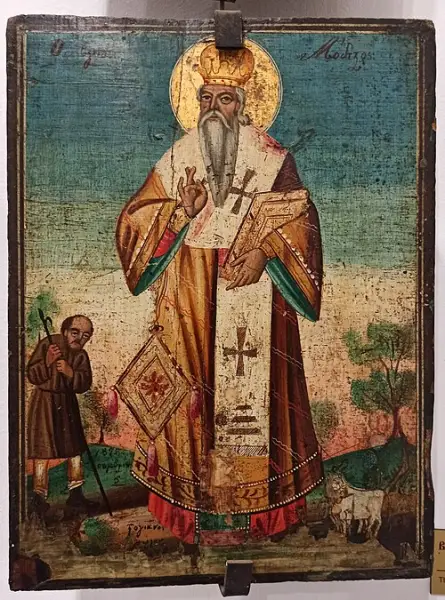
Overview
Modestus led the church of Jerusalem through the wreckage left by the Persian wars of the early seventh century. Born at Sebasteia in Cappadocia, he lost his Christian parents while an infant of five months and was raised in the faith by others. Sold into slavery in Egypt as an adult, he won his pagan master to Christianity and received his freedom at the man's hands. He withdrew to Mount Sinai for a life of asceticism and in time was made abbot of the Monastery of St. Theodosius in Palestine. When the armies of Chosroes II sacked Jerusalem in 614, killing tens of thousands and carrying off Patriarch Zacharias and the True Cross, Modestus narrowly escaped Persian troops while on his way to raise Greek reinforcements. Chosen to govern the patriarchate in Zacharias's absence, he buried the slain monks of Mar Saba and rebuilt the Holy Sepulchre and the city's ruined churches and monasteries with the aid of John the Merciful, patriarch of Alexandria. After Zacharias perished a captive in Persia, Modestus governed the church of Jerusalem in his own name; he went to his rest on 11 March 638, aged about seventy-seven, and was laid to rest on the Mount of Olives.
The Complete Life
A Child of Cappadocia
Modestus began life amid loss. He was born at Sebasteia in Cappadocia, the city that had long honored the Forty Martyrs and stood at the heart of an old Christian tradition in eastern Asia Minor. While he was still an infant of only five months, both of his Christian parents died, leaving him to be brought up in the faith by other hands. The household that received him saw to it that the child of so sorrowful a beginning was formed in the beliefs and practices of the Church, and he grew to adulthood as a convinced Christian. His youth brought a further trial: when he reached adulthood he found himself sold into bondage in Egypt, far from his native land and under the authority of a pagan master. Yet servitude became for him an unexpected apostolate. By his patience and his witness he brought that master to belief in Christ, and the convert granted him his freedom. Freed from bondage, Modestus turned at once toward the monastic life, withdrawing to Mount Sinai, where the desert had long drawn Christians seeking a life of prayer, ascetic discipline, and single-hearted devotion to God.
§ Life
From the Desert to the Monastery of St. Theodosius
The years Modestus passed as an ascetic on Mount Sinai shaped the vocation that would later carry him into public responsibility. Sinai's hermits lived at the meeting point of the biblical past and the monastic present, keeping vigil where Moses had heard the divine voice, and those who embraced that life accepted hunger, watchfulness, and unceasing prayer as their daily rule. From this school of the desert he was called to a post of authority in Palestine: he was made abbot of the Monastery of St. Theodosius, one of the great coenobitic houses of the Holy Land, founded by Theodosius the Cenobiarch between Jerusalem and Bethlehem. As abbot he governed a community of monks in a region where the church of Jerusalem stood among the most venerable in Christendom, guardian of the sacred places of the Passion and Resurrection. The office trained him in administration and in the care of souls, and it placed him within the inner circle of the Jerusalem church. When calamity overtook the Holy City, it was this disciplined monastic leader, proven in the desert and in community government, whom his brethren turned to in their hour of need.
§ Life
Ruin and Rebuilding in the Holy City
In 614 the armies of the Persian king Chosroes II stormed Jerusalem. The chronicler Antiochus Strategos, whose account of the capture has survived, records a toll of 66,509 Christians killed, together with the capture of Patriarch Zacharias and the seizure of the True Cross, the holiest treasure of the city. Modestus had been traveling to raise Greek troops to meet the invasion when Persian soldiers surrounded his party, and he escaped only narrowly with his life. With the patriarch in captivity and the church shattered, Modestus was chosen to stand in for Zacharias and to govern the stricken flock. His first labors were with the dead: he buried the monks slain at the monastery of Saint Sabbas the Sanctified, giving honorable burial to victims of the massacre. Then he turned to the stones themselves. With material help from John the Merciful, the patriarch of Alexandria, whose generosity reached across the eastern churches, he rebuilt the Church of the Holy Sepulchre and restored the ruined churches and monasteries of the city. The reconstruction of Jerusalem's sacred places became the defining work of his life, a testimony that the holy sites would not pass into oblivion.
§ Life
Patriarch in His Own Right
Modestus's provisional charge became a permanent office when Zacharias died in Persian captivity. The turn came with the emperor Heraclius's campaign against Persia, which concluded with the recovery of the captured True Cross. In March 630 Heraclius came in triumph to Jerusalem and restored the Cross to the city, an act remembered as the climax of the long Roman-Persian war, and by that time Modestus was acknowledged as patriarch in his own right. The episcopal lists of the church of Jerusalem assign his formal tenure to the years 632 to 634, after which Sophronius, himself destined for fame in the years of the Arab conquest, succeeded in the patriarchal throne. Modestus's death followed within a few years: he died at Jerusalem on 11 March 638, by then an old man of nearly eighty years. For his grave the Christians chose the Eleona basilica, high on the Mount of Olives, the sanctuary that recalls the Lord's teaching on the last things; there his body received burial, so that the man who had rebuilt the city's shrines was laid to rest in one of its most hallowed sanctuaries, overlooking the ruins he had labored to raise again.
§ Life
Commemoration in East and West
No formal act of canonization stands behind the veneration of Modestus; like the bishops and abbots of the early centuries he passed into the calendar by the recognition of the churches he had served. The Catholic Church keeps his commemoration on 17 December. The Eastern Orthodox Church honors him on several dates according to local usage: on 17 May, on 29 March, or on 16 December, which in the Julian reckoning corresponds to 29 December in the civil calendar, while other Orthodox communities remember him on 18 December, or 31 December where the Julian calendar is followed. The ancient Palestinian-Georgian calendar, which preserves the Jerusalem church's own liturgical usage, venerates him on 16 December, and the Acta Sanctorum additionally notes a commemoration on 19 October. This multiplicity of feast days is itself a witness to the geography of his life: the dates cluster in the calendars of Jerusalem, of the Orthodox East, and of the Roman West, the three worlds among which his reputation as the restorer of the Holy City traveled. He stands in the lists of the patriarchs of Jerusalem between Zacharias, whom he served in captivity, and Sophronius, who inherited the see he had rebuilt.
§ Life
The Restorer of the Holy Places
The legacy of Modestus is written in the stones of Jerusalem and in the memory of the church that survived the Persian catastrophe. When he took up the burden of the patriarchate the Holy Sepulchre lay destroyed, the monastery of Saint Sabbas was in mourning, and the True Cross was a captive in Persia; when he died the great shrine had been raised again, the slain had been buried with honor, and the Cross had returned in the emperor's triumphal procession of March 630. The chronicle of Antiochus Strategos, preserved to the present, keeps the memory of the devastation he confronted and of the scale of loss out of which his rebuilding rose. In the succession of the patriarchs of Jerusalem his name marks the hinge between the age of Zacharias, who went into Persian captivity, and the age of Sophronius, who would face the Arab armies a generation later; the church he reconstructed gave that later generation its physical and spiritual stronghold. His cult spread through Palestine, Constantinople, and the West, and his feast is kept to this day in Orthodox and Catholic calendars alike, under the simple title that sums up his life: bishop and restorer of Jerusalem.
§ Life
Timeline
- 614
Chosroes II's forces destroyed Jerusalem, killed tens of thousands of Christians, and carried off Patriarch Zacharias and the True Cross, while Modestus narrowly escaped encircling Persian troops.
§ Life
- Mar 630
Emperor Heraclius visited Jerusalem to restore the True Cross after Zacharias died in Persian captivity, and Modestus became patriarch in his own right.
§ Life
- 632
Installed as Patriarch of Jerusalem, an office the records assign to him from this year.
§ Life
- 634
His tenure as patriarch came to an end, and Sophronius succeeded him in the see of Jerusalem.
§ Life
- 11 Mar 638
Died in Jerusalem at about seventy-seven years of age; his body was laid to rest in the Eleona church on the Mount of Olives.
§ Life
The Record
- Major works
- Rebuilt the Holy Sepulchre and the ruined churches and monasteries of Jerusalem after the Persian sack of 614
- Canonization
- Pre-congregation; venerated as a saint since antiquity by both the Eastern Orthodox and Roman Catholic Churches
Prayer
Bibliography
Show 5 sources
- Antiochus Strategos, The Capture of Jerusalem by the Persians in 614 AD, trans. F.C. Conybeare, English Historical Review 25 (1910), pp. 502-517
- Jerusalem Patriarchate website, Apostolic Succession section
- "Saint Modestos Day - December 18", archived from the original on 2010-06-07
- "Who was a Christian in the Holy Land?: M", archived from the original on 2013-12-21
- Revue Eleona, April 1961
Profile text adapted from the Wikipedia article, licensed CC BY-SA 4.0.
Pray with this saint every day
Save St. Modestus of Jerusalem to your favorites, read the full profile, and get feast-day reminders in the Saints app.
Get the Saints AppFree on the App Store for iPhone and iPad