
c. 585 – 645·Feast May 12
St. Modoald
Archbishop of Trier and founder of Saint-Symphorien
Overview
Modoald governed the archdiocese of Trier in the first half of the seventh century, standing at the junction of the Merovingian court and the rising monastic movement of Austrasia. Born in Aquitaine around 585, he was a son of Arnulf, who would become bishop of Metz, and belonged to that circle of noble kindred from which the Carolingian dynasty would one day emerge. After service at the court of the Merovingian king Dagobert I, he was raised to the archiepiscopal see of Trier at the king's insistence, occupying it from 626 to 645. He took charge of the young Germanus of Granfelden, a child of Trier's wealthy senatorial family, entrusted to him by his father for his education, and thereby helped form one of the notable saints of the age. His lasting foundation was the house of Saint-Symphorien beside the Moselle, committed to the guidance of his sister, St. Severa. Honored as a saint after his death, he is remembered liturgically on 12 May and venerated as patron of the imperial abbey of Helmarshausen, while his name endures in the genealogies of the Pippinid house.
The Complete Life
A Son of the Arnulfing House
Modoald was born in Aquitaine around the year 585, into a family already marked for greatness in the Frankish church. His father was Arnulf, a nobleman of the eastern kingdoms who would later lay down his worldly offices to become bishop of Metz and whose memory the church would honor as a saint. Through his father he belonged to the kindred later known as the Arnulfings, the house whose union with the descendants of Pepin of Landen would produce Charles Martel and, in time, Charlemagne himself. The family genealogies place Modoald among this gathering of saints and statesmen: his sister Severa, herself revered as a saint, stands beside him, and the daughters of Pepin and Itta, Gertrude of Nivelles and Begga, appear in the same constellation of holy kindred. Of his childhood the records say little beyond the fact of his Aquitanian birth and his father's name, but the company into which he was born tells its own story: a family in which bishoprics, monasteries, and royal service passed from one generation to the next, and in which the pursuit of holiness was woven into the exercise of power at the highest level of the Merovingian world.
§ Family
From the Court of Dagobert to the See of Trier
Before his elevation to the episcopate, Modoald made his career where ambitious young nobles of his race commonly did: at the court of the Merovingian king Dagobert I, the last strong ruler of the united Frankish kingdom. There he came to the king's notice, and when the archiepiscopal see of Trier fell vacant the king had him appointed to it, taking office in 626. The choice joined him to one of the oldest Christian cities of Gaul, a former imperial capital on the Moselle whose church traced its succession back through many centuries. As archbishop he exercised pastoral care over a region where the old senatorial aristocracy still flourished, and among the charges of his ministry was the education of the young Germanus of Granfelden. Germanus's father, a wealthy and devout man of Trier's senatorial family, entrusted his son to Bishop Modoald while the boy was still young, and from the archbishop's household the future abbot and martyr derived the formation that would carry him to the monastery of Remiremont and to sanctity. Modoald thus stood as both shepherd of his metropolitan see and patron of the monastic vocations springing up within it.
§ Family
Saint-Symphorien, Severa, and a Lasting Cult
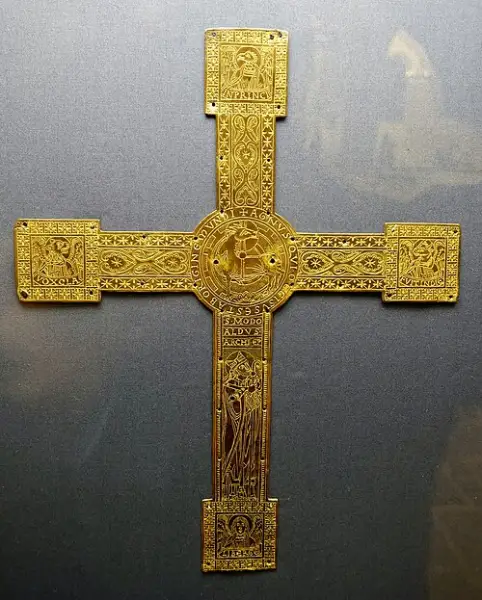
Modoald's most enduring work was the community of Saint-Symphorien, which he established on the banks of the Moselle near his episcopal city. Into this foundation he set his own sister, St. Severa, placing the new house under her supervision, an arrangement that bound his family still more closely to the monastic reform moving through seventh-century Austrasia. Severa is herself commemorated as a saint, remembered in later calendars as Severa of Villeneuve, and through her the foundation became a monument to the sanctity that ran through the whole household of Arnulf of Metz. Modoald governed Trier from 626 until 645, and genealogical notices assign his death to that year or, in some accounts, to 648. The church honored him without any formal process, according him a liturgical feast on 12 May. Centuries later his patronage was claimed by the Reichsabtei Helmarshausen, the imperial abbey on the Diemel in Saxony, and an artifact known as the so-called cross of Modoald was associated with that house, showing how far the memory of the Trier archbishop traveled from the Moselle. He remains in the calendars and genealogies as one of the holy founders of the Pippinid age.
§ Family
Timeline
- 585
Born in Aquitaine, a son of Arnulf, the future bishop of Metz.
§ Family
- 626
Raised to the archiepiscopal see of Trier through the favor of King Dagobert I, whose court he had served.
§ Family
- 645
His episcopate at Trier came to an end after nineteen years; some genealogical sources date his death to 648.
§ Family
The Record
- Major works
- Founded the monastic community of Saint-Symphorien on the Moselle
- Patron of
- Patron saint of the Reichsabtei Helmarshausen
- Canonization
- Pre-congregation; venerated as a saint from an early date, with his feast on 12 May
Prayer
Bibliography
Show 5 sources
- Arduino, Fabio. "San Modoaldo", Santi e Beati, May 3, 2006
- "St. Severa of Villeneuve, France", Antiochian Orthodox Christian Archdiocese
- Monks of Ramsgate. "Modoald". Book of Saints, 1921. CatholicSaints.Info, 10 January 2016
- Boillon, Claude. "Saints Germano and Randoaldo", Santi e Beati, February 19, 2018
- Schulenburg, Jane Tibbetts. Forgetful of Their Sex: Female Sanctity and Society, ca. 500-1100, University of Chicago Press, 1998
Profile text adapted from the Wikipedia article, licensed CC BY-SA 4.0.
Pray with this saint every day
Save St. Modoald to your favorites, read the full profile, and get feast-day reminders in the Saints app.
Get the Saints AppFree on the App Store for iPhone and iPad