
flourished 7th century·Feast Not recorded
St. Modwenna
Abbess and foundress of Burton Abbey
Overview
Modwenna, also called Modwen, was a nun and abbess of the seventh century, remembered as the founder of Burton Abbey in Staffordshire. The medieval Life of St Modwenna describes her as an Irish noblewoman who established her monastery on an island in the River Trent, at the place that grew into Burton-upon-Trent. There she was credited with many holy miracles, and the well on the abbey site was long said to possess healing power. Among those formed under her guidance was Osyth, who became an abbess and saint in her own right. In old age, the story continues, Modwenna left Burton and travelled to Scotland, dying at Langfortin near Dundee, reputedly at the age of one hundred and thirty, after which her body was carried back to Burton for burial. Scholars caution that her legend is tangled: some identify her wholly or partly with St Moninne of Ireland or with a Scottish Modwenna who founded seven churches, and the surviving Life is judged to have little historical value. Her cult, however, left deep marks on the town that grew beside her abbey.
The Complete Life
An Irish Foundress on the Trent
Every account of Modwenna begins across the Irish Sea. The medieval Life of St Modwenna, preserved among the Cotton manuscripts of the British Library, presents her as a noblewoman of Ireland who left home for the English midlands and there founded a monastery of her own. The site she chose was an island in the River Trent, a setting of water and quiet that suited the monastic ideal, and from her foundation grew the great abbey of Burton. Historians of Staffordshire, tracing the abbey's later fortunes, reach back to her as its seventh-century origin. To found a religious house was no small enterprise for a woman of her era: it required land, patrons, recruits and the endurance to govern a community for decades. The sources give little detail of how she accomplished it, but the abbey's long survival, with its monks, its church and its estates, testifies that the first work was done and done well. In the memory of Burton she remained forever the foundress, the figure whose prayers and miracles belonged to the place from its very beginning.
§ Modwenna Nun and saint in England
Miracles and Formation
The tradition that gathered around Modwenna's abbey credited her with many holy miracles worked at Burton, and one of them outlasted all the rest: the well on the abbey site, which to this day is said to have healing properties. Sacred wells are among the most durable monuments of early English Christianity, and Burton's was bound to her name so closely that it kept her memory when nearly everything else of her world had vanished. Her influence was carried forward also through the women she trained. Osyth, who died about the year 700 and was herself honored as a saint and abbess, was raised under Modwenna's direction, and whatever discipline and holiness marked Osyth's later life, the tradition traces it to Modwenna's school. In this she followed the oldest pattern of monastic leadership, in which a founder's chief work was not buildings but people, formed by example and instruction into teachers and saints for the next generation. The healing well and the holy pupil are, in that sense, the two surviving fruits of her mission: one curing bodies, the other shaping souls.
§ Modwenna Nun and saint in England
Last Journey to Scotland
Modwenna's death, in the telling of her legend, came far from the abbey she had founded. After a long life at Burton-upon-Trent she left the monastery and travelled north into Scotland, where she died at Langfortin, near Dundee. The medieval biographers gave her a lifespan to match her renown: she was said to have died at the age of one hundred and thirty, a figure that belongs to the language of legend rather than record but expresses the reverence of a community that could not imagine its foundress as merely old. Faithful to her in death as in life, her monks carried her body back to Burton-upon-Trent and buried it there, so that the abbey held the foundress's remains and the devotion that gathered around them. This return of her relics to the Trent fixed her cult firmly on the site of her foundation and explains why Burton, and not any Scottish place, remained the centre of her memory. Whatever the historical facts of her last journey, the story's logic is clear: the saint belonged to the house she had built.
§ Modwenna Nun and saint in England
Memory in Burton and Beyond
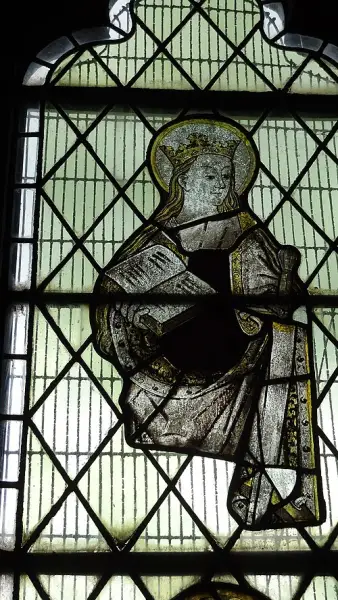
Modwenna's name remains woven into the town that grew beside her abbey. The Burton church of St Modwen keeps her dedication, and so does the Catholic parish of St Mary and St Modwen in the same town, and a chapel at Pillaton Hall also bore her dedication. A medieval statue of the saint survives, and stained glass carried from Burton Abbey to Whittington preserves her pictured face. Yet her legend reached farther than the Trent. Some traditions say she knew Alfred the Great, an impossible chronology since Alfred lived two centuries after her, and scholars read the tale as a sign that her story absorbed material from other holy women. Others identify her with St Moninne of Ireland or with a Scottish Modwenna said to have established seven churches, including one at Longforgan near Dundee, not far from her legendary place of death. The Anglo-Norman text of her Life, historians judge, has little historical value. Behind the tangle stands a foundress of real consequence: whatever the truth beneath the layers, the abbey, the churches, the well and the very name of Modwen keep her memory alive.
§ Modwenna Nun and saint in England
The Record
- Major works
- Burton Abbey, Staffordshire
- Patron of
- Burton-upon-Trent
- Symbols
- Medieval stained glass portrait·The healing well at Burton
- Canonization
- Pre-congregation; medieval cult centred on Burton Abbey
Prayer
Bibliography
Show 5 sources
- Baugh, G. C., et al. "Houses of Benedictine monks: The abbey of Burton". A History of the County of Stafford, Volume 3. London, 1970. British History Online.
- Farmer, David Hugh (1992). Oxford Dictionary of Saints. Oxford University Press. ISBN 0-19-283069-4.
- "Saint Paul's Church, Burton upon Trent".
- "Saint Modwen and the Burton Abbey".
- "St. Modwenna of Scotland".
Profile text adapted from the Wikipedia article, licensed CC BY-SA 4.0.
Pray with this saint every day
Save St. Modwenna to your favorites, read the full profile, and get feast-day reminders in the Saints app.
Get the Saints AppFree on the App Store for iPhone and iPad