
c. 580 – c. 664·Feast January 20 (north Cork); also August 7 and 13
St. Molaga
Beekeeping monk and founder of Balbriggan and Timoleague
Overview
Molaga, born about 580 and died about 664, was an Irish monk whose life and cult belong to County Cork. Known also as Molagga, Molaca, Lóichín and by other forms, he was said to have been born miraculously to parents advanced in years, the son of Dub Dliged and Minchollait, his birth foretold by the holy Cumméne Fota. Baptised by Cumin of Mayo, he studied the scriptures in his native Fermoy before travelling to Ulster and Scotland and on to St David's monastery at Menevia in Wales, where he received his religious name and a bell called Boban Molaga. Warned by an angel, he returned to Ireland, founded a monastery at Balbriggan near Dublin, cured the local king by means of his bell, and planted a church and a swarm of bees in Fingal. Later he came back to the south, survived the great plague of 664, and founded the churches of Timoleague and Labbamolaga, where the Book of Lismore says he was buried. He is honored on January 20 and remembered, with Gobnait and Modomnoc, among Ireland's beekeeping saints.
The Complete Life
A Birth Foretold
Molaga's origins were set, in the telling of his hagiographers, among the wonders that attended the whole of his life. He was born about the year 580 to parents of advanced years, Dub Dliged and Minchollait, and his coming was said to have been foretold by Cumméne Fota, one of the holy men of the age: a pattern familiar in Irish saint lore, where the birth of a great churchman is announced in advance and made to partake of the miraculous. He belonged by birth to the stock of Luchta, and his life was bound to the country of the Fir Maige Féine, whose plain forms the barony of Fermoy in County Cork; his bond with that region became so close that hagiography made him its special patron. Baptised by Cumin of Mayo, he studied the scriptures in his native district, receiving the learning that underpinned his later work as founder and teacher. From the first, then, his story joins the local and the legendary: a child of one Cork plain, marked by prophecy and set apart for the church.
§ Biography
To Wales and Back
His formation took him far from Fermoy. He travelled first to Ulster and to Scotland, following the routes along which Irish monks moved between the Gaelic worlds of Ireland and Alba, and from there he was brought to St David of Menevia in Wales, the great monastic teacher of the Welsh church. With David the tradition connects a double gift: the saint is said to have given Molaga his religious name and a bell named Boban Molaga, the metallic voice of his authority and a relic of his Welsh years. His stay ended by heavenly instruction: an angel warned him to return to Ireland, and he obeyed, crossing the sea to Dublin, remembered in the story by its old name of Dún Duibhlinne. The journey had made him a monk in the international style of the age, formed in Wales and seasoned in the north, yet the angel's warning turned all that schooling homeward. What he brought back, name, bell, discipline and bees, as the tradition tells it, became the instruments of his mission in the Ireland of the seventh century.
§ Biography
Churches and Bees
Molaga's work as a founder began in the east of Ireland. At Balbriggan, north of Dublin, he established a monastery, and there the tradition sets one of his signature wonders: the curing of the local king by means of his bell, the same Boban Molaga given him in Wales. For this service, or in the course of his mission, he received a township in Fingal, where he built a church and set up hives of bees, the detail that binds him to the brotherhood of Ireland's beekeeping saints, alongside Gobnait and the earlier Modomnoc, who is credited with first carrying honeybees from Wales to Ireland. In time he returned to the south of his birth. Tradition gives him the founding of the church at Timoleague, on whose ground the friary later rose, together with Labbamolaga in his native Cork country, where, according to the Book of Lismore, he was buried. His narrative drew him into the company of the leading figures of his century, among them the Munster king Cathal Cú-cen-máthair, and in hagiographical memory he stood as the special patron of the Fir Maige.
§ Biography
Plague and Burial
Molaga lived to a great age even by the measure of Ireland's long-lived monks: more than eighty years spanned the Ireland of his birth and the Ireland of his death. In 664 the island was struck by the great plague that carried off multitudes, monks and kings among them, and the tradition records that Molaga survived it. He died not long afterwards, about the year 664, at Labbamolaga Church in the Cork country of his birth. The Book of Lismore, the great manuscript of Irish learning, records that this was his burial place, and the church's very name, Labbamolaga, Molaga's bed or resting place, has carried the memory ever since. His association with Timoleague gave the coastal friary of West Cork a share in his cult as well, and his shrine was honoured there. Devotion to him did not end with his death; his well still draws the sick, and his name still marks the ground of his labour. Thus the circle of his life closed where it had opened: born in Fermoy, worn out in the service of the churches of two provinces, and laid to rest among his own people.
§ Biography
Lugh, Bees and the Book of Fermoy
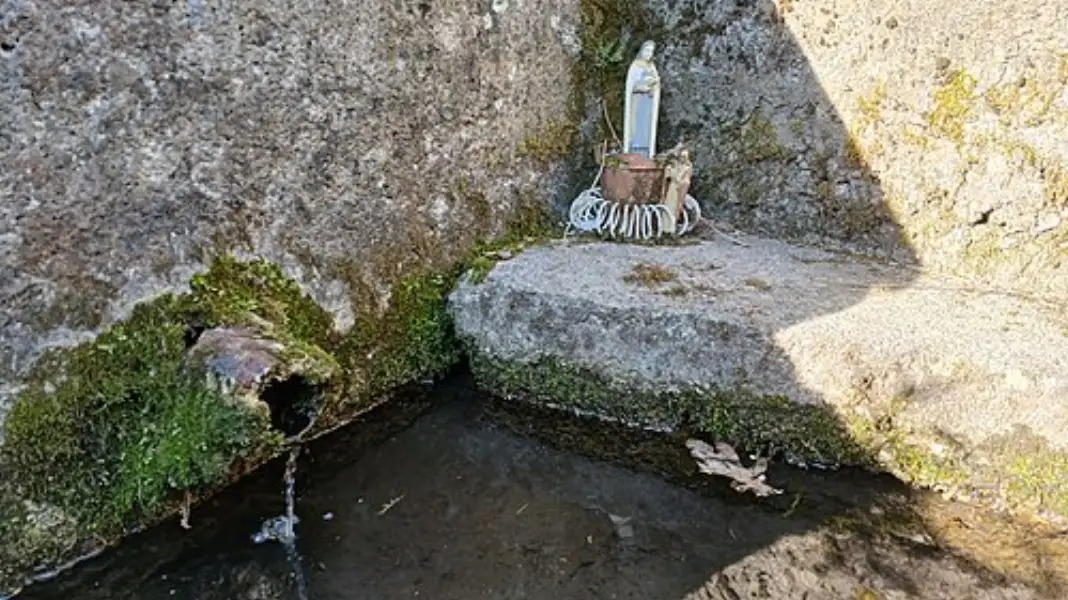
Molaga's cult has interested scholars as much as the devout. William Copeland Borlase first proposed that the cult of the saint grew out of one of the Christian survivals of Lugh, the great god of the old Irish pantheon, and the suggestion has stayed with the saint: his very names, Molaga, Molaige, Lóichín and Lóch, preserve forms that critics have linked to the old god, and two of his feast days fall in August, Lugh's month, on the seventh and thirteenth. The main feast, January 20, was kept in north Cork. A vernacular life of the saint, the Beata Molaga, contained in the Book of Fermoy, was probably composed in the fourteenth century, preserving for the later middle ages the story of his wanderings and foundations. His memory remains fixed in the landscape: St Molaga's Well at Aghacross draws its reputation from his name, Labbamolaga Church guards his grave, and the barony of Fermoy keeps him as its patron. Alongside Gobnait of the west and the older Modomnoc, he anchors the distinctive Irish tradition of saints who kept, loved and blessed bees.
§ Biography
Timeline
- 580
Is born near Fermoy in County Cork to aged parents, his coming announced beforehand, as tradition tells, by Cumméne Fota
§ Biography
- 664
Survives the great plague that sweeps Ireland in this year
§ Biography
- 664
Dies around this year; the Book of Lismore records his burial at Labbamolaga Church
§ Biography
The Record
- Major works
- Monastery at Balbriggan·Church and beekeeping settlement in Fingal·Timoleague church (by tradition)·Labbamolaga Church
- Patron of
- Fermoy barony (Fir Maige Féine)·Beekeeping
- Symbols
- The bell Boban Molaga·St Molaga's Well at Aghacross·Bees
- Canonization
- Pre-congregation; ancient cult of the Fir Maige Féine of County Cork
Prayer
Bibliography
Show 4 sources
- "Munster, saints of". Oxford Dictionary of National Biography (online ed.). Oxford University Press.
- "Molag(g)a (Lóichín)". Dictionary of Irish Biography (online ed.). Royal Irish Academy, October 2009.
- Olden, Thomas (1894). "Molaga". In Lee, Sidney (ed.). Dictionary of National Biography, Vol. 38. London: Smith, Elder & Co.
- Riain, P. Ó. "Traces of Lug in early Irish hagiographical tradition". Z.C.P, xxxvi (1977), pp. 138–56.
Profile text adapted from the Wikipedia article, licensed CC BY-SA 4.0.
Pray with this saint every day
Save St. Molaga to your favorites, read the full profile, and get feast-day reminders in the Saints app.
Get the Saints AppFree on the App Store for iPhone and iPad