
c. 566 – 639·Feast April 18
St. Molaise of Leighlin
Abbot of Old Leighlin and champion of Roman usage
Overview
Molaise of Leighlin, Laisrén or Laserian as he is revered in Ireland and Molaise or Molios as Scotland knows him, was an early Irish abbot who died about 639. Born in Ireland around 566, said to be of noble birth and raised in Scotland, he lived as a hermit on the Holy Isle off Arran before travelling to Rome, where Pope Gregory I ordained him. He entered the monastery of Old Leighlin in County Carlow, became its abbot and possibly its bishop, and set his mark on Irish church history by adapting its discipline to the practice of Rome, championing the Roman method of dating Easter. When he was in his late fifties Rome received him a second time, and Pope Honorius I consecrated him a bishop. To him is attached the Vision of Laisrén, one of the earliest works of vision literature in any vernacular. His monastery flourished and gave its name to a diocese, and his memory lives on both shores of the Irish Sea, in the cathedral town of Old Leighlin and in the cave on Holy Isle where his pilgrimage began.
The Complete Life
Noble Birth, Scottish Upbringing
Molaise was born in Ireland around the year 566, and the tradition is careful to say that he was of noble birth, a son of the aristocracy from which so many of the early Irish churchmen came. His formation, however, was not Irish but Scottish: he was raised across the North Channel, and as a young man he withdrew to the Holy Isle in the Firth of Clyde, off the Isle of Arran, to live as a hermit. The small cave on that island where he prayed is shown to visitors still, a bare shelter above a cold sea. His name travelled with his reputation and took a different shape on each shore of the sea: in Ireland he was honoured as Laisrén, Latinized as Laserian, while in Scotland the affectionate Gaelic form Molaise took root, appearing also as Molaisse, Mo Laise and Molios in the dedications of the west. Few saints of his era belong so distinctly to both countries: born and buried in Ireland, formed and first sanctified in Scotland, and remembered by a different beloved name in each.
§ Life
From Hermit to Rome
The hermit of Holy Isle did not remain a solitary. At some point in his young manhood Molaise made the great pilgrimage of his generation: he went to Rome, the see of Peter, and there he was ordained by Pope Gregory I himself, the pope who sent Augustine to the English and whose mind shaped the western church of the age. The ordination bound the Irish monk personally to the Roman church at a time when the ties between Ireland and the papacy were still being woven, and it set the direction of his later life. Returning to Ireland, he entered the monastery at Old Leighlin in County Carlow, a great monastic school of the south midlands, and rose within it to become abbot, and in the judgment of some records bishop as well. At Leighlin the hermit of Arran became a ruler of men, superior of a community whose school served the church of Leinster, and the champion of a cause that would define his public career: the bringing of Irish church practice, piece by piece, into conformity with Rome.
§ Life
The Roman Easter at Leighlin
Molaise's public work was the work of a reconciler between two traditions. In the monastery of Old Leighlin he adapted church discipline to the practices of Rome, and above all he introduced and advocated the Roman method of dating Easter, the question that divided the Celtic churches from the continental whole in the sixth and seventh centuries. His advocacy carried weight because it was underwritten by personal standing: he had been ordained by Gregory the Great, and when he was in his late fifties he went back to Rome a second time and was consecrated bishop by Pope Honorius I, returning to Ireland as a bishop in the full Roman line. The monastery he governed thrived on this double authority. It grew into one of the great religious centres of Leinster, and when the Irish church reorganized itself into territorial dioceses at the Synod of Ráith Bressail in 1111, the see drawn from his monastery took its name: the diocese of Leighlin, whose bishops have counted the abbot of Old Leighlin as their founder ever since. Whatever tensions the Easter question raised, his settlement of it proved durable enough to become the geography of a diocese.
§ Life
The Vision and the Flame
Two strange and beautiful texts keep Molaise's inner life before the Irish imagination. The first is The Vision of Laisrén, an Old Irish prose narrative which, in Kuno Meyer's judgment, depicts the saint himself, one of the earliest pieces of vision literature in any Christian vernacular. Its fragment shows Laisrén leaving the monastery of Clúain to purify the church of Clúain Cháin in Connaught; after a fast of three nights two angels bear his soul aloft and lead him down to Hell, where the torments of the unredeemed are laid open before his eyes. When a devil moves to seize their guest, the angels answer that the vision is granted so that he may warn his friends of what awaits them. The second text is a note in the Félire Óengusso: Molaise, it says, plucked a hair from the eyebrow of St Sillán with the property that whoever saw it in the morning died instantly, and by removing it he saved others and himself died. Since his name contains lasair, the Irish word for flame, the story has been read as solar mythology, sunrise and death bound together in the saint's fiery name.
§ Life
Death and Feast
Molaise probably died around the year 639, in Ireland, in the monastery he had governed for decades: a man, if the chronology holds, of some seventy years, who had been a hermit of Arran, a priest of Gregory the Great's making and a bishop of Pope Honorius's consecration. His feast was fixed on April 18, the day still observed in the diocese that bears his monastery's name, where the cathedral at Old Leighlin stands as the direct heir of his church. The manner of his passing, as the legend of Sillán's eyebrow tells it, was itself an act of mercy: having drawn the fatal hair away from the world, he took its death upon himself, so that others might live. Whatever one makes of the story, it expresses precisely the theology of his life, a man who stood between dangers and his people, whether the danger was hell, division or the sting of a miraculous hair. He died, as he had lived, a mediator: between Ireland and Rome, between monastic discipline and episcopal order, between the seeing of terrors and the warning that saves.
§ Life
Two Shores, One Saint
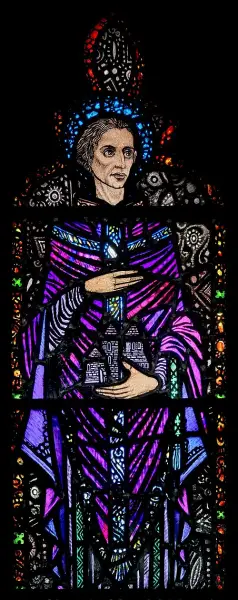
Molaise's memory is shared between two countries and several arts. In Ireland he is revered as Laserian, the reforming bishop of Old Leighlin; in Scotland he is Molaise, the hermit of the Holy Isle, whose cave on Arran remains a place of pilgrimage, its little church bearing his name in the form Molios. A large two-piece medieval statue of the saint survived the centuries on the island of Inishmurray in County Sligo, preserved in the Church of St Molaise there, and is now kept in the National Museum of Ireland, one of the great surviving images of an early Irish saint. In the twentieth century the Harry Clarke Studios made a stained-glass window of him for St Joseph's Church in Carrickmacross, showing the saint in the idiom of the Irish revival. The diocese of Leighlin, established in his monastery's name in 1111, carried his foundation into the modern Church of Ireland, where his feast is still kept. Scholar and pilgrim, monastic founder and subject of Ireland's earliest vision literature, he remains one of the few saints whose story binds Arran's rock and Carlow's cathedral town in a single life.
§ Life
Timeline
- 566
Is born in Ireland around this year, said to be of noble birth
§ Molaise of Leighlin Irish abbot and saint
- 639
Dies in Ireland, probably around this year
§ Molaise of Leighlin Irish abbot and saint
- 1111
His thriving monastery gives its name to a diocese established at the Synod of Ráith Bressail
§ Life
In Their Own Words
he will give warning before us to his friends
The Record
- Major works
- Monastic community of Old Leighlin
- Patron of
- Old Leighlin and its diocese·The Holy Isle of Arran
- Symbols
- The cave on Holy Isle·Medieval statue from Inishmurray·Flame, from lasair meaning flame
- Canonization
- Pre-congregation; venerated in the Catholic, Orthodox and Anglican traditions
Prayer
Bibliography
Show 7 sources
- "St Laserian". Ask About Ireland.
- "Feast of St Laserian/Molaise Day, Old Leighlin Cathedral". Diocese of Kildare and Leighlin, 18 April 2022.
- Kenny, Colum. Molaise. Morrigan, 1998. ISBN 0907677673.
- Chadwick, Nora. Studies in the Early British Church. Cambridge, 1958.
- Óengus of Tallaght (1905). The Martyrology of Oengus the Culdee, ed. Whitley Stokes. Henry Bradshaw Society, Vol. 29, London.
- O'Byrne, Daniel. Ecclesiastical History of the Bishops of the Dioceses of Kildare and Leighlin. Dublin: John F. Fowler, 1867.
- De Breffny, Brian (1983). Ireland: A Cultural Encyclopedia. London: Thames and Hudson.
Profile text adapted from the Wikipedia article, licensed CC BY-SA 4.0.
Pray with this saint every day
Save St. Molaise of Leighlin to your favorites, read the full profile, and get feast-day reminders in the Saints app.
Get the Saints AppFree on the App Store for iPhone and iPad