
c. 510 – 592·Feast June 25
St. Moluag
Apostle of the Picts and patron of Argyll
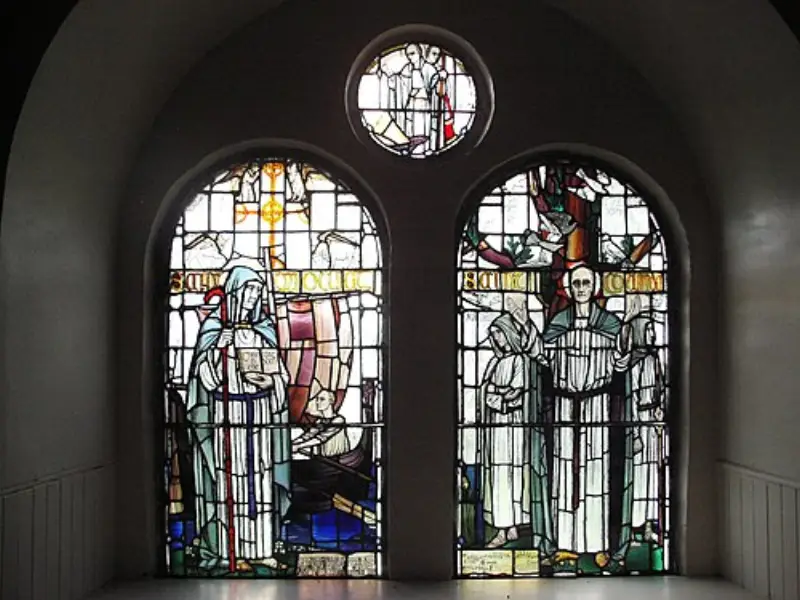
Overview
Moluag, born between about 500 and 520 and died in 592, was an Irish missionary of the Dál nAraide who evangelized the Picts of Scotland in the sixth century and stands beside Columba among the founders of Scottish Christianity. Known to tradition by the pet form of his baptismal name Lughaidh, he left Ireland with twelve followers and, by a legend of the sea, was carried on a detached rock to the Isle of Lismore in Loch Linnhe, where in 562 he founded his chief community on the island the Western Picts had reckoned holy. From Lismore he planted two further centres at Rosemarkie and Mortlach, which became the seats of later medieval sees, and churches through Argyll, Ross, Banff and Aberdeenshire, including three along the valley of the Dee. Bernard of Clairvaux recorded that Lua of the family of Bangor was said to have founded a hundred monasteries alone. He died in the Garioch on June 25, 592, and his monks laid him to rest at Rosemarkie; later his remains were carried back to Lismore. He is the patron of Argyll, and on Lewis was invoked against madness.
The Complete Life
An Ulster Noble of the Dál nAraide
Moluag was born in Ireland between the years 500 and 520, a noble of the Dál nAraide, one of the principal peoples of the Ulaid in the north of Ireland. His baptismal name was Lughaidh, appearing as Lugaid in its plain form, as Luoc and Lua in its Irish endearments, and as Lugidus, Lugadius and Luanus in Latin dress. The name by which history knows him is itself an act of affection: mo, an honorific meaning my, joined to his own name and closed with the endearing suffix oc, so that Lughaidh became Moluag, my dear Lua. Tradition made him one of the sacred kindred of Bangor: the Life of St Comgall may mention him as the Lugaid whom Comgall ordained, and links of kinship between the two have been suspected. Writing around 1185, the Cistercian Jocelin of Furness recorded in his Life of Patrick a prophecy in which Patrick foretold the episcopacy of six Irish priests, Mo-Luóc among them, alongside Columbanus, Meldán, Mo Lua, Cassán and Ciarán. Whether prophecy or back-projection, the list shows how deeply this northern saint was woven into the memory of the Irish church.
§ Name
The Rock That Sailed
Moluag left Ireland with twelve followers to live as a missionary, in the manner of the first generation of Celtic saints. The crossing itself became legend: tradition says that the rock on which he stood broke away from the Irish coast and carried him across the sea to the island in the Lyn of Lorn in Argyll that is now called the Isle of Lismore, in Loch Linnhe. There, in the year 562, he founded his community. The choice of ground was as shrewd as the arrival was miraculous. Lios mor, ancient Gaelic for great courtyard, was an isle the Western Picts reckoned holy; their royal capital stood at Beregonium, over the water at Benderloch; their kings were cremated on the man-made mound of Cnoc Aingeil, the Hill of Fire, at Bachuil, hardly three miles from the site Moluag chose for his first centre. The island was thus the most desirable site a missionary could claim, and the Irish missionaries of the age had learned to build on continuity rather than confrontation, teaching the pagan sacred places their fulfillment. On Lismore the strategy of gradual conversion found its perfect ground.
§ Life
Three Centres and a Hundred Monasteries
From Lismore Moluag carried the mission deep into Pictish country, founding two other great centres at Rosemarkie on the Moray Firth and at Mortlach in Banffshire. All three houses of teaching grew in time into the mother churches of the medieval dioceses of the Isles, Ross and Aberdeen, a testimony to how permanent his network proved. W. Douglas Simpson, surveying his field of labor in Argyll, Ross and Banff, judged his most important establishment to be the Clova Monastery at Kildrummy, but Aberdeenshire keeps the densest memory of him: in the valley of the River Dee he established the three churches of Tarland, Migvie and Durris. His fame reached far beyond his own foundations. In his life of St Malachy, Bernard of Clairvaux wrote that Lua, one of the sons of the sacred family of Bangor, was said to have founded a hundred monasteries alone, a saying Michael Barrett understood of the Irish houses connected with his name. If Lismore was his throne, his work clothed half of northern Britain: a missionary jurisdiction spanning the isles, the Moray coast and the valley of the Dee.
§ Life
The Clear and Brilliant
Moluag belonged to the First Order of Celtic Saints, the earliest generation of Ireland's missionaries to Scotland, and tradition preserved him under a luminous title: the Clear and Brilliant, the Sun of Lismore in Alba. The title suits the shape of his sanctity. Where other missionaries confronted paganism, the school to which he belonged had learned from experience to emphasize the similarity and continuity between the new faith and the old, seeking the conversion of a people through gradual education rather than outright confrontation. His settlement on a holy island of the Picts, a place of royal cremation and old reverence, preached that theology in stone before any sermon was uttered: the God of the Christians did not destroy the sacred, but fulfilled it. The loss of his vita, which scholars infer from his otherwise puzzling prominence in Bernard's Life of Malachy and in Jocelin's Life of Patrick, means that his voice reaches us through dedications, annals and litanies rather than through a written life. What they record is consistent: a founder of communities, a teacher of peoples, a saint remembered as light.
§ Sources
Death in the Garioch
Moluag reached an immense age and died in the Garioch, the district of Aberdeenshire, on June 25 in the year 592 where his work among the Picts had been busiest. His monks carried him to Rosemarkie on the Moray Firth, one of his three great centres, and buried him at the monastery there. The Irish annalists kept the date: the Annals of Ulster enter under that year, in their terse Latin, the obit of Lugaid of Les Mór, fixing his identity with the founder of Lismore beyond doubt. Nearly sixty years after the miraculous voyage of 562, the missionary who had arrived on a detached rock died as the father of a church spread across the isles and much of Pictish country. His grave at Rosemarkie became the first of his shrines; in time his remains were translated to Lismore itself and honoured in the cathedral that bore his name, so that the island of his founding received back, as its holiest possession, the body of the man whose rock had carried him there from Ireland. The date his annalists kept, June 25, became the day of his feast, and so the closing of his life and the yearly remembrance of it have remained a single thing.
§ Life
Pre-congregation Saint of Three Realms
Moluag's sanctity was recognized by the consent of the churches long before any process of canonization existed, and his cult spread through Ireland, Scotland and the Isle of Man without ever needing a decree. His feast on June 25 was kept through the middle ages and was formally restored by Pope Leo XIII in 1898, a rare act of official recognition for a saint never formally canonized. He is one of the forty-eight saints invoked in the Lorrha, or Stowe, Missal, the oldest surviving Irish missal, whose litany calls upon Saint Lua of Lismore to pray for us, an invocation once heard across Ireland, Scotland, Britain, France, Germany, Switzerland and the north of Italy. His succession lived on in persons as well as prayers: the Coarb, or spiritual heir, of Saint Moluag is the chief of the Clan MacLea, the Livingstones of Lismore, hereditary abbots of the island and possessors of the saint's crozier. Few pre-congregation saints can show an unbroken succession of this kind, running from the monastery of 562 to a living Highland family of the present day. In his own country of Ulster, as in the lands he converted, his day has never wholly dropped from remembrance.
§ Veneration
Crozier, Bell and Fair
The material memory of Moluag is unusually rich. His crozier passed to the Livingstone chiefs of the Clan MacLea at Bachuil, near the old Hill of Fire, and remains in their keeping; his bell survived until the sixteenth century, when it disappeared at the Reformation, and an ancient bell found at Kilmichael Glassary in Argyll was long thought to be the lost one. Churches across the Gaelic world were dedicated to him: the cathedral of Kilmoluag on Lismore, Teampull Mholuaidh on Lewis, churches scattered over Skye, Mull, Raasay, Tiree and Pabay, Clatt and Tarland in Aberdeenshire, and Kirk Malew far off on the Isle of Man. At Alyth in Perthshire the ruins called the Alyth Arches preserve a later church that succeeded a sixth-century one on the same ground. Fairs kept his memory in the calendar: St Mallock's Fair at Clatt ran for eight days, Tarland kept a Luoch Fair, and Alyth celebrated Simmalogue Fair. Scholars have connected the concentration of his cult in north-east Scotland with the reign of the Pictish king Nechtan mac Der-Ilei, and at Mortlach, whose church guarded some of his relics, the abbey raised in 1010 honoured the victor whose aid the Scots had sought.
§ Legacy and dedications
Timeline
- 510
Is born in Ireland between about 500 and 520, a noble of the Dál nAraide, given the name Lughaidh
§ Name
- 562
Founds his community on the Isle of Lismore in Loch Linnhe, formerly the sacred island of the Western Picts
§ Life
- 25 Jun 592
Dies in the Garioch at an extreme old age and is buried at his monastery in Rosemarkie; the Annals of Ulster record his obit
§ Life
- 1010
Máel Coluim II of Scotland founds an abbey at Mortlach, giving thanks for a victory won after calling upon the saint
§ Legacy and dedications
- 1898
Pope Leo XIII restores the feast day of Saint Moluag, kept on June 25
§ Veneration
In Their Own Words
One of the sons of that sacred family (Bangor) Lua by name, is said himself alone to have been the founder of a hundred monasteries
in honour of God Omnipotent, the blessed Virgin, and Saint Moloc, our patron
The Record
- Major works
- Monastic community on the Isle of Lismore·Monastic centres at Rosemarkie and Mortlach·Clova Monastery at Kildrummy·Churches of Tarland, Migvie and Durris
- Patron of
- Argyll·Against madness, invoked on Lewis·The Clan MacLea, hereditary coarbs of Lismore
- Symbols
- The crozier of Saint Moluag at Bachuil·His lost bell·Bishop's vestments
- Canonization
- Pre-congregation; ancient Celtic cult, feast restored by Pope Leo XIII in 1898
Prayer
Bibliography
Show 6 sources
- Barrett, Michael. A Calendar of Scottish Saints. Fort Augustus: The Abbey Press, 1919.
- Carmichael, Ian. Lismore in Alba.
- Farmer, David Hugh. The Oxford Dictionary of Saints. Oxford: Oxford University Press, 1992.
- Moran, Rev. Patrick. Irish Saints in Great Britain. Dublin: M H Gill & Son, 1879.
- MacDonald, Iain G (2013). Clerics and Clansmen, The Diocese of Argyll between the Twelfth and Sixteenth Centuries. Brill.
- Simpson, W. Douglas (1922). A Forgotten Aberdeenshire Monastery. Aberdeen: Aberdeen UP.
Profile text adapted from the Wikipedia article, licensed CC BY-SA 4.0.
Pray with this saint every day
Save St. Moluag to your favorites, read the full profile, and get feast-day reminders in the Saints app.
Get the Saints AppFree on the App Store for iPhone and iPad