
died c. 570·Feast July 2
St. Monegundis
Frankish anchorite and healer at Tours
Overview
Saint Monegundis, also called Monegund, Mongon, or Molmadund, was a Frankish hermit of the sixth century whom Gregory of Tours numbered among the holy figures of his De Vita Patrum. A native of Chartres, she married at her parents' wish and bore two daughters, both of whom died in childhood of fever. Overcome by a grief beyond the consolation of husband or friends, she left her household and withdrew into a small cell, living on barley bread and water, sleeping on a mat, and giving her remaining goods to the poor. Fearing that her growing fame for holiness and healing might lead her into vainglory, she moved to Tours, near the basilica of Saint Martin, where other women joined her as anchorites and a convent, Saint Pierre-le-Puellier, eventually took shape. She was famed as a healer: the blind, the deaf, the paralyzed, and the demon-possessed were among those Gregory reports she cured, both during her life and at her tomb afterward. On her deathbed she blessed oil and salt for the sick who would come after her, and many were healed through them. She died of natural causes around 570 and was buried in her cell. Her feast is kept on 2 July.
The Complete Life
From Bereaved Wife to Bride in a Cell
Monegundis was born at Chartres and, as her parents wished, entered marriage, bearing two daughters whose deaths in childhood from fever shattered her life. Gregory of Tours, who knew her story and perhaps the woman herself, records that the loss left her beyond all human comfort. From that desolation came an unexpected calling. Rather than sinking into despair, she resolved to give herself wholly to God, leaving her husband's household for a small cell where she lived as an anchorite on bread and water. Later writers disagreed on the terms of her departure: some sources say she undertook the eremitical life with her husband's consent and permission, while one modern translator emphasizes that she turned from the world and from her husband's company to devote all her time to God, pouring out prayer for her own sins and for those of the people. Gregory presents her as a model of the married woman who, supported by her husband, transformed the bitter disappointment of bereavement into spiritual nourishment for others. Her bedding was a narrow mat spread over a bench or the bare floor; the barley she baked into loaves she ground with her own hands when fasting left her in need of strength, and whatever else her house held went to the poor.
§ Life
A Hermitage by Martin's Tomb
Sanctity of so unusual a kind could not remain hidden. Monegundis became a leader of a local circle of worshippers, and those seeking physical healing made their way to her cell, where she served as a spiritual director. Fame brought its own danger; fearing that the praise of her neighbours for her miracles might draw her into vainglory, she resolved to leave Chartres. With her husband's permission she departed for Tours, taking leave of household, friends, and family, and settled near the basilica and shrine of Saint Martin, the great pilgrimage centre of Gaul. One account tells how her husband carried her home to Chartres, only to yield when she talked her way back to Tours. Near Martin's tomb she and her followers built a hermitage, and as her reputation spread other women joined her to live as anchorites. In time this company grew into a convent known as Saint Pierre-le-Puellier. At the basilica she remained untroubled, for her husband asked nothing further of her. Her diet stayed austere: barley bread, and a little wine on feast days. The magnetism of Martin's shrine, one modern historian notes, drew the spiritually ambitious of the age, and Monegundis became both a pilgrim at his tomb and a centre of devotion in her own right.
§ Life
Signs of Mercy at the Cell
The wonders attributed to Monegundis at Chartres and Tours, and at her tomb after her death, fill Gregory's account. A woman spying rudely from a roof on the recluse went blind, and was restored when Monegundis, grieved at being the cause, prayed, laid hands on her, and marked her with the cross. A deaf man recovered his hearing after she prostrated herself in prayer. At Esvres, on her way to Tours, a girl with a tumour begged healing at Mass; after the saint had prostrated herself and signed the afflicted place, the wound burst open and the girl went home cured. A widow's paralyzed daughter, a child covered with sores, a boy poisoned and unable to eat, a paralyzed boy raised by the hand, and a blind woman whose cataracts fell away all figured among the cures Gregory reports, along with many delivered from demons by the laying on of hands. She survived a trial of another kind: a servant left her without warning, and for five days no one brought her food or water, until prayer drew drink from the snow outside her cell and flour for her loaves. Gregory sums up her discipline as daily prayer, fasting, and vigils, adding that no one whom she allowed to approach waited long for a cure.
§ Attributed miracles
The Blessing That Outlived Her
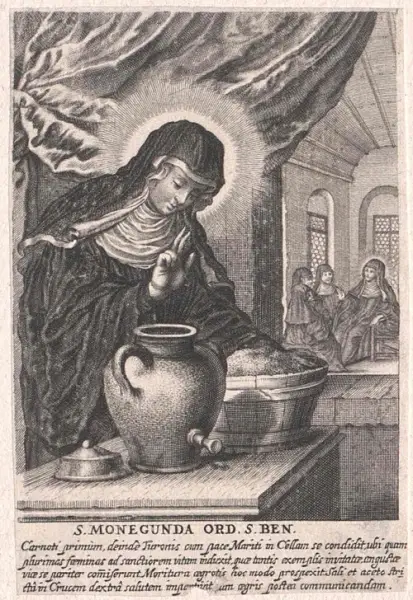
Monegundis died of natural causes around the year 570 and was buried in the small cell that had been her dwelling. The scene at her deathbed became part of her enduring gift to the sick: the nuns around her wept and asked who would now heal the afflicted who came seeking help, and in answer she consecrated oil and salt, leaving them for the healing of those who would come after. Gregory records that many were healed through these blessed elements at her shrine. The blind, the mute, the fevered, and the paralyzed made their way there. One man touched the cloth that covered her body and his fever left him; a blind man sleeping by her tomb after prayer was told in a dream to seek Martin's shrine, awoke with one eye healed, and found the second restored when he obeyed; a paralyzed man named Marcus, after nine hours of prayer at her shrine, stood and walked home. Art of later centuries shows her in the gesture those deathbed blessings made famous, holding oil and salt in blessing. Her cult kept her feast on 2 July, the day of her death, honoured as her birth into eternal life.
§ Life
A Woman in the Lives of the Fathers
The memory of Monegundis rests almost entirely on the biography Gregory of Tours wrote in his De Vita Patrum, composed about 570, the year of her death; unusually for a collection so titled, it features a woman. Modern historians have read the work in several keys. Jo Ann McNamara sees in it Gregory's intention, as she reads it, to fold the region's homegrown saints into the wider body of the Church and bind Martin's devotees to the authority of the see of Tours. Barbara Rosenwein observes that Gregory presented Monegundis, so devoted to Martin, the patron of his diocese, as a model for other bishops, and describes her as a mirror reflecting a mirror: she drew the cult of the faithful while still kneeling as a pilgrim at Martin's grave, honouring his relics as her own were honoured in turn. Her convent of Saint Pierre-le-Puellier at Tours endured as the fruit of her later years, and her story passed from Gregory's pages into the dictionaries of holy women that preserved her memory into modern times. The Church honours her on 2 July, and she is venerated in both the Roman Catholic and Eastern Orthodox churches as a holy recluse of the Frankish world, a widow whose grief became a wellspring of healing for others.
§ Life
Timeline
- 570
Death came from natural causes; she was laid to rest in her own cell.
§ Life
- 570
Gregory of Tours recorded her life in De Vita Patrum, having known her personally.
§ Life
In Their Own Words
no one, not even her husband or friends, could console her
Nor was there any delay in the cures of all those whom the saint permitted to come to her
The Record
- Symbols
- blessing oil and salt
- Canonization
- Pre-congregation; venerated in the Roman Catholic and Eastern Orthodox churches
Prayer
Bibliography
Show 5 sources
- Dunbar, Agnes B.C. (1901). A Dictionary of Saintly Women. Vol. 2. London: George Bell & Sons. pp. 95-96.
- Gregory of Tours (1996). "Monegund, a Widow and Recluse of Tours in Gaul". In McNamara, Jo Ann; Halborg, John E.; Whatley, E. Gordon (eds.). Sainted Women of the Dark Ages. Translated by McNamara, Jo Ann. Duke University Press. pp. 51-59. ISBN 0-8223-1200-X.
- McNamara, Jo Ann (1996). "Monegund, Widow and Recluse of Tours (d. 570)". In Sainted Women of the Dark Ages. Duke University Press. pp. 51-53. ISBN 0-8223-1200-X.
- Rosenwein, Barbara H., ed. (2018). Reading the Middle Ages: Sources from Europe, Byzantium, and the Islamic World. Vol. 1. University of Toronto Press. p. 38. ISBN 978-1-4426-3677-4.
- Butler, Alban (1995). Butler's Lives of the Saints (2nd ed.). Westminster, Maryland: Liturgical Press. p. 8. ISBN 0814623778.
Profile text adapted from the Wikipedia article, licensed CC BY-SA 4.0.
Pray with this saint every day
Save St. Monegundis to your favorites, read the full profile, and get feast-day reminders in the Saints app.
Get the Saints AppFree on the App Store for iPhone and iPad