
c. 332 – 387·Feast August 27
St. Monica
Mother of Augustine and model of persevering prayer
Overview
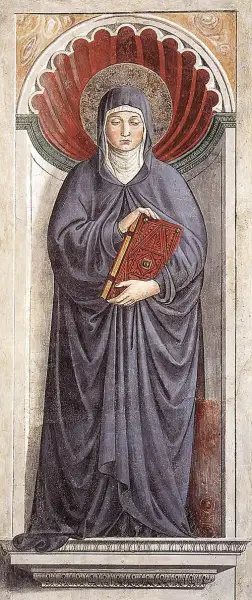
Saint Monica of Hippo (c. 332 – 387), sometimes written Monnica, was an early North African Christian saint and the mother of Saint Augustine. Most likely born at Thagaste in what is now Algeria, and believed on the evidence of her name to have been a Berber, she was married young to Patricius, a pagan decurion of violent temper and dissolute habits. Through years of almsgiving, patience, and prayer she won the respect of her household, though she could not secure the baptism of her three children. Her eldest son Augustine fell into wayward living and joined the Manichaeans at Carthage, and Monica wept for him, popular legend says, every night. A vision reconciled her to the son she had once driven from her table, and a bishop consoled her with the assurance that the child of her tears would never perish. She pursued Augustine to Rome and then to Milan, where through Bishop Ambrose she at last saw him converted to Christianity after seventeen years of resistance. After six quiet months at Cassiciacum she saw him baptized, and she died at Ostia as the two prepared to return to Africa. Augustine's grief for her helped to shape his Confessions, the book that carried her memory to the whole church.
The Complete Life
A Christian Wife in a Pagan House
Monica was born around the year 332, most probably at Thagaste in Numidia, the Roman North African town now represented by Souk Ahras in Algeria, and her name has led scholars to believe she was a Berber. While still young she was given in marriage at Thagaste to Patricius, a pagan decurion, a civic magistrate of the town. The marriage was hard: Patricius was reported to have a violent temper and dissolute habits, and his mother, who lived in the household's orbit, showed similar behaviour. Monica answered this difficult domestic world with almsgiving, good deeds, and disciplined habits of prayer. These virtues annoyed her husband, yet the tradition records that he always held her in respect, and his forbearance toward her observance became the space in which her faith endured. Her three children who lived past infancy were two sons, Augustine and Navigius, together with a daughter remembered as Perpetua of Hippo. Because Patricius had not become a Christian, Monica could not have her children baptized, and her grief was heavy when the young Augustine fell seriously ill. Patricius agreed in that crisis to allow his baptism, then withdrew his consent when the boy recovered — a disappointment that set the pattern of the long spiritual struggle of her motherhood.
§ Life
The Wayward Son and the Tears
Monica's anxieties centred on Augustine. Recovered from his illness, he grew into a wayward and self-confessedly lazy young man, and was sent to school at Madauros; he was seventeen and studying rhetoric at Carthage when Patricius died. At Carthage Augustine joined the Manichaeans, and when he came home and expounded his new views, Monica drove him from her table, refusing to let the house that kept the Christian faith entertain what she took for its enemy. Yet the same tradition tells that she was granted a vision which convinced her to be reconciled with him, and her severity yielded to a renewed and patient charity. In her distress over him she sought out a bishop, who consoled her with words that became famous: the child of those tears, he assured her, would never perish. The promise fixed the course of her vocation. Popular legend remembers her weeping through every night for her son, and the church remembers in her the vocation of the parent who prays: her holiness was formed not in a cloister but in a hard marriage and a long maternal sorrow, transformed by prayer into one of the most fruitful intercessions in the history of the church.
§ Life
Following Her Son to Milan
Monica's persistence took physical form in pursuit of her son. Augustine had gone secretly to Rome, and she followed him there, only to find on her arrival that he had already moved on to Milan; she followed him again. In Milan the search reached its turning point, for there she found Ambrose, the city's bishop, and through his teaching and her unfailing presence she ultimately saw her son convert to Christianity after seventeen years of resistance. Mother and son then spent six peaceful months together at Rus Cassiciacum, the retreat at present-day Cassago Brianza, where Augustine composed his earliest works, and there Ambrose baptized Augustine in Milan's church of St John the Baptist. The long labour of her intercession was complete: the boy for whom she had wept was a Christian and a catechumen no longer. Setting out with him for Africa, she stopped at Civitavecchia and at Ostia, the port of Rome. Her mission accomplished, she fell ill there, and her death at Ostia closed the journey that had begun in a pagan household at Thagaste. Augustine's grief at losing her, the tradition holds, inspired the Confessions in which he told her story.
§ Life
Purer Petitions at the Tombs of the Martyrs
Augustine's Confessions preserves a glimpse of his mother's personal devotion. She made a practice of carrying to the oratories raised in the saints' memory her offerings of porridge, bread, water, and wine, sharing at the martyrs' tombs in the old African manner. When she came to Milan, Ambrose forbade her the offering of wine, warning that it might become an occasion of gluttony for those already given to drink; Monica submitted at once to the bishop's correction. Augustine wrote of the change with admiration: instead of a basket of earth's fruits, his mother had learned to offer at the martyrs' oratories a heart charged with purer petitions, and to give everything she could spare to the poor, so that the Lord's body might be worthily celebrated in communion where, after the pattern of his passion, the martyrs had been slain and crowned. The episode reveals the temper of her spirituality — tactile, domestic, loyal to the dead and to the poor — refined by obedience into something more inward. A woman who had once carried bread to the tombs learned to carry her whole heart there, and almsgiving completed the offering. It is this disciplined, tearful, generous piety that the church honours in her.
§ Life
Death at Ostia
Monica's earthly story closes at Ostia, the harbour city at the mouth of the Tiber. She and Augustine had left Milan after his baptism and were travelling toward Africa when they stopped at Civitavecchia and then at Ostia, and there she died in the year 387, having lived to see the conversion for which she had prayed for seventeen years. She was buried at Ostia, and at first she seems to have been almost forgotten: during the sixth century her body was transferred to a concealed crypt within the church of Santa Aurea in that same town, and she was laid near the tomb of Aurea of Ostia. Yet her memory did not depend on a known grave. Augustine's grief for her poured into the Confessions, the most widely read of all spiritual autobiographies, and through that book the mother who had wept for her son became known to every generation of Christians. Her final months had given the church its image of maternal intercession fulfilled: the pilgrim mother who reached the harbour of her hopes, and who could be released from the body once the son of her tears stood reborn in Christ.
§ Life
From a Hidden Crypt to Rome
Monica was honoured as a saint from antiquity without any formal process of canonization, but the history of her cult is a story of rediscovery. Buried almost forgotten at Ostia, she received an epitaph from Anicius Auchenius Bassus which survived in ancient manuscripts; the actual stone came to light again in the summer of 1945, when two boys, digging a pit for a football post in the courtyard next to Santa Aurea, brought the fragment up. In the thirteenth century devotion to her began to widen, and a feast in her honour appeared on 4 May. In 1430 Pope Martin V directed that her relics be carried to Rome; many miracles were reported along the route, and her cultus stood established beyond doubt. The archbishop of Rouen, Guillaume d'Estouteville, later raised at Rome a church honouring Augustine, the Basilica di Sant'Agostino, and placed her relics in a chapel at the left of the high altar, where her tomb remains a point of devotion. The Office of St Monica, however, does not appear to have entered the Roman Breviary before the sixteenth century, a reminder of how slowly her formal liturgical honour grew around an ancient and beloved cult.
§ Veneration
Patron of Marriages, Mothers, and the Lapsed
The church's confiding in Monica has made her one of the most widely invoked of saints. She is patron of married women and of difficult marriages, of disappointing children, of victims of adultery or unfaithfulness, of victims of verbal abuse, of alcoholics, of Berbers, of lapsed Catholics, and of the conversion of relatives — a catalogue drawn straight from the trials of her own life. Her name is borne across the Catholic world: churches and parishes from Pangasinan and Pampanga in the Philippines to Angat, Iloilo, Antique, Capiz, Bohol, and Tanza; Saint Monica University at Buea in Cameroon; and, most famously, the city of Santa Monica, California. A legend holds that in the eighteenth century Father Juan Crespí named a local dripping spring Las Lágrimas de Santa Mónica, Saint Monica's Tears, recalling the tears she shed for her son, though his diary shows the name he actually gave was San Gregorio; by the 1820s Santa Monica was in use as the name, its first official appearance coming in 1827 in a grazing permit, and Eugene Morahan's statue of the saint was completed in Palisades Park in 1934. She is honoured by the Church of England and the Episcopal Church on 4 May, and her story has passed into novels, films, oratorio, and poetry.
§ Veneration
Timeline
- 332
Born at Thagaste in Numidia, most likely, into a Christian family of Berber descent.
§ Life
- 387
Died at Ostia while stopping there with Augustine on the journey back to Africa.
§ Life
- 1430
Pope Martin V ordered her relics brought to Rome; many miracles were reported along the way.
§ Veneration
- 1934
The Zusters Augustinessen van Sint-Monica founded at Utrecht, doing social work and sheltering vulnerable women.
§ Veneration
- 1945
Her ancient epitaph stone rediscovered at Santa Aurea, Ostia, after boys dug a hole for a football post.
§ Veneration
- 2014
The order's Hilversum convent, City of God, closed, leaving Utrecht as the sisters' remaining rest home.
§ Veneration
In Their Own Words
the child of those tears shall never perish
In place of a basket filled with fruits of the earth, she had learned to bring to the oratories of the martyrs a heart full of purer petitions, and to give all that she could to the poor – so that the communion of the Lord's body might be rightly celebrated in those places where, after the example of his passion, the martyrs had been sacrificed and crowned.
Here the most virtuous mother of a young man set her ashes, a second light to your merits, Augustine. As a priest, serving the heavenly laws of peace, you taught [or, you teach] the people entrusted to you with your character. A glory greater than the praise of your accomplishments crowns you both – Mother of the Virtues, more fortunate because of her offspring.
The Record
- Patron of
- patron of married women and of difficult marriages·patron of disappointing children·patron of victims of adultery or unfaithfulness·patron of victims of verbal abuse·conversion of relatives·patron of alcoholics·patron of Berbers·patron of lapsed Catholics
- Symbols
- depicted weeping in prayer for her son
- Canonization
- Pre-Congregation; her cultus was firmly established when Pope Martin V ordered her relics translated to Rome in 1430.
Prayer
Bibliography
Show 5 sources
- Brett, Michael; Fentress, Elizabeth (1997). The Berbers. Wiley-Blackwell.
- Brown, Peter (2000). Augustine of Hippo: A Biography: New Edition with an Epilogue. Berkeley: University of California Press.
- Power, Kim (1999). "Family, Relatives". In Allan D. Fitzgerald (ed.). Augustine through the ages: an encyclopedia. Grand Rapids: Wm. B. Eerdmans. ISBN 978-0-8028-3843-8.
- McGerr, Patricia (1964). My Brothers, Remember Monica: A Novel of the Mother of Augustine. New York: P. J. Kenedy.
- Smither, Howard E. (1977). A History of the Oratorio. UNC Press. ISBN 978-0-8078-1274-7.
Profile text adapted from the Wikipedia article, licensed CC BY-SA 4.0.
Pray with this saint every day
Save St. Monica to your favorites, read the full profile, and get feast-day reminders in the Saints app.
Get the Saints AppFree on the App Store for iPhone and iPad