
c. 435 - c. 517·Feast July 6
St. Moninne
Foundress of Killeavy on Slieve Gullion
Overview
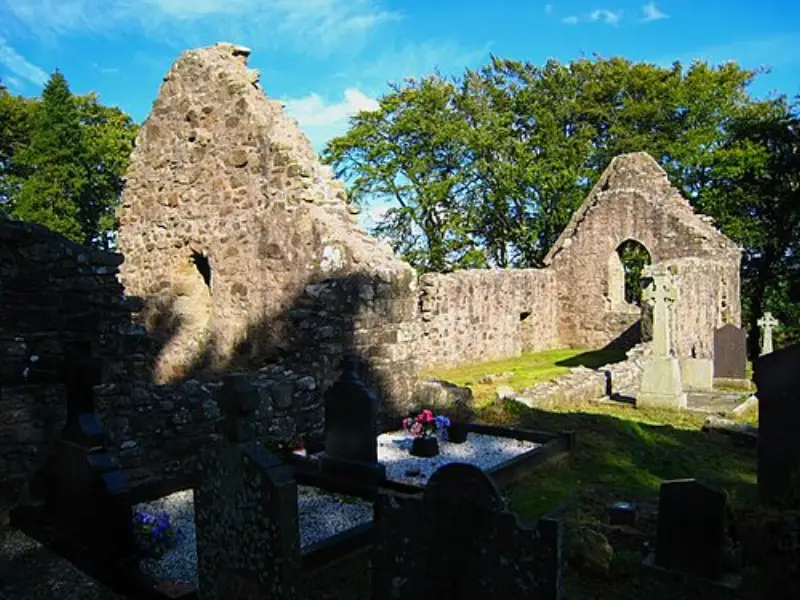
Saint Moninne of Killeavy, also called Modwenna, Darerca, or Moninna, was one of the early female saints of Ireland. Born around 435 at Donaghmore in County Down, daughter of Machta, a king whose lands stretched from Louth to Armagh, she was said to have been baptized, confirmed, and veiled by Saint Patrick himself, who foretold that her name would be remembered through time. Formed in the religious life under Saint Brigid of Kildare, she founded convents in Scotland and England and a nunnery at Faughart in County Louth before guiding her community to its lasting home on the slopes of Slieve Gullion in what became County Armagh. There, at Killeavy - the church of the mountain - she established a settlement of eight virgins and a widow with her infant son, living an eremitical life modelled on Elijah and John the Baptist; the boy, Luger, grew up to be a bishop. Moninne died around 517 and was buried at Killeavy, where a great granite stone covers her grave. Her feast is kept on 6 July, the old Pattern day on which pilgrims prayed at her graveslab and climbed to her holy well. The well itself faded from memory when the Pattern was outlawed in 1825, until Father James Donnelly found it again in 1880, and it remains a place of pilgrimage, while the local Gaelic Athletic Association club founded in 1888 still bears her name.
The Complete Life
A King's Daughter Marked by Patrick
Moninne was born around 435 in the Donaghmore district of County Down, into a family of rank: her father Machta ruled the lands lying between Louth and Armagh, while her mother, Comwi or Coman, came from the house of a northern king. Tradition attaches her earliest years to Saint Patrick himself. Passing through the lands of Machta, Patrick stopped at her parents' house and foretold that the child's name would be remembered through all time; the same tradition says he baptized and confirmed her and gave her the veil. Her very name carried a story. Some records call her Darerca or Blinne, others Moninna, an Irish endearment meaning my Ninna or my daughter. One legend derives the name from the cure of a mute man, whose first utterance after Moninne healed him was the cry Ninna; another says that Ninna was the first word she spoke as an infant. Whatever its origin, the name became fixed in the memory of the Irish Church, and the child of the royal house of Down grew into one of the notable women saints of Ireland's first Christian generations.
§ Life
Formed by Brigid, Sent to Found
Moninne was said to have been brought up under the care of Saint Brigid of Kildare, an apprenticeship that shaped the rest of her life. When she in turn received followers, she planted several convents across Scotland and England, and a nunnery rose under her hand at Faughart in County Louth. Her early communities did not remain undisturbed. One night at Faughart the sisters were disturbed by sounds of profane merriment drifting up from the homesteads lower down the hill; enquiring into the cause, they learned that a wedding party was being celebrated in one of the houses. The revelry became for Moninne and her sisters an occasion of discernment rather than scandal: they determined to seek a place better suited to their manner of life, and made their way west to the island of Begerin in Leinster. There her uncle, Saint Ibar, one of the first Irish bishops, guided them in the ways of monastic observance. Under his instruction the community matured, and in time it returned north, settling first at Faughart again and then at Killeavy, the mountain church that would forever be identified with her name.
§ Life
The Church of the Mountain
At Killeavy, whose name means church of the mountain, Moninne planted her enduring foundation on the slopes of Slieve Gullion in what became County Armagh. The community was small and austere from the first: eight virgins and a widow with her baby boy. The child, named Luger, was raised with affection by the sisters and in due course became a bishop, a sign in the hagiographer's eye of the fruitfulness of the holy house. The life followed an eremitical pattern modelled on that of Elijah and Saint John the Baptist, joining the solitude of the desert fathers to the discipline of a vowed community. Moninne also founded the church of Faughart in honour of Saint Brigid, the saint who had formed her youth, binding the two foundations of her life together in gratitude. The mountain settlement drew others seeking prayer and counsel, and its church became the centre of a devotion that outlasted her by centuries. Her death came about 517; at Killeavy her sisters laid her to rest beneath a massive slab of granite. From this house her name spread through the Irish Church and beyond, remembered in the calendars of both the Catholic and Orthodox traditions.
§ Life
Grave, Well, and Pattern Day
The grave of Saint Moninne at Killeavy was marked by a large granite stone, and for centuries pilgrims kept the Pattern - the anniversary of the church's dedication - on 6 July. Prayers were said at the graveslab, after which the pilgrims climbed the slopes of Slieve Gullion to her holy well, returning to the stone for the final prayer. The coming of the penal era ended these gatherings: with persecution of the Catholic faith the ceremonies were banned by law, and after the Pattern's suppression in 1825 the holy well itself passed from memory. It was rediscovered in 1880 by Father James Donnelly, curate of Meigh, and is now distinguished by a tall white cross. In 1928 the Pattern returned, lingering, it seems, until 1934; a shrine with a statue of the Virgin Mary was placed over the well, which bears the inscription Tobhar Naoimh Blathnaidh. On 4 August 1974 the site formed the historical setting of a Holy Year pilgrimage. Her feast is still celebrated on 6 July, when pilgrims visit the well, and the Gaelic Athletic Association club founded at Killeavy in 1888 bears her name as Killeavy St Moninna's GAC.
§ Veneration
Timeline
- 435
Born around this year at Donaghmore, County Down, daughter of Machta and Comwi.
§ Life
- 517
Died around this year and was buried at Killeavy.
§ Life
- 1825
The Pattern of Saint Moninne was suppressed by law amid persecution of the Catholic faith.
§ Veneration
- 1880
Father James Donnelly, curate of Meigh, rediscovered her long-forgotten holy well.
§ Veneration
- 1888
The Gaelic Athletic Association club of Killeavy was founded under her patronage.
§ Veneration
- 1928
The Pattern of Saint Moninne was revived at her grave and holy well.
§ Veneration
- 4 Aug 1974
The well site served as the historical setting for a Holy Year pilgrimage.
§ Veneration
The Record
- Major works
- Killeavy monastery on Slieve Gullion·Faughart Church, County Louth·convents in Scotland and England
- Canonization
- Pre-congregation; venerated in the Roman Catholic and Orthodox churches
Prayer
Bibliography
Show 5 sources
- Reade, George. "Cill-Sleibhe-Cuillinn", The Journal of the Historical and Archaeological Association of Ireland, Vol. 1, 1868.
- O'Hanlon, John. Lives of the Irish Saints, Vol. 7, 1873, p. 84.
- Bitel, Lisa M. Land of Women, Cornell University Press, 1998. ISBN 9780801485442.
- Robert Bartlett, "Moninne (d. 517)", Oxford Dictionary of National Biography, Oxford University Press, 2004.
- Duffy, Patrick. "Saint Moninne of Killeavy", CatholicIreland.net.
Profile text adapted from the Wikipedia article, licensed CC BY-SA 4.0.
Pray with this saint every day
Save St. Moninne to your favorites, read the full profile, and get feast-day reminders in the Saints app.
Get the Saints AppFree on the App Store for iPhone and iPad