
died 588·Feast July 16
St. Monulph
Sixth-century bishop of Tongeren and Maastricht
Overview
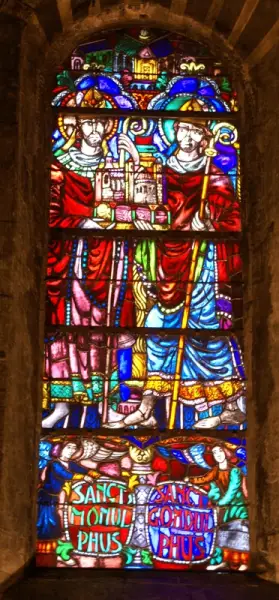
Saint Monulph guided the see of Tongeren and Maastricht in the sixth century and is honoured as a saint in the Roman Catholic Church and remembered, together with his successor Gondulph, among the founding figures of Christianity in the Meuse valley. Tradition makes him a native of Dinant, son of Count Randace, and gives 588 as the year of his death; late medieval bishops counted him the twenty-first bishop of the Tongeren-Maastricht-Liège see. Some historians credit him with moving the seat of the old diocese from Tongeren to Maastricht, where his cathedral is presumed to have been the church of Our Lady within the Roman castrum. Gregory of Tours records his most enduring work: a great stone church raised over the grave of Saint Servatius outside the castrum, the predecessor of today's Basilica of Saint Servatius. Tradition also links him to chapels at Embourg, consecrated in 556, and at the meeting of the Meuse and the Ourthe, founded in 588, where the city of Liège would later rise. In 1039 his remains, with those of Gondulph, were elevated in the presence of Emperor Henry III, and their cenotaph, set in the eleventh-century church, survives in the basilica's eastern crypt. The two saints share the feast of 16 July, and a robe preserved in the basilica treasury keeps Monulph's memory among the treasures of Maastricht.
The Complete Life
A Bishop in a Shifting Land
Monulph stands in the episcopal lists of Tongeren-Maastricht-Liège as its twenty-first bishop, a sixth-century occupant of one of the oldest sees of the Low Countries. Later medieval writers record that he was born at Dinant, the son of Randace, count of Dinant, though the earliest surviving accounts of his life are two vitae preserved in the Acta Sanctorum, neither older than the eleventh century. His traditional date of death is 588. According to some historians the removal of the ancient see from Tongeren to Maastricht was Monulph's own doing, a move that in practice had been under way since the bishops began residing there at the beginning of the sixth century. Which Maastricht church served him as cathedral is unknown, but scholars assume it was the church of Our Lady within the Roman castrum, though no excavation has been carried out inside that building. The scholar Louis Duchesne even proposed that Monulph succeeded Saint Servatius directly, in contradiction of the account given by Gregory of Tours, the sixth-century bishop and historian whose testimony otherwise frames the succession. Whatever the precise order of the episcopal line, Monulph led a frontier diocese at the moment its centre of gravity shifted from the crumbling Roman city of Tongeren toward Maastricht.
§ Monulph
The Great Church over Servatius
Gregory of Tours, in his Liber de Gloria Confessorum, preserves the deed for which Monulph is chiefly remembered: the building of a large stone church - a templum magnum - above the resting place of Saint Servatius on the outskirts of the Maastricht castrum. Its first dedication was to Saint Salvator, this church was brought to light by excavation in the 1980s and is recognised as the forerunner of the present Basilica of Saint Servatius. In raising a worthy monument over the tomb of his great predecessor, Monulph bound his own name to the cult of Servatius, which would become one of the most celebrated of the northern lands. Tradition also credits him with foundations along the Meuse. He is said to have consecrated the chapel of Embourg, at Chaudfontaine, in 556, and to have established in 588 a chapel of Cosmas and Damian where the Ourthe meets the Meuse, on the ground where Liège would one day rise. Both he and his successor Gondulph are likewise honoured for efforts to rebuild the destroyed city of Tongeren. These traditions, though dressed in legend, present Monulph as a builder of churches in a land being refashioned out of Roman ruins.
§ Monulph
Paired with Gondulph, Remembered in Stone
Monulph's cult flourished for centuries at Maastricht, where he is usually depicted beside his successor Gondulph, who may himself be entirely legendary since no historical facts about him are known; the Catholic Encyclopedia of 1913 even raised the question whether the two names conceal a single person. The two saints share the feast day of 16 July. In 1039 the remains of both were elevated in a solemn ceremony at which Emperor Henry III was present; Humbert, provost of the Saint Servatius chapter, then set a cenotaph along the axis of the rising eleventh-century church. Taken down in 1628 and brought to light again in 1890, it stands today in the basilica's eastern crypt. A thirteenth-century legend, born of a misreading of an older text, tells how the pair left their tombs to be present at the consecration of Aachen Cathedral in 1139. Physical testimony to the cult survives elsewhere: the city archives of Chartres preserve a seventh-century attestation, once part of a relic in Chartres Cathedral, naming the robe of Lord Monulph, bishop of Maastricht, among its sacred coverings; and the treasury of the Basilica of Saint Servatius keeps a so-called robe of Saint Monulph, probably dating from the thirteenth century.
§ Monulph
Timeline
- 556
Tradition holds that he consecrated the chapel of Embourg, at Chaudfontaine.
§ Monulph
- 588
Tradition records that he founded the chapel of Cosmas and Damian at the confluence of the Meuse and the Ourthe.
§ Monulph
- 588
Tradition gives this as the year of his death.
§ Monulph
- 1039
His remains, and those of Gondulph, were elevated before Emperor Henry III at Maastricht.
§ Monulph
- 1139
A thirteenth-century legend tells of the two saints leaving their tombs for the consecration of Aachen Cathedral.
§ Monulph
- 1628
The cenotaph placed by provost Humbert was removed from the church of Saint Servatius.
§ Monulph
- 1890
The cenotaph of Monulph and Gondulph was rediscovered and later placed in the eastern crypt.
§ Monulph
In Their Own Words
Hic sunt pignora de coberturio domno monulfo trejectinse episcopo
The Record
- Major works
- great stone church over the grave of Saint Servatius at Maastricht·chapel of Cosmas and Damian at the Meuse-Ourthe confluence (attributed)
- Symbols
- shown together with Saint Gondulph
- Canonization
- Pre-congregation; revered as a saint in the Roman Catholic Church
Prayer
Bibliography
Show 5 sources
- Raymond Van Dam, Glory of the Confessors (annotated translation of Gregory of Tours' Liber de Gloria Confessorum), 1988.
- Régis de la Haye, De bisschoppen van Maastricht. Maastricht, 1985 (in Dutch).
- Renate Kroos, Der Schrein des heiligen Servatius in Maastricht und die vier zugehörigen Reliquiare in Brüssel. Munich, 1985 (in German).
- De Sint Servaas (bi-monthly restoration bulletins, 1-65). Maastricht, 1982-1992.
- Chisholm, Hugh, ed. (1911). "Liége". Encyclopædia Britannica. Vol. 16 (11th ed.). Cambridge University Press. pp. 593-594.
Profile text adapted from the Wikipedia article, licensed CC BY-SA 4.0.
Pray with this saint every day
Save St. Monulph to your favorites, read the full profile, and get feast-day reminders in the Saints app.
Get the Saints AppFree on the App Store for iPhone and iPad