
died early 6th century·Feast July 8
St. Morwenna
Patron saint of Morwenstow in north Cornwall
Overview
Saint Morwenna is the eponymous patron of Morwenstow, a village and parish on the storm-beaten north coast of Cornwall. A twelfth-century life of Saint Nectan first records her, listing her among the daughters of the Welsh king Brychan; her name may descend from the Welsh morwyn, a maiden, or join Mor and Gwenn, white sea, in Welsh and Breton alike. Trained in Ireland, she crossed to Cornwall and settled at Hennacliff, the Raven's Crag, a hermitage on a high cliff above an almost constantly stormy Atlantic, from which in certain conditions the coast of her native Wales could be seen. For the local people she built a church with her own hands, hauling stone up from below the cliff upon her head; where she rested, a spring burst forth, and the holy well west of the church, its well house a grade II listed building, remains associated with her. The place took her name, becoming Morwenstow, Morwenna's holy-place. Early in the sixth century, as she lay dying, she asked her brother Saint Nectan to lift her so that she could gaze a last time upon her native shore, and she was buried at her church. A medieval painting of a gaunt woman with a scroll, blessing a kneeling monk, was later found on its north wall. Her feast is 8 July.
The Complete Life
A King's Daughter Across Two Seas
Morwenna emerges from a twelfth-century life of Saint Nectan, which numbers her among the many daughters of Brychan, the Welsh king whose saintly children people the calendars of Wales, Cornwall, and Brittany. Etymologists connect her name with the Welsh morwyn, a maiden, while others read it as a compound of Mor and Gwenn, white sea, in Welsh and Breton alike; the name is found in Wales and Brittany as well as Cornwall. Whatever its derivation, the woman who bore it was formed for sanctity across two seas. She received her training in the religious life in Ireland, then crossed over to Cornwall, joining the movement of Celtic holy men and women who carried monasticism from Ireland into the southwestern peninsula. There she chose a wild and demanding setting for her service: a hermitage on the Raven's Crag called Hennacliff, high above a sea that storms through most of the year, where on rare clear days the Welsh coast of her childhood lay visible across the water. The place afterwards took the name Morwenstow, meaning Morwenna's holy-place, and the church that grew from her settlement remains the parish church of the village to this day.
§ Life
Stone Carried Up the Cliff
At Hennacliff Morwenna made her home, and for the local people she built a church with her own hands. Tradition preserves the vivid detail that she bore the building stone from below the cliff upon her head, and that where she once paused for breath, water sprang from the rock west of her church. That spring became the holy well of the parish, lying just over five hundred metres west of the church, halfway down the precipice; its well house stands as a grade II listed building, though the water itself has long since run dry. The image of the saint carrying stone from the beach to the cliff top became the defining legend of her cult, and the well at the spot where she paused remains the place most closely associated with her. Through this labour a Christian settlement took root on one of the harshest coasts of Cornwall, and the church she raised became the mother church of the parish that still bears her name. She is the eponymous patron of Morwenstow, honoured in that capacity by the Anglican, Roman Catholic, and Eastern Orthodox churches, and her memory is kept there on 8 July, her feast day.
§ Life
A Last Look at the Welsh Shore
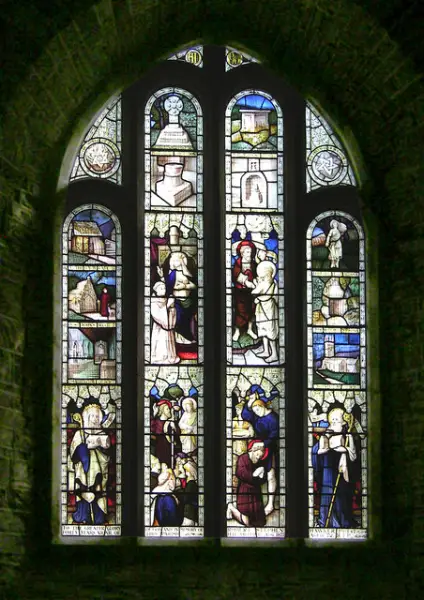
Early in the sixth century, as Morwenna lay dying, her brother Saint Nectan came to visit her. She begged that he lift her for one final look across the water toward her native shore, the coast of Wales visible on clear days from her clifftop, and with that farewell look across the sea that had carried her to her mission she ended her life of exile and labour. She was buried at the church she had built at Morwenstow, and her grave there became the centre of her local cult. Centuries later a painting was discovered on the north wall of the church and thought to represent her: an austere woman holding a scroll against her breast, one hand lifted in benediction above a monk kneeling at her feet. The image, whatever its precise date, shows how the parish remembered her, as an ascetic and intercessor standing between heaven and her people. In the stained glass of the parish church of Saint Morwenna and Saint John the Baptist she appears again, the local saint watching over the community she founded, buried where she preached and prayed.
§ Life
Well, Glass, and a Name on the Cliff
The holy well of Morwenna lies just over five hundred metres west of the church, halfway down a precipice above the sea. According to the historian Nicholas Orme it is nowadays associated with the saint, and legend places it at the very spot where she paused for breath as she hauled stone from the shore toward her cliff-top church. The little well house over it enjoys a grade II listing, though the spring no longer flows. Her memory also lives in the parish church, dedicated to Saint Morwenna and Saint John the Baptist, the second dedication added around 1275 when the church was given to Saint John the Baptist's hospital at Bridgwater, and where she appears in stained glass. Scholars caution against conflating her with other Cornish holy women: she is commonly misidentified with Marwenne of Marhamchurch and with the saint Moren, patron of Lamorran. Yet the identification of the foundress of Morwenstow has remained firm, and the village on its stormy cliff keeps her name in its very foundation, Morwenna's holy-place, still visited by those who trace the paths of Cornwall's Celtic saints along the granite coast.
§ Morwenna's Well
The Record
- Major works
- church at Morwenstow
- Patron of
- Morwenstow, Cornwall
- Symbols
- scroll clasped to her breast, right arm raised in blessing
- Canonization
- Pre-congregation; honoured in the Anglican, Roman Catholic, and Eastern Orthodox churches
Prayer
Bibliography
Show 5 sources
- Baring-Gould, Sabine (1914). The Lives of the Saints. J. Grant. p. 263.
- Orme, Nicholas (2000). The Saints of Cornwall. Oxford University Press. p. 196.
- "St. Morwenna of Morwenstow, Cornwall". Antiochian Orthodox Church. Archived from the original on 28 November 2023.
- Nash Ford, David. "EBK: St. Morwenna". Nash Ford Publishing. Retrieved 10 April 2024.
- Historic England, "Holy well of St Morwenna about 14 metres down the cliff to the west of the church of St Morwenna (1231518)", National Heritage List for England.
Profile text adapted from the Wikipedia article, licensed CC BY-SA 4.0.
Pray with this saint every day
Save St. Morwenna to your favorites, read the full profile, and get feast-day reminders in the Saints app.
Get the Saints AppFree on the App Store for iPhone and iPad