
330 - 405·Feast August 28
St. Moses the Black
Desert Father, hieromonk, and martyr of Scetis
Overview
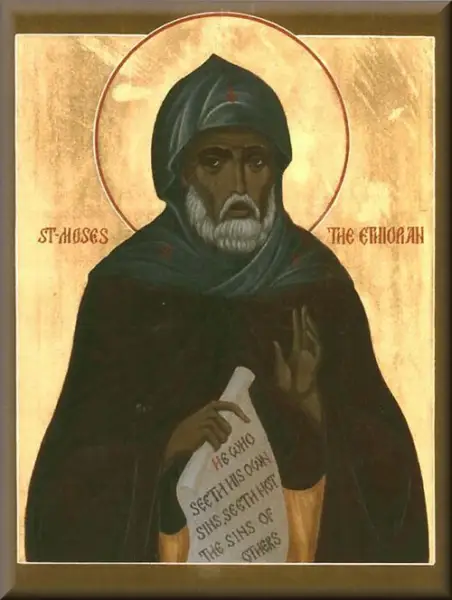
Saint Moses the Black, also called Moses the Ethiopian, the Strong, the Robber, or the Nubian, was a Desert Father, hieromonk, and martyr of fourth-century Egypt. Born around 330, he was a Nubian slave of huge strength who, after committing a murder and being banished by his master, became leader of a notorious band of seventy-five robbers in the Nile Valley. Hiding from the authorities among the monks of Scetis in Wadi El Natrun, he was so struck by their peace and contentment that he gave up his violent life, became a Christian, and joined the community. His conversion proved as total as it was sudden: he overpowered his own attackers and led them to repentance, learned patience under the guidance of the abbot Isidore, and taught his brothers mercy by appearing at a council of judgment carrying a sack of sand, saying his own sins ran out behind him where he could not see them. In time he guided a settlement of hermits in the Western Desert and received priestly ordination. Around 405, when Berber raiders threatened the monastery, he refused to let his brothers take up arms and was martyred with seven companions on 24 Paoni, 1 July. His relics rest at the Paromeos Monastery; he is invoked as patron of Africa and nonviolence.
The Complete Life
A Terror of the Nile Valley
Moses the Black lived during the fourth century in Egypt. His dark skin earned him the nickname Murin, the Ethiopian. His early years were passed in bondage to a powerful owner; implicated in a killing, he was driven out and took up with a robber band. At the head of seventy-five lawless men he spread fear along the Nile, his band so numerous and so savage that whole districts lived in dread of its passing. His body matched his reputation, immense and powerful and without fear, and the band soon answered to him as its chief. The sources paint the picture of a formidable and dangerous man: a thief and killer at the head of a feared company, accustomed to force and unafraid to use it. Stories of his raids became part of the lore that later chroniclers recorded with a certain awe, for it was this man, strong, violent, and desperate, whom providence would lead into the desert of Scetis. There his strength would be converted rather than discarded, and the terror of the valley would become one of the most beloved fathers of Egyptian monasticism.
§ Early life
The Robber Who Found the Monks
The turning point came, characteristically, in the course of a crime. A barking dog once thwarted Moses in a planned robbery, and he swore vengeance on the owner. Swimming the Nile with a sword held in his mouth on a second attempt, he found his intended victim warned and hidden; frustrated, he stole four of the man's sheep, slaughtered them, and sold their fleeces for wine. Hiding afterwards from the local authorities, he hid among the monks of a desert colony at Wadi El Natrun, the place once known as Scetis, close to Alexandria. What he found there, lives wholly given to God and a deep, settled joy, worked on him beyond resistence. The violent man who had come only to hide found in the monastery a world whose strength was of another kind, and he did not leave it. Moses renounced his old existence, received baptism, and entered the brotherhood at Scetis. So complete was the change that the historian Sozomen, writing some seventy years later, judged that no such sudden passage from vice to virtue had ever been witnessed, nor so rapid a progress in the philosophy of the desert.
§ Conversion to Christianity
Slowly the Sun Drives Out the Night
The conversion of his life did not at once convert his temperament, and Moses had a difficult time adjusting to monastic discipline; traces of his criminal past lingered. When robbers attacked his desert cell he fought back, overpowered the intruders, and dragged the whole band to the chapel where the brothers were at prayer, telling them he did not think it Christian to hurt the robbers and asking what should be done with them. The captured thieves repented of their lives and sought entry into the brotherhood. Zealous in everything, he grew despondent upon judging himself still far from perfection, and despair and old passions once more assailed him; the abbot Isidore took him at dawn to the roof and showed him how gradually the first rays dispel the night, teaching that the perfect contemplative is formed no faster. Moses proved an effective prophetic spiritual leader. When he broke a communal fast to feed visiting brothers, the monks who came to reproach him relented, saying he had kept not a human commandment but the divine commandment of hospitality. And when called to a meeting to judge a brother's fault, he arrived with a sack of sand on his shoulder, saying his own sins ran unseen behind him; the assembled brothers forgave the offender. Moses later led a colony of hermits in the Western Desert and was ordained a priest.
§ Monastic life
The Sword Refused
In his old age, at about seventy-five, news arrived, about the year 405, that Berber raiders known as the Mazices were preparing to fall upon the monastery. The brothers reached for weapons, but Moses forbade it outright: they were to withdraw, not to fight. A violent death, he said, was the fitting end for a former robber, citing the Gospel warning that those who take up the sword will perish by it. He remained behind, joined by seven others who would not abandon him, and the bandits put them all to death on 24 Paoni, 1 July, in the year 405. Another account, preserved in The Paradise of the Holy Fathers, shows him dying in peace after a final exchange with Abba Zechariah on the goodness of silence; at the moment of death, with Abba Isidore sitting beside him, he looked up to heaven and declared that the gates of heaven had been opened for his son Zechariah. Either way the tradition agrees on the essentials: the man who had lived by violence died refusing it, and the robber of the Nile Valley closed his life as a martyr of non-resistance at Scetis, honoured ever after among the Desert Fathers.
§ Death
From Dread of Demons to Patron of Peace
Sozomen, in his Ecclesiastical History, written about seventy years after the martyrdom, summed up the judgement of the age: God had made Moses an object of dread to the demons, ordained him presbyter over the monks at Scetis, and left him numerous eminent disciples at his death at seventy-five. His teaching survived in the sayings of the Desert Fathers, counsels to harm no one, to harbour no bad thought against anyone, and to attend to one's own faults rather than a neighbour's, and his life of repentance and asceticism helped shape early Christian monasticism, influencing figures such as John Cassian. The modern Church has found in him an apostle of non-violence, and he is invoked as patron of Africa and of nonviolence. His relics rest today in the Church of the Virgin Mary at the Paromeos Monastery in Wadi El Natrun, his principal shrine. Iconographers have painted him from the novgorod panels of late medieval Russia to the frescoes of Mount Athos, and his memory is kept across the traditions of East and West: on 28 August in the Greek and Syriac churches, on 1 July and 24 Paoni among the Copts, and on 2 July in the Episcopal Church.
§ Legacy
Timeline
- 330
Born in Egypt into slavery, later becoming the leader of a band of seventy-five robbers.
§ Early life
- 1 Jul 405
Martyred with seven companions by Mazices bandits at Scetis, having forbidden the brothers to resist.
§ Death
In Their Own Words
My sins run out behind me and I do not see them, but today I am coming to judge the errors of another.
Do no harm to anyone; do not think anything bad in your heart towards anyone; do not scorn the man who does evil
So sudden a conversion from vice to virtue was never before witnessed, nor such rapid attainments in monastical philosophy.
The Record
- Patron of
- Africa·nonviolence
- Canonization
- Pre-congregation; venerated across the Eastern Orthodox, Oriental Orthodox, Catholic, Anglican, Lutheran, and Assyrian churches
Prayer
Bibliography
Show 6 sources
- "Venerable Moses the Black of Scete", Orthodox Church in America.
- Lesser Feasts and Fasts 2018. Church Publishing, Inc. 2019. ISBN 978-1-64065-235-4.
- Ward, B. (1984). The Sayings of the Desert Fathers: The Alphabetical Collection (revised ed.). Liturgical Press: Collegeville, MN.
- Sozomen, Hermias (2018). The Ecclesiastical History of Sozomen. Merchantville, New Jersey: Evolution Publishing. ISBN 978-1-935228-15-8.
- Palladius (1918). The Lausiac History. London: The Macmillan Company.
- Felicity, Sister (1964). "St Moses the Black". Life of the Spirit (1946-1964). 19 (214): 36-38.
Profile text adapted from the Wikipedia article, licensed CC BY-SA 4.0.
Pray with this saint every day
Save St. Moses the Black to your favorites, read the full profile, and get feast-day reminders in the Saints app.
Get the Saints AppFree on the App Store for iPhone and iPad