
c. 990 – 1043·Feast July 26
St. Moses the Hungarian
Hungarian monk of the Kiev Cave Monastery
Overview
Moses the Hungarian was a Kievan monk of Hungarian birth whose life joined the Carpathian world of his origins to the monastic culture of Kievan Rus'. He was born around 990–995, in a land still largely pagan, though the baptism of the Transylvanian chieftain Gyula at Constantinople had opened a channel between Hungary and the Christian East. That connection carried the young Moses out of Transylvania and into the service of the princely family at Kiev. Between 1015 and 1018, already preparing himself for the monastic habit, he served as escort to Predslava, daughter of Vladimir I of Kiev. He was an eyewitness when the princes Boris and Gleb were done to death, and had to take shelter in the household of the sister of Prince Yaroslav, the ruler later known as Yaroslav the Wise. Then, in 1018, the Polish expedition carried him away into captivity, and he did not regain his freedom until 1025. The remainder of his life was spent in the Kiev Cave Monastery, where he died on 26 July 1043. The Eastern Orthodox Church venerates him as a saint on 26 July.
The Complete Life
A Youth Between Two Worlds
Moses was born around 990 to 995 in the Principality of Hungary, a country whose people were at that time still mostly pagan, though their conversion was already beginning to take shape. His youth belonged to a border world in which the steppe roads ran from the Carpathian basin northward to the great princely city on the Dnieper. One turning of that road ran through Transylvania, where the Hungarian chieftain Gyula had accepted baptism at Constantinople. That act bound a corner of pagan Hungary to the Christian East, and it probably made possible the journey that defined Moses' life: his departure from Transylvania to take up service with the princely family at Kiev. He thus grew up between two loyalties, the land of his birth and the faith that reached out to meet it, and he chose the faith. The path he followed was not the well-worn road of a Latin mission but the Byzantine one, by way of the Bosphorus, into the world of Kievan Rus'. The record does not preserve the names of his parents or the circumstances of his childhood; what it keeps is the direction of his going, from the lands of his own people toward the Christian principality on the Dnieper.
§ Life
Service at the Princely Court
At Kiev, in the years between 1015 and 1018, Moses belonged to the household of the princely family as escort to Predslava, the daughter of Vladimir I of Kiev. The office placed a young Hungarian in daily attendance on one of the Christian princesses of the ruling house, and it was held by a man already preparing to become a monk. Court service and monastic intent, usually rival callings, were joined for a short season in him. Those years were also years of terror. Moses was present at Kiev when the princes Boris and Gleb were assassinated, a killing that stained the beginning of the succession struggle, and he had to find shelter with the sister of the future Prince Yaroslav I the Wise to preserve his own life. The court that had received him could no longer protect him. What remained constant through the upheaval was the purpose he had formed before the blood was shed: that he belonged to God, and that every other station, princely or refugee, was provisional. In an age when the murder of kinsmen settled the questions of succession, attendance on a princess of the ruling house was no idle honour, and the shelter Moses needed after the killing shows how narrow his situation had become. The notices of his life pass quickly over these years, but they gather into them the whole setting of his sanctity: court, chapel, conspiracy, and the quiet resolve of a man preparing for the habit.
§ Life
Captivity and the Cave Monastery
In 1018 the Polish expedition swept through the lands of Kievan Rus', and Moses was carried off to Poland as a prisoner. For years his life hung on the fortunes of war, far from the Kiev he had made his own and farther still from Hungary. Only in 1025 did he win his way back. By then the bright years at court were long past, and he gave himself to the calling he had prepared for before everything was interrupted: he entered the Kiev Cave Monastery and spent there the rest of his life. Nothing further is recorded of those years, and their silence is itself a kind of testimony; the man who had escorted princesses and survived assassination and captivity ended as one more monk among the caves above the Dnieper. He had come to Kiev as a young foreigner in the service of princes; he ended as an elder of the monastery that the Russian Church would count among the holiest of its houses. His release from Poland in 1025 closed the chapter of his worldly fortunes, and from then on the record follows him no further than the walls of the Lavra. He died there on 26 July 1043, and that date, kept as the day of his repose, became the day on which the Church remembers him.
§ Life
Remembrance East and West
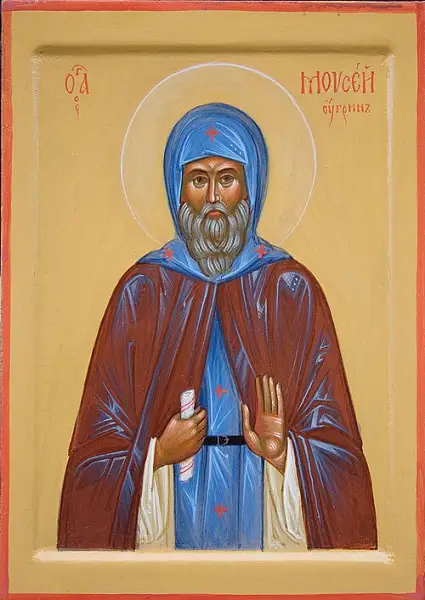
The memory of Moses passed into the roll of the saints of Kievan Rus', and his cult outlived the principality in which it was born. The Eastern Orthodox Church keeps his feast on 26 July; the Eastern Catholic Churches honour him on the same day. These bodies, which stand in communion with Rome while keeping the Byzantine inheritance, honor him as well. His memory is therefore shared across the painful dividing lines of later history: a saint of the Kiev Cave Monastery claimed equally by Orthodox and Eastern Catholic faithful. To Hungarian Christians he has a further significance, for he stands among the earliest of their countrymen to be raised to the altars of the Christian East, a reminder that the faith reached the Hungarians not only from the West but also from Constantinople. The convent workshop icon of the Venerable Moses the Hungarian keeps his face before the faithful, a Hungarian who found his homeland at last in the caves of Kiev. His feast is kept on the very day that marks his death, according to the old custom by which the day of repose becomes the day of memory.
§ Life
Timeline
- 990
Born in the Principality of Hungary, in a land still for the most part pagan.
§ Life
- 1015
Served as escort to Predslava, daughter of Vladimir I of Kiev, while already preparing to become a monk.
§ Life
- 1018
Carried off to Poland as a prisoner in the wake of the Polish expedition.
§ Life
- 1025
Regained his freedom, returned to Kiev, and entered the Kiev Cave Monastery for the rest of his days.
§ Life
- 26 Jul 1043
Died at the Kiev Pechersk Lavra; the date of his repose became the day of his feast.
§ Life
The Record
- Canonization
- Pre-congregation; venerated as a saint by the Eastern Orthodox Church and the Eastern Catholic Churches
Prayer
Bibliography
Show 2 sources
- István Ivancsó, "Egy elfelejtett szent: Magyar Mózes" (Moses the Hungarian: a Forgotten Saint), in Aetas, retrieved November 5, 2007
- "Hungarian Orthodox Saints: The Story of Three Brothers", HungarianConservative.com
Profile text adapted from the Wikipedia article, licensed CC BY-SA 4.0.
Pray with this saint every day
Save St. Moses the Hungarian to your favorites, read the full profile, and get feast-day reminders in the Saints app.
Get the Saints AppFree on the App Store for iPhone and iPad