
1910-1997·Feast September 5
St. Teresa of Calcutta (Mother Teresa)
Religious Foundress and Missionary
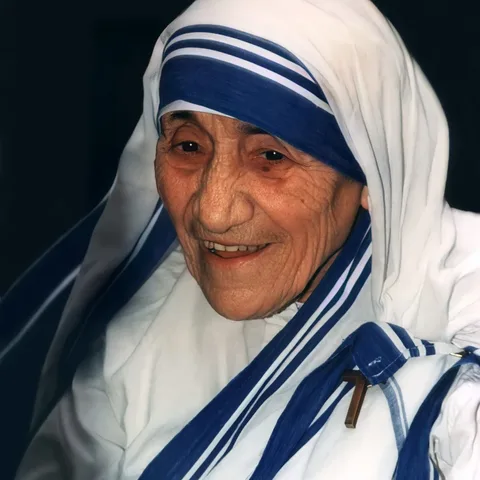
Overview
Anjezë Gonxhe Bojaxhiu was born in Skopje on 26 August 1910, the youngest child of a Kosovar Albanian family; her father died when she was eight, probably poisoned for his politics. Fascinated from girlhood by missionary lives in Bengal, she left home at eighteen for the Sisters of Loreto in Ireland, reached India in 1929, and took the name Teresa after the Little Flower of Lisieux. Nearly two decades of teaching in Calcutta convent schools ended on a train to Darjeeling in September 1946, in what she called the call within a call: leave the convent and serve the poorest of the poor from among them. Trading her habit for a white sari with blue borders, she begged, studied basic nursing in Patna, and in 1950 received approval for the Missionaries of Charity, whose fourth vow pledges wholehearted free service to the destitute. She opened Kalighat's Home for the Dying, a leprosy haven called Shanti Nagar, and a children's home; the congregation spread to more than a hundred countries. Honored with the Nobel Peace Prize in 1979, she carried meanwhile, by her own letters, an interior darkness lasting almost fifty years. After years of failing hearts and illness she died in Calcutta on 5 September 1997.
The Complete Life
Early Life
Anjezë Gonxhe Bojaxhiu — Anjezë the Albanian form of Agnes, Gonxhe the word for a flower bud — came into the world on 26 August 1910 at Skopje, a town of the Ottoman Empire that is today North Macedonia's capital, the last-born of a Kosovar Albanian Catholic household. She was christened the day following her birth and afterwards treated 27 August, the baptismal date, as her real birthday. Her parents were Nikollë and Dranafile Bojaxhiu. Politics destroyed the family early: her father, active in the Albanian community's affairs under Ottoman rule, went to a political meeting in Belgrade and died in 1919 — poisoned, the family believed, at Serbian hands — leaving her fatherless at eight. Missionary stories from Bengal captivated her as a small girl, and by twelve she already understood her life as consecrated. A pilgrimage resolve settled the matter for good on the Assumption of 1928, at Vitina-Letnice's Black Madonna shrine, a place she visited often. Late that same year, aged eighteen, she quitted home forever for the Loreto Sisters at Rathfarnham in Ireland, there to learn English — the medium of their Indian schools. Neither her mother nor her sister would she ever see again.
§ Early life and family
Conversion and Vocation
India received her in 1929. The novitiate was made at Darjeeling, in the lower Himalayas, where she picked up Bengali and taught in the school attached to the convent of St Teresa. First vows came on 24 May 1931, with the name Teresa chosen for Thérèse of Lisieux, the missions' patron — the Spanish spelling serving to distinguish her from a sister already so named. Solemnly professed on 14 May 1937, by Loreto's custom she became 'Mother' Teresa at the order's school in Entally, in east Calcutta, where she taught for close on two decades and rose to headmistress in 1944 — work she later said she had genuinely loved. Around the school, however, the city was dying: the 1943 Bengal famine, and the Muslim-Hindu killing that began with Direct Action Day in August 1946. On 10 September 1946, riding the train to Darjeeling for her yearly retreat, she received what she ever afterwards called the call within a call — an interior command to quit the convent and serve the destitute from among them, a command she described as so absolute that to disobey it would have been to break faith. Permissions took two years. In 1948 she left Loreto, put on the plain white sari with its blue border, took Indian nationality, and spent some months learning basic medicine at Patna's Holy Family Hospital before going into the slums.
§ Early life and family
Mission and Ministry
Her earliest work was a school she opened in the Motijhil district of Calcutta, and then plain care of the hungry and sick wherever she met them. Vatican leave for a diocesan congregation came on 7 October 1950, and the Missionaries of Charity set their purpose in her own hard inventory: the hungry, the naked, the shelterless, the crippled, the blind, the leper — all who feel unwanted and unloved, uncared for, burdens to society whom everyone shuns. Her first hospice opened in 1952 with the city authorities' help: Kalighat, the Home for the Dying (Nirmal Hriday), fitted into a building abandoned beside the temple of Kali. A refuge for leprosy patients, Shanti Nagar, came next, then a home for children; clinics on wheels, dispensaries, soup kitchens, and orphanages multiplied with the congregation. Besides the standard vows the sisters bind themselves by a fourth — wholehearted and free service of the poorest of the poor. The institute counted more than 4,500 sisters working in over 133 countries by 2012, and a priestly branch, the Missionaries of Charity Fathers, was added under Joseph Langford.
§ Missionaries of Charity
Spirituality and Teaching
The wellspring of all this labor was Eucharistic and severe: to see in each abandoned body the body of Christ. And it ran, as her letters revealed after her death, through almost total darkness. From about the time the congregation began she lived in a sustained sense of God's absence while behaving as one who felt His presence; those who examined the cause read this as mystical participation in Christ's thirst and in the destitute's poverty of body and soul, not as disbelief. Her own diary records the same lesson from the first slum year — begging food and supplies, alone, with Loreto's ease whispering that one word from her would restore it all — and her answer, that of her own free choice and out of love she would stay and do God's will whatever it should be, refusing herself even tears.
§ Missionaries of Charity
Trial and Final Years
Mother Teresa's trials in her last decades were of three kinds: her own body — heart failure and repeated illness, and in 1997 her resignation as head of the congregation on 13 March; the interior darkness that did not lift; and criticism, which she did not answer. That criticism was directed at the conditions in her homes for the dying, at what medical observers judged insufficient pain relief and diagnostic care, and at the use of donated funds; it remains part of the honest record of her life. She died in Calcutta on 5 September 1997, and the Indian government gave her a state funeral.
§ References
Canonization
The cause moved at the pace the modern Church reserves for its most public figures. Waiving the usual five-year wait, John Paul II allowed the cause to open almost immediately; the miracle required for beatification — the healing of an Indian woman's abdominal tumor — was recognized in 2002, and John Paul II beatified her on 19 October 2003. A second miracle, the healing of a Brazilian man with brain tumors, was recognized in 2015, and Pope Francis canonized her in St Peter's Square on 4 September 2016 as Saint Teresa of Calcutta, her feast kept on the anniversary of her death. In 2017 she was named co-patron of the Archdiocese of Calcutta alongside St Francis Xavier.
§ Introduction
Legacy
Mother Teresa remains the most recognized religious figure of the twentieth century, and her legacy is double. The Missionaries of Charity, with their fourth vow, institutionalized care for people the world's systems had written off; her white sari with blue borders became one of the universal images of charity, and the Nobel committee's 1979 Peace Prize and the 1962 Ramon Magsaysay award made her a global witness. At the same time the publication of her letters changed the popular understanding of holiness itself, showing that a life of visible service can rest on decades of felt abandonment. Her authorized biography by Navin Chawla appeared in 1992, and books, documentaries, and films about her continue; in communist Albania, which had barred her from her family and branded her a Vatican agent, she was received only after the regime's fall.
§ References
Timeline
- 1910
Born Anjezë Gonxhe Bojaxhiu in Skopje, 26 August; baptized the next day
§ Introduction
- 1928
Leaves home to join the Sisters of Loreto at Rathfarnham, Ireland
§ Early life and family
- 1929
Arrives in India; novitiate in Darjeeling, teaching at St. Teresa's School
§ Early life and family
- 1931
Takes first vows in 1931 (24 May) and solemn vows on 14 May 1937, choosing the name Teresa after Thérèse of Lisieux
§ Early life and family
- 1946
Experiences the 'call within a call' on the train to Darjeeling, 10 September
§ Missionaries of Charity
- 1950
Vatican approval for the diocesan congregation of the Missionaries of Charity, 7 October
§ Introduction
- 1952
Opens Kalighat, the Home for the Dying (Nirmal Hriday), in a former Hindu temple
§ Missionaries of Charity
- 1979
Awarded the Nobel Peace Prize
§ References
- 1997
Resigns as head of the Missionaries of Charity, 13 March; dies in Calcutta, 5 September
§ Declining health and death
- 2016
Canonized by Pope Francis in St. Peter's Square, 4 September
§ Introduction
In Their Own Words
By blood, I am Albanian. By citizenship, an Indian. By faith, I am a Catholic nun. As to my calling, I belong to the world. As to my heart, I belong entirely to the Heart of Jesus.
I was to leave the convent and help the poor while living among them. It was an order. To fail would have been to break the faith.
The biggest disease today is not leprosy or tuberculosis, but rather the feeling of being unwanted.
I see God in every human being. When I wash the leper's wounds, I feel I am nursing the Lord himself. Is it not a beautiful experience?
I have found the paradox that if I love until it hurts, then there is no hurt, but only more love.
The hunger for love is much more difficult to remove than the hunger for bread.
If we have no peace, it is because we have forgotten that we belong to each other.
The Record
- Patron of
- Co-patroness of the Archdiocese of Calcutta (2017, with St. Francis Xavier)
- Symbols
- White sari with blue borders·The poorest of the poor at her side
- Canonization
- Beatified by Pope John Paul II on 19 October 2003; canonized by Pope Francis on 4 September 2016; named co-patron of the Archdiocese of Calcutta in 2017
Prayer
Bibliography
Show 3 sources
- ↑ Albanian : Nënë Tereza ; Bengali : মাদার টেরিজা , romanized : Mādāra Ṭērijā , or মাদার তেরেসা , Mādāra Tērēsā .
- ↑ After World War I and the dissolution of the Ottoman Empire, Skopje became part of the Kingdom of Serbs, Croats and Slovenes , for the duration of Teresa's childhood. Since the 1990s, Skopje has been the capital of North Macedonia .
- ↑ Although some sources state she was 10 when her father died, in an interview with her brother, the Vatican documents her age at the time as "about eight".
Profile text adapted from the Wikipedia article, licensed CC BY-SA 4.0.
Pray with this saint every day
Save St. Teresa of Calcutta (Mother Teresa) to your favorites, read the full profile, and get feast-day reminders in the Saints app.
Get the Saints AppFree on the App Store for iPhone and iPad