
died c. 283·Feast May 3
St. Moura
Third-century Egyptian martyr honoured across Lebanon
Overview
Saint Moura — Mart Moura, as the East calls her — was a Christian woman of the third century whose martyrdom is honoured in Egypt and throughout the Middle East. A Christian woman from Upper Egypt, she was married to a deacon named Timothy, and with him she faced the last great persecution of the ancient church. When the emperor Diocletian set out to erase every trace of Christianity, the governor Urban called Timothy and his wife to adopt paganism; with courage they refused, and both were crucified, dying slowly around the year 283. Some traditions place the martyrdom instead under the emperor Decius, before his death in June 251. The place of their death was Ansena, a city of Upper Egypt known in the Roman Thebaid as Antinoöpolis. Her feast is kept on 3 May and on 25 September in the Catholic and Eastern Orthodox churches, on 10 October and 3 May in the Maronite calendar, and on 5 Hathor and on 8 Pashons within the Coptic church; the Bollandists kept 3 May. In northern Lebanon numerous churches are dedicated to her, a sanctuary stands at Kahf Al Malloul, and the monastery of Saint Moura at Ehden became the birthplace of the Lebanese Maronite Order in 1694.
The Complete Life
A Christian Household in Upper Egypt
Moura belonged to the Christian community of Upper Egypt in the third century, the age in which the church of the Nile valley produced some of its first and most celebrated martyrs. She was the wife of a deacon named Timothy, and their marriage joined two lives in the same faith at a time when that faith carried a rising price. The account of her life preserved by Father Youakim Moubarac presents her simply as a Christian from Upper Egypt, a woman whose distinction lay not in office or learning but in the constancy she would show when her belief was put to the test. Her title in the East, Mart Moura, and her remembrance among the saints of the Coptic, Eastern Orthodox, Oriental Orthodox, and Catholic churches, testify to how widely the memory of this married couple spread after their deaths. Little else is recorded of her daily life — her family, her occupations, the village of her childhood — for the tradition that carried her name forward was formed around a single decisive act. What the church preserved of Moura was not her biography but her refusal, and everything else about her has been gathered around that moment.
§ Life
Refusal and Crucifixion at Ansena
The trial of Timothy and Moura came with the imperial decision to destroy the church. According to the account transmitted by Moubarac, when the emperor Diocletian mounted the throne and set out to wipe away every trace of Christianity, the governor Urban called the deacon and his wife before him, inviting them to adopt paganism. Husband and wife together made their refusal with courage, and the sentence was crucifixion: both were nailed to the cross and died a slow death, around the year 283. The tradition also preserves a second chronology, supposing that the martyrdom took place instead under the emperor Decius; on that reading the deaths would fall before June 251, the date of Decius's own death. Whatever the true reign, the place is fixed in memory: the couple's martyrdom occurred at Ansena, an Upper Egyptian city that the Roman Thebaid knew as Antinoöpolis. There the deacon and his wife ended their lives on the cross, and there the church of Egypt began to keep their feast. The couple's death, side by side, made them one of the great married martyrdoms of the early church and bound their two names together in every calendar that remembers them.
§ Life
A Feast Kept on Many Calendars
No council or pope proclaimed Moura a saint; her cult arose where she died and travelled with the Christians of Egypt and Syria into every calendar of the East. Her feast is kept on 3 May and on 25 September in the Catholic and Eastern Orthodox churches, and in the Coptic church on 5 Hathor and 8 Pashons. The Maronite calendar of saints records her on 10 October and 25 September, and also on 3 and 7 May, while the Bollandists, the learned Jesuit compilers of the lives of the saints, retained 3 May for her commemoration. This multiplicity of dates is itself a witness to the antiquity and breadth of her veneration: different churches of the East preserved different traditions of her commemoration, and all of them kept her. She is listed among the martyrs of the Coptic Orthodox Church, honoured in Egypt and the Middle East, and her memory stands in the synaxaria beside that of her husband Timothy, whose own feast carries hers with it. A martyr of no recorded words, Moura lives in the church's memory through dates, places, and the unbroken practice of celebrating her witness each year.
§ Life
Churches and a Monastery in Lebanon
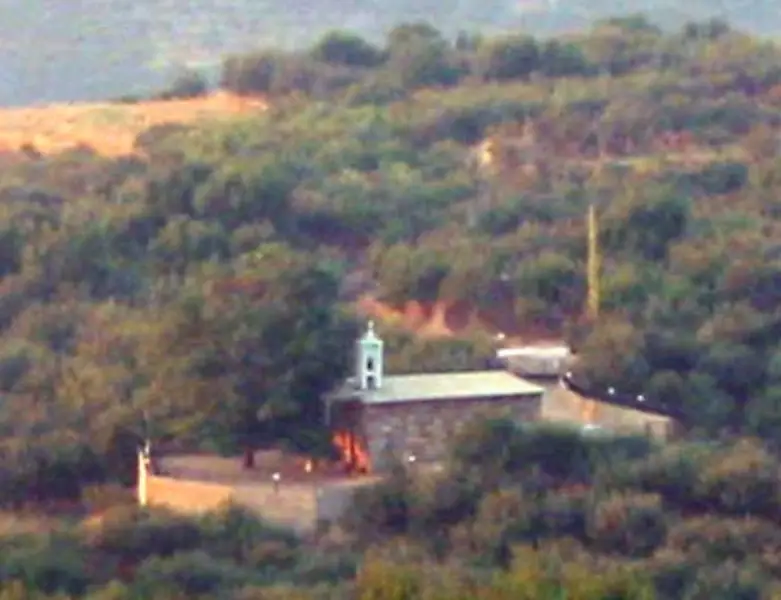
In Lebanon the memory of Mart Moura took root in stone. Several churches are dedicated to her among the Maronites of the north, at Mayfouq, Kfarsghab, Karm el Mohr, Kobayat, Rachiine, Miziara Bnachii, and Bekarzala, and a sanctuary stands at Kahf Al Malloul. The church of Kfarsghab, the most honoured among them, received a Maronite Synod in 1598, while the church at Bnachii draws a devotion of real weight throughout the Zgharta District. At Bekarzala in Akkar the saint is the patron of the village, and the village church houses a painting of her made in 2007 by Nabil Antoine Chahine, an academic and maker of films who lives in Melbourne, Australia. Greatest of all her foundations is the monastery dedicated to her at Ehden, for it was there that three young Maronites from Aleppo in Syria founded the Lebanese Maronite Order in 1694, under the patronage of Patriarch Estephane El Douaihy. A martyr of the Egyptian Thebaid thus became the motherhouse patron of one of the principal religious orders of the Maronite church, and her name is carried today by monasteries, parishes, and villages across the mountains of the north.
§ Places of worship
Timeline
- 283
Crucified with her husband Timothy at Ansena after refusing the governor Urban's summons to paganism.
§ Life
- 1598
The church of Saint Moura at Kfarsghab hosted a Maronite Synod.
§ Places of worship
- 1694
Three Maronite young men from Aleppo founded the Lebanese Maronite Order at her monastery in Ehden.
§ Places of worship
- 2007
A painting of the saint by Nabil Antoine Chahine placed in the village church of Bekarzala, Akkar.
§ Places of worship
The Record
- Patron of
- patron saint of Bekarzala, Akkar
- Symbols
- Martyr
- Canonization
- Pre-congregation; venerated as a martyr in the Eastern Orthodox, Oriental Orthodox, and Catholic Churches since antiquity.
Prayer
Bibliography
Show 3 sources
- Moubarac, Youakim (1984). Pentalogie Antiochienne / Domaine Maronite - Tome II - Volume I, p. 39. Editor Cenacle Libanais - Beirut - Lebanon.
- Kamel, Girgis (1999). Antinoepolis, The City of The Pharaoh's Sorcerers. Agape Editions.
- "شهادة تيموثاوس ومورا (مافرا)". home.massarra.org. Archived from the original on 2017-06-26.
Profile text adapted from the Wikipedia article, licensed CC BY-SA 4.0.
Pray with this saint every day
Save St. Moura to your favorites, read the full profile, and get feast-day reminders in the Saints app.
Get the Saints AppFree on the App Store for iPhone and iPad