
fl. 967–975·Feast February 10
St. Mærwynn
Founding abbess of Romsey Abbey
Overview
Mærwynn, also remembered as Merewenna or Merwinna, was a tenth-century abbess of Romsey Abbey in England, honored as a saint by both the Catholic Church and the Eastern Orthodox Church. The documentary record fixes her period of office in the years 967 to 975, and the strongest single fact about her career is political as much as spiritual: King Edgar the Peaceable appointed her to lead the reconsecrated abbey of Romsey, entrusting her with the office at Christmas in 974. Medieval legend, which made her a native of Ireland educated by Saint Patrick, has been set aside by historians, since five centuries separate the two figures. What survives instead is more solid: a royal charter of Edgar to Romsey Abbey, her name in the Liber Vitae, the medieval confraternity book of the New Minster at Winchester, and an entry in the Secgan manuscript's list of the saints' burial places. Edgar sent his daughter Ælfflæd to be raised under Mærwynn's care, and the two grew so bound to one another that the abbess became in effect a foster mother to the princess. Mærwynn was buried at Romsey Abbey, near the place where Ælfflæd was later laid, and her principal feast is kept on February 10.
The Complete Life
Called to Rule at Romsey
The abbey at Romsey that Mærwynn came to lead was a house newly restored to religious life, and she stands in its records as the founding abbess of the reconsecrated community. The appointment was not an internal election alone. King Edgar the Peaceable, the monarch who did so much to organize monastic reform in tenth-century England, appointed her to the position, and the sources fix the moment with unusual precision: he installed her as abbess on Christmas in the year 974. That a king should place a woman at the head of a royal abbey, and choose the great feast of the Nativity to do it, says something about both the standing of the house and the confidence Edgar placed in her. Later imagination embellished her origins, telling a story that she had been born in Ireland and educated by Saint Patrick himself. Historians have gently dismantled that legend, noting that five centuries lie between the apostle of Ireland and the abbess of Romsey, and that no serious chronology can join them. What remains without embellishment is the office itself: Mærwynn governed a royal foundation at a hinge moment of English monastic history, and her name entered the records precisely because the king's own authority stood behind her.
§ Life
Foster Mother to a Princess
Among the responsibilities Edgar laid upon his abbess, the most personal was the care of his own daughter. The king sent Ælfflæd, his child by his marriage, to Romsey to be brought up under Mærwynn's direction, and the arrangement matured into something deeper than guardianship: the princess became to her abbess like a daughter, and Mærwynn like a foster mother to the girl. Royal children were often placed in monasteries for their education, and some remained there as nuns; what the sources preserve in Ælfflæd's case is the affection that grew in the cloister, so strong that the two were eventually buried near one another. Beyond the household, Mærwynn's historical footprint is unusually well anchored for a woman of her century. Her name appears in a royal charter by which Edgar endowed Romsey Abbey, in the medieval confraternity book of Winchester called the Liber Vitae of the New Minster, where the names of those bound in prayer to the community were recorded, and in the Secgan manuscript's old catalogue of the saints and their burial places. Few tenth-century abbesses can be traced through three such independent witnesses, and together they show a woman fully embedded in the religious and political networks of Edgar's England.
§ Life
Death and Burial at Romsey
The date of Mærwynn's death is not recorded; the documents that preserve her name fall silent after her years of office in the 960s and 970s. What is known is where she was laid. She was buried at Romsey Abbey, the community she had founded and governed, and her grave was placed close beside the spot where Ælfflæd, the royal child she had raised, was buried in turn. The pairing of the two graves is the last and most eloquent fact of her life: the abbess and the princess remained together in death as they had lived together within the cloister, and the Secgan manuscript, the Old English record of where the saints lie, counted her among the buried holy of the English church. Her liturgical memory settled early and has never entirely faded. Her principal feast is kept on February 10 in both the Catholic Church and the Eastern Orthodox Church, while Catholic calendars add a secondary commemoration on October 29, marking the day her relics, together with those of Ælfflæd, were translated. A saint whose dates are uncertain but whose grave, feast, and foster daughter all bear witness, she belongs to Romsey as surely as Romsey belonged to her.
§ Veneration
A Saint of Both East and West
Mærwynn never passed through any formal process of canonization; she belongs to the vast company of saints whose cult arose in the community that buried them and was confirmed simply by continuing. She is honored as a saint in the Catholic Church and in the Eastern Orthodox Church alike, a recognition resting on her office, on the early catalogues that listed her among the holy dead, and on the unbroken local memory of Romsey. Her principal feast day falls on February 10 and is observed in both communions, a rare point of convergence between them. In the Catholic Church additional commemorations developed around the movement of her body: October 29 marks the translation of her relics, carried together with those of her foster daughter Ælfflæd, and the Monks of Ramsgate, compilers of one of the standard English dictionaries of the saints, noted certain other secondary days in her honor. The survival of her cult in the East as well as the West reflects the movement of monks and calendars across the old English tradition, which carried the memory of Anglo-Saxon holiness into Orthodox practice. Whatever the mechanics, the result is that an abbess of a small Hampshire house is prayed to on two continents today.
§ Veneration
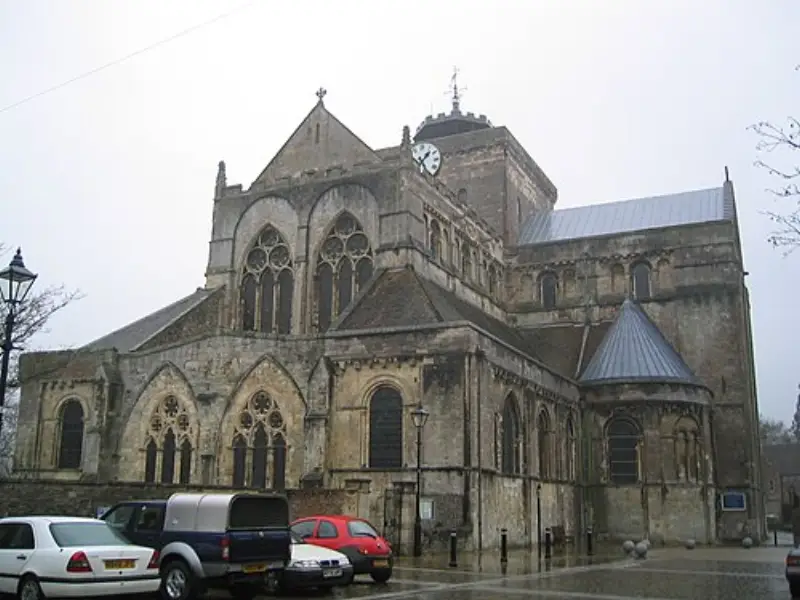
Stones Beneath the Norman Church
The abbey Mærwynn governed did not long survive her in its original form. It was the second of four church buildings that rose in succession on the Romsey site, and in the year 1003 Viking raiders destroyed it, less than three decades after her death. Yet her house was not erased. Archaeologists have located the foundations of her abbey beneath the tower, the stalls of the choir, and a section of the nave of the great Norman church that stands at Romsey today, so that the community that prays there now gathers literally above the walls she knew. Her name has traveled with the building. Medieval writers knew her as Merewenna or Merwinna, and she entered the standard repertories of English sanctity, from the Secgan burial list to the medieval confraternity books of Winchester, and from them into the modern dictionaries of the saints that keep her feast before a wider public. Historians value her for a different reason: as one of the small number of tenth-century Englishwomen whose existence is fixed by contemporary documents rather than legend alone. A king's charter, a book of prayer, a list of graves, and foundations under a Norman nave are an unusual set of monuments for an abbess, and they have kept Mærwynn where legend alone could not.
§ Romsey Abbey
Timeline
- 967
Documentary evidence places her tenure as abbess of Romsey in the years 967 to 975.
§ Mærwynn
- 25 Dec 974
Appointed by King Edgar the Peaceable as founding abbess of the reconsecrated Abbey of Romsey, at Christmas.
§ Life
- 1003
Viking raiders destroyed the abbey she had led, the second of four church buildings raised on the site.
§ Romsey Abbey
The Record
- Canonization
- Pre-congregation; recognized as a saint in the Catholic Church and the Eastern Orthodox Church.
Prayer
Bibliography
Show 7 sources
- Farmer, David Hugh (2011). "Merewenna (10th century)". The Oxford Dictionary of Saints (5th rev. ed.). Oxford University Press. pp. 307−308. ISBN 978-0-19-959660-7.
- Butler, Alban; Burns, Paul (1995). Butler's Lives of the Saints. A&C Black. ISBN 978-0-86012-259-3.
- Thomas Perkins, Bell's Cathedrals: A Short Account of Romsey Abbey (Project Gutenberg, 2007), pp. 17, 70.
- Liebermann, Felix (1889). Die Heiligen Englands: Angelsächsisch und Lateinisch. Hanover. II.34.
- Liber vitae ('The New Minster Liber Vitae of Winchester'). The British Library Digitised Manuscripts. Stowe MS 944, Folio 26r.20.ix.
- "St. Merewenna". Eucharist and Truth.
- February 23 / February 10. Holy Trinity Orthodox Church, Orthodox Calendar.
Profile text adapted from the Wikipedia article, licensed CC BY-SA 4.0.
Pray with this saint every day
Save St. Mærwynn to your favorites, read the full profile, and get feast-day reminders in the Saints app.
Get the Saints AppFree on the App Store for iPhone and iPad