
fl. 6th century·Feast August 12
St. Muiredach of Killala
Founding bishop of Killala in Connacht
Overview
Muiredach mac Echdach, known also as Murtagh, was the founding bishop of Killala in the west of Ireland, and he stands among the early saints of the Irish Church whose cult took root in Connacht. He belonged to the Cenél Lóegairi and was connected to the royal family of King Lóegaire mac Néill, so that the blood of the high kings ran in a man who chose the service of a small frontier church. The traditions about him reach far back: the old records call him one of Patrick's aged household and say that Patrick in person set him over the church of Killala, though that link sits awkwardly beside his recorded activity in the late sixth century. He laboured in County Sligo, where he is said to have met St Columba at Ballysadare in 575, and in age he withdrew to the uninhabited island of Inishmurray off the Sligo coast, where he died as a hermit. His feast is kept on 12 August, and the cathedral church of the Diocese of Killala at Ballina bears his name to this day.
The Complete Life
A Prince's Kindred
Muiredach bore the patronymic mac Echdach, son of Eochaid, and belonged to the Cenél Lóegairi, the kindred descended from Lóegaire mac Néill, the king of Tara against whom Patrick had stood in the old stories of the conversion. To be connected to that royal family was to be born into the foremost house of the midlands, a lineage of power and of peril. Nothing is recorded of his mother, his birthplace, or the years of his boyhood; the sources that carry his memory were written for the church he served, not for the family he left. Yet the very fact that a man of the ruling kindred appears at the head of a Connacht see says something about the shape of the early Irish Church, in which the sons and cousins of kings filled the offices of bishops and abbots, carrying the authority of their blood into a new kind of service. In later life he was known also as Murtagh, the familiar form of his name among the people who kept his feast. The Murtagh whom the west honoured was the same kinsman of kings, his great name given a homelier dress by the people of Connacht.
§ Life
An Old Man of Patrick's Family
The tradition of Killala asserts that Muiredach was an old man of Patrick's family, and that the apostle of the Irish himself set him at the head of the Church of Killala as early as 442 or 443. The claim carries the weight of great antiquity, but it does not sit easily with the rest of the record, which shows Muiredach at work in the late sixth century, more than a hundred years after Patrick's death. Scholars judge that the connection probably reflects the interests of Armagh, the primatial see that claimed the heritage of Patrick and found it profitable to trace the bishops of distant churches back to his hands. Whatever the truth of the commission, the substance of the tradition is plain: Killala looked upon Muiredach as its founding bishop, the man who first gathered its Christians and gave the church of the little town its order. In the memory of Connacht he was not a latecomer to an existing foundation but the planter of it, and his name remained fixed to the see from the beginning. In churches of that age a founding bishop was less an office than a presence, and Killala remembered Muiredach in precisely that role, as the man without whom its story would not begin.
§ Life
In the Fields of Sligo
Muiredach appears in the record as active in County Sligo, where his ministry left traces that outlived him. The most memorable of these is the meeting said to have taken place in 575 at Ballysadare, a town in the county, between the ageing bishop and St Columba. If the date is right, the encounter belongs to the year of Columba's own turning points, and it sets the bishop of a modest Connacht see in the same company as the greatest of the Irish missionaries. The story of such meetings was treasured by local tradition, which liked to bind its own saints into the fellowship of the famous ones, and Ballysadare kept the memory of this one. Beyond the meeting with Columba, the details of his work among the churches of Sligo have faded; what remains is the pattern of a bishop labouring not in a cathedral close but across a wide country of farms and shorelines, where the faith was carried from place to place by men of his order, and where the very names of the wells and townlands still recall the saints who blessed them.
§ Life
The Hermit of Inishmurray
When age came upon him, Muiredach is thought to have withdrawn from his labours to Inishmurray, an uninhabited island lying off the Sligo coast in Donegal Bay, an island that bears his name. There, in the severest solitude the west of Ireland offers, a rock in the open Atlantic, he ended his days as a hermit. It may be, as the tradition allows, that he was also patron of the monastery that stood on the island, a house founded there by Laisrén mac Decláin, so that his last retreat was not a flight from the Church but a return to one of its prayerful strongholds. There he died, and there the island kept his memory long after the monastery itself had fallen silent. The choice of such a resting place was in the spirit of the age: the saints of the Irish Sea sought bare islands as other men seek thrones, believing that the edge of the world was the nearest ground to heaven. Inishmurray's early Christian remains still mark the island where the old bishop completed his life, and the island itself keeps his name as the surest memorial his last years left.
§ Life
Patron of Killala
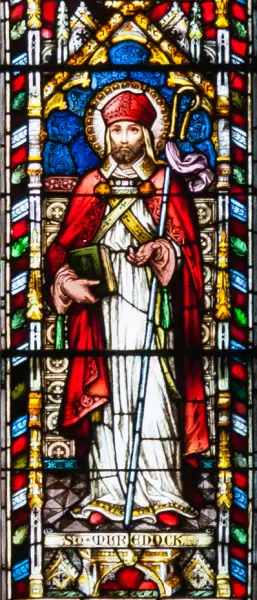
Muiredach's cult settled firmly into the church of his founding. His feast is kept on 12 August, the day on which the diocese and its people have remembered him for centuries. The bond between the saint and his see found its most visible expression in St Muredach's Cathedral at Ballina, the cathedral church of the Roman Catholic Diocese of Killala, which carries his name as its title; in its east window the saint stands depicted in glass, the work of the firm of Franz Mayer and Company of Munich, so that the worshippers who gather for Mass look upon the face of their patron. Few early Irish saints can claim so continuous a link between a sixth-century founding and a living diocese. The scholars who weigh the traditions about him, and the questions of chronology and of Armagh's claims that surround them, are examining the materials of history; the people of Killala have never needed the debate resolved. To them Muiredach is the first bishop of their church, the saint of their shoreline and their island, and his name in the cathedral's dedication keeps the founding alive.
§ Life
Timeline
- 442
St Patrick himself set him over the church of Killala, on a tradition that dates the event as early as 442 or 443.
§ Life
- 575
Met with St Columba at Ballysadare, in County Sligo, where he was active in his later years.
§ Life
The Record
- Canonization
- Pre-congregation; honoured as a saint from the early Irish Church
Prayer
Bibliography
Show 5 sources
- Galloway, Peter (1992). The Cathedrals of Ireland. Belfast: The Institute of Irish Studies. p. 25. ISBN 0-85389-452-3
- Mac Shamhráin, Ailbhe. "Muiredach", Dictionary of Irish Biography, 2009
- Healy, John. "Killala." The Catholic Encyclopedia. Vol. 8. New York: Robert Appleton Company, 1910. 21 Mar. 2013
- Duffy, Patrick. "Aug 12 – St Muiredach (c. 480) patron of Killala diocese", Catholic Ireland, 12 August, 2012
- "St. Muredach's Cathedral Ballina", Mayo North
Profile text adapted from the Wikipedia article, licensed CC BY-SA 4.0.
Pray with this saint every day
Save St. Muiredach of Killala to your favorites, read the full profile, and get feast-day reminders in the Saints app.
Get the Saints AppFree on the App Store for iPhone and iPad