
died c. 686·Feast October 16
St. Mummolin of Noyon
Monk of Luxeuil and Bishop of Noyon
Overview
Mummolin, whose name survives in many forms including Momelin, Mommolenus and Mommolinus, was a monk of Luxeuil who rose to rule an abbey in Saint-Omer and finally the bishopric of Noyon and Tournai. Born on Lake Constance's shores, he entered the monastery of Luxeuil and was formed under the abbacy of Eustasius in the tradition of Columbanus. Sent out from Luxeuil to preach the Gospel among the Morini, he went in the company of St Bertin and St Ebertram, fellow countrymen from the Constance lake country, to St Omer, who received them gladly. He headed the first monastery in the marshes near Saint-Omer, then led the new abbey of Sithiu, later the Abbey of Saint Bertin, before being chosen bishop of Noyon and Tournai upon the death of St Eligius. He governed that extensive see for twenty-six years, preached fluently in Latin and in the Flemish tongue, and translated the body of his predecessor. He died around 686, and his feast is kept on 16 October.
The Complete Life
From the Lake to Luxeuil
Mummolin was born on the shores of Lake Constance, among the Alemannian lands where the missionary tide of the seventh century was turning old paganism to the faith. His early years were given to the monastery of Luxeuil in France, the great foundation of the Columbanian movement, where he lived under St Eustasius and drank in the severe and apostolic spirit of that house. Luxeuil was then one of the nurseries of northern Europe's Christianity, and its monks were constantly sent out in bands to found new monasteries and preach to peoples still unconverted. In such a school a bright and zealous young religious could not remain hidden, and the abbot's choice of Mummolin for the mission to the far north shows the confidence his community placed in him. One gift in particular marked him out for the work ahead: the writer of his early life attests that both tongues came easily to him: Latin, and the Romance speech from which French would in time be moulded, besides the Teutonic language of the Flemings among whom he would spend his apostolate. Luxeuil formed such men for a Church that could not yet see how far its missionary road would run.
§ Baring-Gould's account
Companion of Bertin in the Marshes
When the call came to preach the Gospel among the Morini, one of the last pagan peoples of Gaul, Mummolin went forth with two men of his own lake country, St Bertin and St Ebertram, and the three made their way to St Omer in the land of the Morini, by whom they were gladly received. There Mummolin built a little monastery on a hill that rose out of the wide and dreary marshes, and gathered a company of disciples about him as their head. He served as superior rather than abbot while the brothers lived some eight years in this first dwelling, remembered ever afterwards as the Old Monastery or Saint Mummolin's. The place in time became too strait for the growing community, and another site was sought and found where the city of Saint-Omer now stands, then called Sithieu. There rose the New Monastery of Saint Peter's, known to history as the abbey of Sithiu and later as the Abbey of Saint Bertin, where Mummolin ruled with his companions in a common work of prayer and clearing of the wilderness.
§ Butler's account
Bishop of Noyon and Tournai
Upon the death of St Eligius, the great bishop of Noyon, Mummolin was elected to succeed him in the united sees of Tournai and Noyon; Butler assigns the consecration to the year 659 or 665. The change from abbot to bishop did not end his care for the monastic life he had formed. He set Ebertran over a monastery he founded at Saint-Quentin itself, raised close by the old ruins of Vermand, and his name appears in the subscriptions to the Testament of St Amand and to several charters of that age, tokens of a bishop at work in the affairs of the Church. In devotion to his predecessor he translated Eligius' body with due honour, an act of piety that bound his episcopate to the memory of the saintly goldsmith-bishop. Folcard, writing the life of St Omer, records that Mummolin governed that extensive see for twenty-six years, a long tenure in a turbulent age, and one that carried the faith of the Morini country through its most fragile decades. The episcopate he assumed was thus no quiet dignity but the leadership of a mission field still being won.
§ Butler's account
Death and the Division of Relics
Mummolin closed a life bright with virtue around the year 686, though the old accounts do not fully agree on the year: the monks of Ramsgate place his death about 680, and Baring-Gould follows a tradition that gives 683. He was buried in the church of the apostles, and centuries later his remains were enshrined with splendour in the cathedral of Noyon, where the faithful came to honour the successor of Eligius. His relics did not remain in one place. One portion of them is venerated at Tournai, whose flock he had also ruled as bishop; another portion rests at Noyon, the seat of his long episcopate; and some fragments of his skull are kept at Saint-Momelin near Watten, at the very site where his first monastery in the marshes had been founded. The division of his remains among these three places traced, as it were, the map of his life: the mission station of his youth, the northern see of his maturity, and the cathedral city where his labours ended. Whatever the precise year, all the traditions agree on the substance: a long life of labour, ended in peace and followed at once by popular veneration.
§ Baring-Gould's account
Memory in Flanders and Picardy
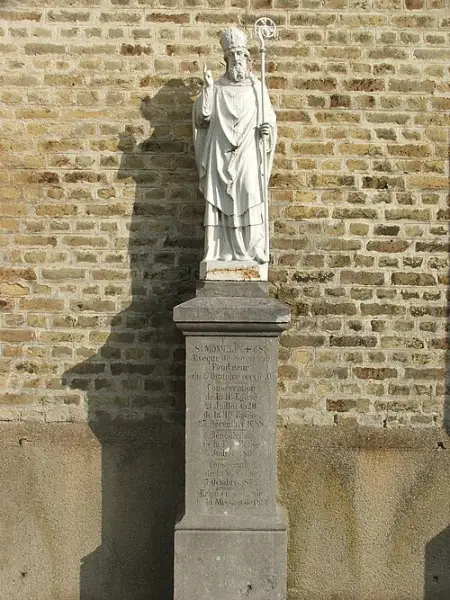
The memory of Mummolin has endured on both sides of the Franco-Belgian border for more than thirteen centuries. He is honoured in the dioceses of Noyon and Tournai and in the Flemish lands of his mission on 16 October, the day the Gallican and Belgian martyrologies assign to his feast. The old life of him, probably written in the eighth century, furnished the materials on which the later hagiographers drew, and its testimony to his eloquence in two tongues kept alive the picture of a missionary at home among Latin clerics and Flemish villagers alike. His companions overshadowed him in fame, for Bertin gave his name to the great abbey of Sithiu and Omer to the city that grew around it, yet Mummolin kept his own memorials: the village of Saint-Momelin preserves his name at the site of the Old Monastery, where a statue of the saint stands, and the cathedral of Noyon enshrined his body among its treasures. The hagiographers of every age, from Baring-Gould to the monks of Ramsgate, have retold his story for new generations. Few missionaries of the Columbanian movement can show so long a chain of remembrance running from the marshes of the seventh century to the guidebooks of our own.
§ Hagiography
Timeline
- 659
Chosen Bishop of Noyon and Tournai upon the death of St Eligius; Butler dates the consecration to 659 or 665.
§ Butler's account
- 686
Died after governing the see of Noyon and Tournai for twenty-six years; some accounts place his death about 680 or in 683.
§ Life
In Their Own Words
A French Saint, successor of Saint Eligius or Eloy as Bishop of Noyon. He died A.D. 680 about.
The Record
- Major works
- The Old Monastery near Saint-Omer·The new abbey of Sithiu, later the Abbey of Saint Bertin
- Canonization
- Pre-congregation; venerated from the early medieval Church
Prayer
Bibliography
Show 4 sources
- Baring-Gould, Sabine (1897), The Lives Of The Saints, vol. 12, October, Pt. 2, London: J. C. Nimmo, retrieved 2021-08-15
- Butler, Alban (1833), The Lives of the Fathers, Martyrs, and Other Principal Saints, vol. 2, Coyne, retrieved 2021-08-15
- "Saint Mummolinus of Noyon", CatholicSaints.info, 16 October 2013, retrieved 2021-08-15
- St. Augustine's Abbey, Ramsgate (1921), The Book of Saints: A Dictionary of Servants of God Canonized by the Catholic Church, London: A. & C. Black, ltd., retrieved 2021-07-26
Profile text adapted from the Wikipedia article, licensed CC BY-SA 4.0.
Pray with this saint every day
Save St. Mummolin of Noyon to your favorites, read the full profile, and get feast-day reminders in the Saints app.
Get the Saints AppFree on the App Store for iPhone and iPad