
died c. 679·Feast November 18
St. Mummolus of Fleury
Second Abbot of Fleury and relic-bearer
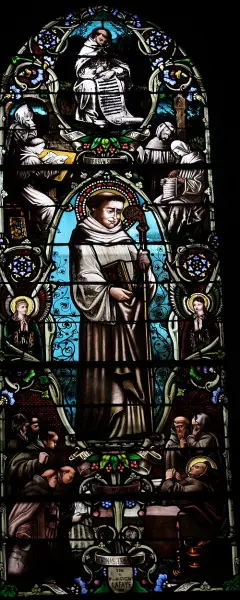
Overview
Mummolus, whose name appears also as Mommolin or Mommole, ruled the Loire monastery of Fleury, the abbey now known as Saint-Benoît-sur-Loire, for thirty years between September 632 and January 663, and is reckoned its second abbot. His abbacy is remembered above all for one of the boldest enterprises of Merovingian monasticism: the transfer of the relics of St Benedict of Nursia, the founder of Western monasticism, and of his sister St Scholastica, from Monte Cassino to Fleury. In 660 he sent a monk of his community to the ruined monastery in Italy with the mission of carrying off the saints' remains, an undertaking blessed by a dream of Aigulphus and accomplished with monks from Le Mans. The arrival of Benedict at Fleury brought the abbey immense prestige and streams of pilgrims, and gave the town its modern name. In his last years Mummolus undertook the long pilgrimage to Compostela; coming home worn out, he was welcomed by the Benedictines of Sainte-Croix in Bordeaux, where he died, soon after 679, with a reputation for holiness that the people of the city never forgot.
The Complete Life
Shepherd of a Young Abbey
Fleury Abbey had been founded in the seventh century by Leodebod, abbot of Saint-Agnan of Orléans, on ground beside the Loire, and Mummolus became its second or third father, according to the differing reckoning of the sources. His tenure was long and momentous: thirty years of rule, counted from September 632 to January 663, spanning the most delicate decades of a young foundation's life. The abbot of a house like Fleury was a builder, administrator, and spiritual guide at once, answerable for the fields and the oratory, the guests and the choir. Mummolus proved equal to the charge, and his name attaches to the act that changed the abbey's destiny forever. It was he who conceived that the poor and ruined monastery on Monte Cassino, its founder's grave desecrated by the Lombards, should yield up its treasure to a living house that could guard it. Whatever judgement may be made of the means, the purpose was conceived in the fearless logic of an age that believed relics belonged where they could be most fruitfully venerated, and Fleury under Mummolus claimed that place.
§ Life
The Translation of St Benedict
In 660 Mummolus dispatched one of his monks to Monte Cassino, the monastery ruined by the Lombards, with the deliberate mission of stealing the relics of St Benedict and St Scholastica from their grave in the church. The monk did not go alone: he was accompanied by religious from the monastery of Mans, and together they succeeded. Adrevald of Fleury preserves the fuller story, telling how a Fleury monk named Aigulphus was shown in a dream that the two saints' tombs lay ruined, and how Mummolus thereupon granted him leave to attempt their rescue. Miraculous aid, the account says, led the party to the tomb and helped them smuggle the bodies home to Gaul. Scholastica's remains went to Mans, where a new monastery rose to receive them; those of Benedict were carried to Fleury. Mummolus intended his burial in the church of Saint Peter, yet a beam of miraculous light poured out from the smaller church dedicated to the Virgin, and the sign was accepted by all as meaning that the father of monks was to rest in her church instead, where his tomb drew the ages of pilgrims that followed.
§ Life
Pilgrim to Compostela
At the end of his life the old abbot undertook the longest journey of his years, the pilgrimage to the shrine of St James at Santiago de Compostela. Exhausted by the road, he turned homeward through Béarn and then crossed the Landes de Gascogne, that belt of moorland and pine where travellers fainted for want of water. At Aureilhan he stopped, and there the tradition says he made a spring of fresh water rise from the ground, a gift for the wayfarers who would come after him. When he reached Bordeaux in 679, worn out with the journey, the Benedictines of the abbey of Sainte-Croix received him quickly and gladly, and in their house his last season was spent. In that city he acquired a reputation for holiness before he died, a reputation confirmed shortly afterwards by his death among them. The people of Bordeaux came out in great numbers for his funeral, and from that day forward they attributed to his intercession every benefit they received, keeping him as one of their own saints by affection rather than decree.
§ Life
Saint-Benoît-sur-Loire and the Disputed Grave
The translation that Mummolus set in motion made Fleury's fortune and changed the map of French pilgrimage. The abbey town took from the translation the very name it bears today, Saint-Benoît-sur-Loire, Benedict upon the Loire, and the possession of the founder of the Benedictine order brought the monastery great prestige, drawing many pilgrims who, moved by the miracles worked through the saint, made donations that enriched the house for centuries. The story, however, has always had its challengers. The monks of Monte Cassino dispute it to this day, and their own shrine of St Benedict in the abbey church on the mountain remains a place of pilgrimage for the founder's followers, so that the two great houses guard a rivalry more than thirteen centuries old. Some sources place the reception of the relics at Fleury not in Mummolus' day but on 11 July 703. The abbot's memory otherwise survives thinly in art, for his iconography is rare; the chief example is Guillaume Cureau's painting of 1647 in the abbey church of Sainte-Croix at Bordeaux, showing Saint Mommolin healing a possessed person.
§ Life
Timeline
- Sep 632
Became abbot of Fleury Abbey, beginning a thirty-year tenure recorded as running from September 632 to January 663.
§ Life
- 660
Sent a monk of Fleury, joined by monks of Le Mans, to Monte Cassino to retrieve the relics of St Benedict and St Scholastica.
§ Life
- Jan 663
His thirty-year abbacy is recorded as extending to January 663.
§ Life
- 679
Arrived exhausted in Bordeaux at the end of a pilgrimage to Santiago de Compostela; welcomed by the Benedictines of Sainte-Croix Abbey, he died there shortly afterwards.
§ Life
- 11 Jul 703
Some sources date the reception of St Benedict's relics at Fleury to 11 July 703 rather than to Mummolus' own day.
§ Life
- 1647
Guillaume Cureau painted Saint Mommolin healing a possessed person for the abbey church of Sainte-Croix in Bordeaux.
§ Iconography
The Record
- Major works
- The translation of the relics of St Benedict of Nursia to Fleury Abbey·The relics of St Scholastica given to Le Mans, where a new monastery was founded for them
- Symbols
- depicted healing a possessed person, after the painting by Guillaume Cureau
- Canonization
- Pre-congregation; honoured by popular veneration, especially at Fleury and Bordeaux
Prayer
Bibliography
Show 5 sources
- "An Abbot of the Tenth Century", The Month and Catholic Review, I (XX), London: Simpkin, Marshall, and Company, January–April 1874, retrieved 2021-08-16
- Head, Thomas (2005), Hagiography and the Cult of Saints: The Diocese of Orléans, 800-1200, Cambridge University Press, ISBN 0521365007, retrieved 2021-08-16
- Laporte, J. (1969), "L'Abbaye de Fleury", Dictionnaire d'histoire et de géographie ecclésiastiques, vol. XVII, Paris: éditions Letouzey & Ané
- Mostert, Marco (1987), The Political Theology of Abbo of Fleury: A Study of the Ideas about Society and Law of the Tenth-century Monastic Reform Movement, Uitgeverij Verloren, ISBN 9065502092, retrieved 2021-08-16
- Watkins, Basil (November 19, 2015), "Mummolus (Mommolus, Mommolenus)", The Book of Saints: A Comprehensive Biographical Dictionary, Bloomsbury Publishing, ISBN 9780567664150, retrieved 2021-08-16
Profile text adapted from the Wikipedia article, licensed CC BY-SA 4.0.
Pray with this saint every day
Save St. Mummolus of Fleury to your favorites, read the full profile, and get feast-day reminders in the Saints app.
Get the Saints AppFree on the App Store for iPhone and iPad