
290 – 310·Feast November 17
St. Munditia
Virgin and martyr of the Roman catacombs
Overview
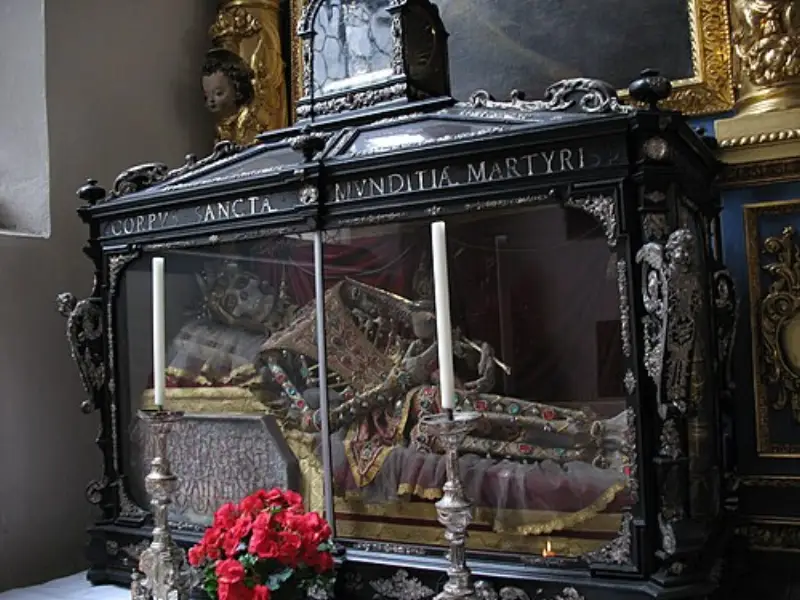
Munditia, sometimes given as Mundita, is venerated as a Christian virgin and martyr, a woman of the age of persecution whose remains rest today in Munich. Born about 290 in Piasca in Hispania, she lived through the tumultuous final decades of pagan Rome and died at Rome about 310, according to a reading of her epitaph that places her death in the consulate of Andronicus and Probus. Her memorial slab, which originally sealed the arcosolium of her grave in the catacombs, commends Munditia Protogenia, who lived sixty years and passed peacefully into eternity; a Roman document of authenticity reads the mysterious letters APC as describing her death by beheading. Her relics were translated from the catacombs of Cyriaca at Rome to Munich in 1675 and set in a Baroque shrine consecrated in 1677 in St. Peter's Church, the church Munichers call the Alter Peter. There her gilt and gem-studded skeleton, with false eyes in its netted skull, lies in a glass case at a side altar. Her feast is kept on 17 November, and she is honoured as patron of single and unmarried women.
The Complete Life
A Daughter of Hispania
Munditia is recorded as having been born about the year 290 at Piasca, in the Roman province of Hispania, the mountain country of the Spanish northwest. She was born, if the dating holds, into a generation that would know the last and fiercest of the persecutions, the great assault on the Church launched at the turn of the fourth century, and the peace that followed it. Nothing else of her family or her childhood has survived; her name itself comes down in the double form of Munditia Protogenia, carved into the slab that closed her grave, and even that was recovered rather than remembered. The early accounts say simply that she lived through those tumultuous times and embraced her faith with an ardour that would eventually lead to her martyrdom. Whatever brought her from Spain to Rome, whether family, fortune, or the movement of Christians toward the city where Peter and Paul had died, she was in the capital of the empire at the moment when her faith would be demanded of her at the highest price. That she was ready to pay it is the one thing about her that the centuries have never doubted.
§ History
The Martyrdom and the Inscription
Munditia died at Rome about the year 310, a martyr of the faith in the generation when the storms of persecution were only beginning to break. The evidence for the manner of her death lies in the strange letters APC cut at the end of her epitaph. The Roman document of authenticity that accompanied her relics states that they mean ASCIA PLEXA CAPITA, that she was beheaded with a hatchet, and so they describe her martyrdom. Another reading takes the letters for ANDRONICO PROBO CONSULIBUS, fixing her death to the consulate of Andronicus and Probus, which would place it in the year 310. Her epitaph, still legible after so many centuries, commends her with the reserved dignity of the early Christian lapidaries: it records the devout remembrance of Munditia Protogenia, a woman of sixty years called worthy of honour, whose passing into eternity, fifteen days before the Calends of December, was a peaceful one. The word peacefully, set over a death by the executioner, carries the quiet defiance of a community that knew what its martyrs had won. The sixty years her epitaph claims for her would make her, if taken exactly, an aged martyr, a woman whose confession was the crowning of a whole lifetime of faith.
§ Inscription
From the Catacombs to Munich
In 1675 Munditia's relics were brought up from the catacombs of Cyriaca at Rome and translated to Munich, part of the great movement by which the bones of the early martyrs were carried north to adorn the churches of the Catholic restoration. Two years later, on 5 September 1677, the Baroque shrine prepared for her in St. Peter's Church was consecrated, and there her remains were displayed in the fashion of the age: a skeleton covered in gilt and set with gems, false eyes placed in the skull, the head wrapped in netting, the whole enclosed in a glass case at a side altar. The century of Enlightenment did not know what to do with her; in 1804 her relics were hidden behind a wooden shrine, and for almost eighty years the martyr stood out of sight. In 1883 the covering was taken away, and interest in her cult revived. Her feast on 17 November is now celebrated in the church each year with a High Mass and a candlelit procession, and she is honoured as the patron of single and unmarried women.
§ History
The Saint in the Glass Case
Munditia has kept her hold on the imagination of Munich and of visitors from far beyond it. The jewelled skeleton in the Alter Peter is one of the striking images of the city's oldest parish church, at once a relic of the Roman catacombs and a masterpiece of Baroque piety, and it has drawn to her side worshippers, tourists, and poets. Among the latter, Vahni Capildeo gave her a poem, Saint Munditia, in the collection No Traveller Returns of 2003, imagining the saint raised out of her grave more than thirteen hundred years after the flesh had left her bones, and returned to stand among the living in church. Despite the obscurity of her origins and the mystery that surrounds almost every circumstance of her life, she is venerated for the steadfastness in faith that her death implies, and she stands as patron to single women and spinsters, for whom her solitary dignity has a particular meaning. A martyr known only by her name, her years, and her epitaph remains, thirteen centuries after her burial, a living presence in a Bavarian church.
§ Cultural references
Timeline
- 290
Born at Piasca in the Roman province of Hispania, according to the traditional dating of her life.
§ History
- 310
Suffered martyrdom at Rome; her epitaph's letters APC may record her death in the consulate of Andronicus and Probus.
§ Inscription
- 1675
Her relics were translated from the catacombs of Cyriaca at Rome to Munich.
§ History
- 5 Sep 1677
Her Baroque shrine in St. Peter's Church, Munich, was consecrated.
§ History
- 1804
Her relics were hidden from sight behind a wooden shrine, a token of the changed temper of the times.
§ History
- 1883
The wooden covering was removed, restoring public interest in her cult.
§ History
- 2003
Vahni Capildeo's poem Saint Munditia appeared in the collection No Traveller Returns.
§ Cultural references
In Their Own Words
In devout remembrance of Munditia Protogenia. The commendable. Who lived 60 years. Who passed peacefully into eternity 15 days before the Calends of December APC
The Record
- Patron of
- single and unmarried women·spinsters
- Symbols
- a gilt-covered, gem-studded skeletal relic in a glass case
- Canonization
- Pre-congregation; venerated as a virgin and martyr from the evidence of her ancient inscription
Prayer
Bibliography
Show 4 sources
- "Die heilige Munditia". Archived from the original on 14 April 2011. Retrieved 2 December 2016
- "Munich Travel Guide - Frommer's". Retrieved 2 December 2016
- "Munditia - Catholic Saints Day". catholicsaints.day. 2023-07-07. Retrieved 2025-01-22
- Vahni Capildeo, No Traveller Returns (Salt Publishing, 2003), 163
Profile text adapted from the Wikipedia article, licensed CC BY-SA 4.0.
Pray with this saint every day
Save St. Munditia to your favorites, read the full profile, and get feast-day reminders in the Saints app.
Get the Saints AppFree on the App Store for iPhone and iPad