
518 – 614·Feast January 13
St. Mungo
Missionary of Strathclyde and founder of Glasgow
Overview
Kentigern (Welsh Cyndeyrn Garthwys), known by the affectionate pet name Mungo, meaning my dear one, was a missionary in the Brittonic kingdom of Strathclyde in the late sixth and early seventh centuries, and to Glasgow he gave both its founding and its patron saint. Born at Culross in Fife in 518, the son of the princess Teneu and, by the genealogies, of Owain, king of Rheged, he was raised by Saint Serf among the Picts before beginning his missionary labours on the Clyde at the age of twenty-five. There he built his church beside the Molendinar Burn, on the ground where Glasgow Cathedral now stands, and for thirteen years converted the district by preaching and austere example. Driven out by the anti-Christian King Morken, he withdrew through Cumbria to Wales, founded a cathedral at Llanelwy, made a pilgrimage to Rome, and then answered the invitation of King Riderch Hael to return to Strathclyde, evangelising Galloway from an episcopal seat at Hoddom before re-establishing himself at Glasgow, where Saint Columba is said to have visited and exchanged pastoral staves with him. Probably the first Bishop of Glasgow, he died there on 13 January 614. His tomb became the heart of the medieval city, and his four celebrated miracles live on in Glasgow's arms and motto.
The Complete Life
A Princess's Son, Born at Culross
Mungo's beginnings belong as much to legend as to history, but the tradition is unusually full. His mother Teneu was a princess, her father King Lleuddun ruling the lands about modern Lothian — perhaps, some think, the Gododdin of the Old North. She became pregnant by Owain mab Urien — by the British Library manuscript's account through violence, by other accounts through a love affair conducted while Owain was still married to Penarwen. Her furious father had the girl thrown from the heights of Traprain Law, but she survived, and was then set adrift in a coracle, in which she crossed the Firth of Forth to Culross in Fife. There, about the year 518, her son was born. A saintly household received the child: Saint Serf, then labouring among the Picts of that region, brought the boy up, and it was Serf who gave him the pet name by which Scotland knows him: Mungo, from the Cumbric equivalent of the Welsh for my dear one. His baptismal name, Kentigern, probably descends from the British Cuno-tigernos, joining the elements for hound and for lord. Of royal blood on both sides — his father Owain a king of Rheged — the foundling of Culross grew up in the household of a saint, formed for the work that would make him an apostle.
§ Life
Thirteen Years on the Clyde
At twenty-five, Mungo began the missionary labours that fixed his life's work. Taking his stand on the Clyde at what is now Glasgow, he raised his church on ground facing an extinct volcano, hard by the Molendinar Burn, where the medieval cathedral stands today. For some thirteen years he worked that district from a small cell in great austerity, drawing many to the faith by the holiness of his example and his preaching. The choice of ground was characteristic of Celtic monastic mission: a holy man, a cell, and a community gathering around him at a crossing of waters became the seed of a city. Even as a young man under Serf's eye he had shown the temperament that the miracle stories preserve — the boy who restored the robin his companions had killed, and who revived the dead fire of the monastery with a hazel branch when he woke to find his watchfulness had failed. Those early signs of quickening life where death and cold had been became the emblem of his vocation: to bring the faith to a Brittonic people whose Christianity was being lost, and to be, as the genealogies and traditions suggest, the first apostle of Strathclyde.
§ Life
Exile, Wales, and the Return to Strathclyde
Mungo's mission was interrupted by politics. Within Strathclyde a powerful movement against the Christian faith, led by King Morken, forced him to withdraw from the district, and he retired toward Wales by way of Cumbria, where ancient churches at Bromfield, Crosthwaite, Dearham, and elsewhere preserve the memory of his passage. He spent a while with Saint David in his monastery at St Davids, then pressed on into Gwynedd, where at Llanelwy — the St Asaph of English — he established a cathedral, setting his disciple Asaph over it as bishop in his stead. While in Wales he undertook a pilgrimage to Rome. The turning of his fortune came with a change of throne: Riderch Hael, the new king of Strathclyde, invited Mungo to return to his kingdom, and he went back, taking up for some years an episcopal seat at Hoddom in Dumfriesshire and evangelising the district of Galloway from there. Excavations at Hoddom have since brought to light a late sixth-century stone baptistery, confirmation of early Christian work there. He made his way back to Glasgow at last, and a large community gathered about him; and it was close by, at Kilmacolm, that Saint Columba, then at work in Strathtay, came to see him: the two saints fell into one another's embrace, talked long together, and swapped their pastoral staves.
§ Life
The Four Signs of Glasgow
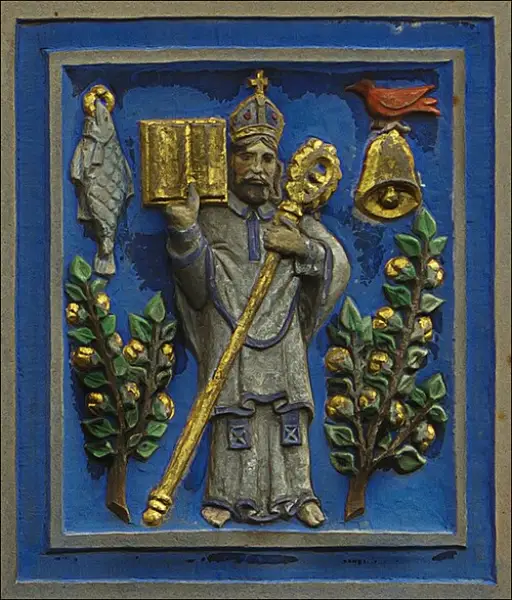
The Life of Saint Mungo records four miracles performed in Glasgow, and a traditional rhyme gathers them under four emblems: the bird that never flew, the tree that never grew, the bell that never rang, and the fish that never swam. Each sign speaks of life raised where loss seemed total. The robin that his schoolfellows had killed was restored to life at his prayer; the fire he had let go out in Saint Serf's monastery was rekindled from a hazel branch; the bell, held to have been carried from Rome in Mungo's own keeping, sounded in the church's services and tolled for the dead, its medieval original surviving in later copies; and the ring that Queen Languoreth of Strathclyde had lost — her husband King Riderch having secretly thrown it into the Clyde and demanded she produce it — was found inside the belly of a fish his messenger caught, clearing the queen of a false charge of infidelity. Whether read as wonder or as parable, the four deeds fixed the imagination of the city: they pass on the conviction that the saint's God gives back the dead bird, the cold hearth, the silenced bell, and the good name of the accused.
§ Miracles
Old Age and Death on 13 January
Mungo lived to an extreme old age, and the tradition preserves his infirmity with what scholars judge a ring of authenticity: in his last years he became very feeble, so feeble that his chin had to be held in place with a bandage — a detail of bodily decay too undignified to be invented for a founder's legend. The tradition says that his death came as he bathed, on a Sunday, the 13th of January, in the city of Glasgow, at ninety-five or ninety-six years of age. The dating of his death has been debated: the year is sometimes given as 603, and the Annales Cambriae record 612, while the received date is 614 — 13 January fell on a Sunday in both 603 and 614, which may account for the divergence. David McRoberts argued that the reported death in the bath is a garbled memory of a collapse during a baptismal service, a reading that would give the old bishop a liturgical rather than a domestic ending. A fragmentary manuscript of the late fifteenth century, generally called Lailoken and Kentigern, sets Mungo at odds with the mad prophet Lailoken, whom some knew as Merlin, tying the close of his career to the same Strathclyde world of Riderch Hael and Arfderydd in which his later years were spent.
§ Analysis
The Shrine Below the Cathedral
Mungo was venerated from the early middle ages without any formal canonization. Over the place of his burial rises the cathedral that bears his name; the shrine within its crypt drew Christian pilgrims in great numbers until the Scottish Reformation, and his remains are believed to lie there yet. A spring, St Mungo's Well, ran eastward from the apse. Through all Scotland his festival was observed on 13 January; the Bollandists printed a special mass for the feast whose text goes back to the thirteenth century; in the East, the Greek Orthodox tradition keeps him on 13 January and the Russian Orthodox Church on the 14th, while the Church of England commemorates him on the same January date. The city's coat of arms displays his four miracles, and Glasgow's two mottoes, both the religious and the more secular form of Let Glasgow flourish, derive from his own call that the city should flourish by the preaching of God's word. His name sanctified the waters of Britain far from Glasgow: Saint Mungo's Well at Copgrove near Ripon in North Yorkshire was long believed effective for treating rickets. Few founders of cities have remained so continuously present in the devotion, heraldry, and speech of the place they founded.
§ Veneration
Churches, Schools, and a Charity in His Name
During his years as archbishop of Strathclyde Mungo established a number of churches, Stobo Kirk the most notable among them, and St Kentigern's Church at Lanark is said to have been established by the saint himself shortly before his death. His dedications now blanket Britain and reach far beyond it: churches at Townhead and Dennistoun in Glasgow, at Kilmarnock, Cumbernauld, Falkirk, Blackpool, Melling on Merseyside, Fallowfield in Manchester, Grinsdale, and the Cumbrian villages of Mungrisdale, Caldbeck, Bromfield, Castle Sowerby, Crosthwaite, Dearham, and Irthington, two Greek Orthodox communities in Cumbria, a church at Eyeries on the Beara peninsula in Ireland, and Saint Mungo's United Church at Cushing, Quebec, built in 1836. Schools keep his name too: St Mungo's Academy in Bridgeton, St Kentigern's Academy opened at Blackburn, West Lothian in September 1974, St Mungo's High School in Falkirk, and Saint Kentigern College and its allied schools in Auckland, New Zealand; at St Asaph there is a St Kentigern Hospice. In London, the Glasgow-born Harry Stone named the homeless charity St Mungo's for the patron saint of the city where he was born; established in 1969, it runs hostels, outreach, shelters, and a free Recovery College.
§ Namesake churches, schools and charities
Timeline
- 518
Born at Culross in Fife, where his mother Teneu had drifted in a coracle across the Firth of Forth.
§ Life
- 573
Battle of Arfderydd, where the prophet Lailoken appeared; the victory is linked to Riderch Hael's rise and Mungo's return to Strathclyde.
§ Analysis
- 597
His father Owain mab Urien met his death in battle against Bernicia.
§ Life
- 13 Jan 614
Died at Glasgow in the kingdom of Strathclyde, aged 95 or 96, said to have died in his bath.
§ Life
- 1185
Jocelin of Furness produced his Life of Saint Mungo, reworking an older legend of Glasgow together with an Old Irish document.
§ Biographers
- 1321
Kirkmahoe in Dumfriesshire, where Kentigern is honoured as Mo Choe, recorded as the church of Saint Kentigern in the Arbroath Liber.
§ Name
- 1503
St Mungo's Chapel founded at Culross on the site traditionally regarded as his birthplace.
§ Namesake churches, schools and charities
- 1817
The present St Mungo's Parish Church built at Alloa, replacing a medieval chapel dedicated to him.
§ Namesake churches, schools and charities
- 1926
The silted ruins of the Culross birthplace chapel excavated; the site is now a scheduled monument.
§ Namesake churches, schools and charities
- 1949
LNER Peppercorn Class A1 steam locomotive 60145, named Saint Mungo, entered service with British Railways.
§ Veneration
- 1959
Glasgow Fire Brigade's fireboat St Mungo began serving the Clyde, remaining in use until 1975.
§ Veneration
- 1969
The London homeless charity St Mungo's established, named for his birth city's patron by the Glasgow-born Harry Stone.
§ Namesake churches, schools and charities
- Sep 1974
St Kentigern's Academy opened at Blackburn, West Lothian.
§ Namesake churches, schools and charities
In Their Own Words
Here is the bird that never flew / Here is the tree that never grew / Here is the bell that never rang / Here is the fish that never swam
Let Glasgow flourish by the preaching of the word
The Record
- Major works
- Church on the Molendinar Burn at Glasgow, predecessor of Glasgow Cathedral·Cathedral foundation at Llanelwy (St Asaph), Wales·Episcopal seat and mission base at Hoddom, Dumfriesshire·Stobo Kirk and other churches of Strathclyde
- Patron of
- patron of Glasgow·patron of Scotland·patron of Penicuik·patron of salmon·those accused of infidelity·against bullies
- Symbols
- Bishop with a robin on his shoulder·holding a bell·a fish with a ring in its mouth
- Canonization
- Pre-congregation; venerated from the early middle ages, his shrine at Glasgow Cathedral a great centre of pilgrimage until the Scottish Reformation.
Prayer
Bibliography
Show 6 sources
- Baring-Gould, Sabine & Fisher, John (1907: 2000). Lives of the British Saints. 8 vols. Felinfach: Llanerch.
- Davies, John Reuben, "Bishop Kentigern among the Britons", in Boardman, Steve, John Reuben Davies, Eila Williamson (eds), Saints' Cults in the Celtic World. Woodbridge: Boydell Press, 2009.
- Wade-Evans, A. W. (1934). Welsh Christian Origins. Oxford: Alden Press.
- Hale, Reginald B. (1989). The Beloved St. Mungo, Founder of Glasgow. University of Ottawa Press. ISBN 978-0-7766-0227-1.
- Rees, Elizabeth (2000). Celtic Saints: passionate wanderers. London: Thames & Hudson.
- Chesterton, G. K. (1911). The Innocence of Father Brown.
Profile text adapted from the Wikipedia article, licensed CC BY-SA 4.0.
Pray with this saint every day
Save St. Mungo to your favorites, read the full profile, and get feast-day reminders in the Saints app.
Get the Saints AppFree on the App Store for iPhone and iPad