
1841 – 1917·Feast January 30
St. Mutien-Marie Wiaux
Christian Brother and teacher of Malonne
Overview
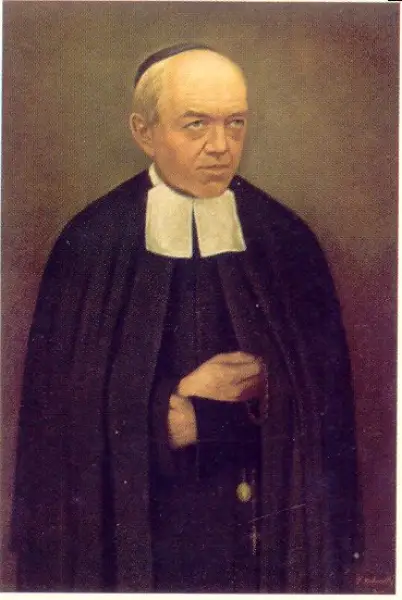
Mutien-Marie Wiaux, born Louis-Joseph Wiaux, was a Belgian Brother of the Christian Schools who spent fifty-eight years as a teacher at a single school and is honoured as a saint by the Catholic Church. He was born on 20 March 1841 in the village of Mellet in Hainaut, the third of six children of a blacksmith and a café-keeper, in a home where the day ended with the family rosary. A gentle, pious boy unsuited to his father's trade, he entered the Brothers' novitiate at Namur on 7 April 1856 and received the religious name Mutien-Marie. After assignments at Chimay and Brussels he was sent in 1859 to the Institut Saint-Berthuin, a boarding school at Malonne, and he taught there until his death. Judged a failure at first, he grew with patience into an effective teacher of music and art, Prefect of discipline, and a brother famous for his readiness in every need. He died on 30 January 1917, was beatified in 1977 by Pope Paul VI, and was canonized by Pope John Paul II on 10 December 1989.
The Complete Life
The Blacksmith's Son of Mellet
Louis-Joseph Wiaux was born on 20 March 1841 in Mellet, a small village in French-speaking Belgium now part of the town of Les Bons Villers, into a household where faith and work were woven together. His father was a blacksmith; his mother ran a café out of the family house, and in the evenings the customers came for beer and card games and the easy fellowship of the village. When the last of them had gone, the family closed the day as it opened it, by praying the rosary together. The boy grew up the third of six children, gentle and obedient, and marked by a piety that set him apart: his schoolmates were led by his example to pray at the local church when the school day ended. When his schooling was finished he was apprenticed in his father's shop, and there he discovered that both his body and his temperament were unfit for the forge. Meanwhile another call had been quietly taking root, and he thought at first of following his brother into the Society of Jesus. The village gave him little book learning, but it gave him the two things his later life would draw upon constantly: the habit of daily prayer and an instinct for the company of ordinary people.
§ Early life
The Brothers of the Christian Schools
The pastor of Mellet, the Abbé Sallié, redirected the boy's longing toward the Brothers of the Christian Schools, the community often called the Christian Brothers, who were then preparing to open a school at Gosselies close by. Louis sought them out, and came away convinced that this was the life he wanted. He made his way to Namur and on 7 April 1856 was received into the Brothers' novitiate; the next July he took the habit, together with the religious name Mutien-Marie, Mutien in honour of the ancient Roman martyr Mucian. In the novitiate he won a double reputation: he kept the Rule of the Institute with a strictness that everyone noticed, and he kept, at the same time, a sense of humour so reliable that his fellow novices enjoyed his company. Both traits would remain his for life, the exactness and the cheerfulness, and neither ever cancelled the other. On 8 September 1857 he left the novitiate for his first school, sent to teach the children of Chimay, beginning the teaching career that would consume the rest of his days. He was sixteen years old when he took up the chalk, and he would lay it down only when he laid down his life.
§ Christian Brother
Fifty-Eight Years at Saint-Berthuin
From Chimay, Mutien moved the next year to the Institut Saint-Georges in Brussels, and in 1859 came the assignment that defined him: the Institut Saint-Berthuin at Malonne, now part of the city of Namur, a boarding school of the Brothers. He taught there for the next fifty-eight years, until his death. The beginning was discouraging. Combining the classroom with the spiritual life was hard for him, his students were disorderly and out of control, and his superiors judged his teaching so poor that, in an order that existed to teach, they weighed expelling him for the good name of the school. What saved him was patience, and the aid of the Brother who directed the school's Fine Arts department. Under that help he matured into an able teacher and prefect of discipline, his gentleness and piety counting for more than brilliance; music and art became his subjects, for he was a saint of feeling, not of learning. He taught catechism to the town's children in the parish church, and within the community he was the brother always available: comforting the homesick boy, or walking to the station to meet a traveller who did not know the city.
§ Christian Brother
A Hidden Life of Prayer
The sanctity of Mutien-Marie was made of ordinary materials used faithfully for an extraordinarily long time. His religious observance was exact; the Rule of the Institute was the frame of his days, and within it he gave whatever moments he could seize to prayer, in adoration at the tabernacle, or before Our Lady's grotto in the school grounds. His humour belonged to the same spiritual pattern, for it made him easy to live with in a community where he might easily have been difficult, the brother of strict observance whom the novices nonetheless sought out. He was not a scholar, and his gifts were of feeling rather than ideas: music, art, kindness, presence. In the classroom this became a pedagogy of patience, in the dormitory a ministry of comfort, in the parish a catechist's slow instruction of the town's children. Those who wrote his story afterwards found no dramatic events to relate, only fifty-eight years of the same fidelity, and it was precisely this that made his memory dear to the Brothers: a proof that the religious life, lived with constancy and good humour, is itself a path to the altars.
§ Christian Brother
The Last Winter
Mutien-Marie had enjoyed good health through nearly all his long life, until November 1916, in the middle of the war that occupied his country, when his strength broke and he had to be moved to the house infirmary. Even then he struggled to keep the community's rhythm of prayer, sharing in it as long as he could. On 26 January 1917, in bitter cold, he was discovered at the communion rail as the Brothers gathered for their first service of prayer, unmistakably weakened. The superior urged him back to the infirmary, and he never left it again. He died there on 30 January 1917, seventy-five years old, and two days afterwards was laid to rest in the Brothers' section of the cemetery at Malonne, the town he had served for more than half a century. Almost at once his fame began to spread. Miracles were attributed to his intercession, and the grave of the quiet art teacher became a place where the people of the region sought help, the first movement of the devotion that would carry his name across the universal Church.
§ Death
From the Town Cemetery to the Altars
The reputation of sanctity that followed his death drew so many pilgrims to Mutien's grave that the Brothers and the diocese resolved to bring his remains within easier reach of the faithful. Once the diocese had opened the process for his canonization, his body was transferred on 11 May 1926 into a new tomb hard by the parish church on Malonne's high street, where pilgrims could find him without difficulty. The cause advanced through the decades that followed. On 30 October 1977, Pope Paul VI beatified him in Vatican City; a shrine was built in his honour at Malonne in 1980, and his body was transferred yet again, into a tomb of white marble inside the shrine at Fond de Malonne, where they are venerated today. On 10 December 1989, Pope John Paul II canonized him in Vatican City, enrolling the schoolmaster of Malonne among the saints of the Catholic Church. The Brothers celebrate his feast on 30 January, the anniversary of his death, and the shrine beneath the hill of Malonne remains the centre of his cult. Between the grave in the town cemetery and the marble tomb of the shrine lies the whole modern history of his recognition by the Church.
§ Veneration
The Saint of Sensibility
Mutien-Marie Wiaux left no writings, no foundations, and no events that historians can date with drama; his legacy is the kind of holiness that is practised rather than performed. He is remembered among the Brothers of the Christian Schools as proof that their ordinary work, the classrooms and dormitories and parish catechism hours of a boarding school, can be a road to sanctity, and his own manner defined the road: patience with the unruly, gentleness with the weak, music and art as instruments of the soul's formation, and unfailing availability to whoever needed him. He was, as his biographers liked to say, a saint of sensibility and not of intellect, and that description has made him approachable to generations of teachers who did not feel brilliant either. At Malonne his shrine receives pilgrims, and his feast on 30 January is kept among the Brothers throughout the world. The man whose superiors once considered expelling him for incompetence ended as the canonized glory of his Institute, and the school where he failed so badly at first keeps his name in honour forever.
§ Life
Timeline
- 20 Mar 1841
Born Louis-Joseph Wiaux at Mellet, Hainaut, third of six children in a devout Catholic family.
§ Early life
- 7 Apr 1856
Entered the novitiate of the Brothers of the Christian Schools at Namur; received the habit the following July with the name Mutien-Marie.
§ Christian Brother
- 8 Sep 1857
Left the novitiate to teach at the Brothers' elementary school in Chimay.
§ Christian Brother
- 1858
Assigned to the Institut Saint-Georges, another of the Brothers' elementary schools, in Brussels.
§ Christian Brother
- 1859
Assigned to the Institut Saint-Berthuin, a boarding school at Malonne, where he would teach for the next fifty-eight years.
§ Christian Brother
- Nov 1916
His health gave way markedly and he was moved to the infirmary, still fighting to hold his place in the community's prayers.
§ Death
- 26 Jan 1917
Found praying at the communion rail in bitter cold; too weak to continue, he returned to the infirmary for the last time.
§ Death
- 30 Jan 1917
Died at Malonne; his burial followed two days after, in the Brothers' section of the town's cemetery.
§ Death
- 11 May 1926
Remains moved to a new tomb beside the parish church on the main street of Malonne, as his canonization process opened.
§ Veneration
- 30 Oct 1977
Beatified by Pope Paul VI in Vatican City.
§ Veneration
- 1980
A shrine built in his honour at Malonne; his remains moved to a white marble tomb within it.
§ Veneration
- 10 Dec 1989
Canonized by Pope John Paul II in Vatican City.
§ Veneration
The Record
- Canonization
- Canonized by Pope John Paul II on 10 December 1989 in Vatican City, after beatification by Pope Paul VI on 30 October 1977
Prayer
Bibliography
Show 3 sources
- "Saint Mutien-Marie Wiaux". Institute of the Brothers of the Christian Schools. Archived from the original on 11 May 2006. Retrieved 5 January 2013
- "La vie". Sanctuaire du Frère Mutien-Marie de Mallone (in French). Archived from the original on 21 December 2012. Retrieved 5 January 2013
- "San Muziano Maria Wiaux". Santi, Beati e Testimoni (in Italian). Retrieved 5 January 2013
Profile text adapted from the Wikipedia article, licensed CC BY-SA 4.0.
Pray with this saint every day
Save St. Mutien-Marie Wiaux to your favorites, read the full profile, and get feast-day reminders in the Saints app.
Get the Saints AppFree on the App Store for iPhone and iPad