
c. 250 – 350·Feast August 8
St. Myron of Crete
Archbishop of Crete and wonder worker
Overview
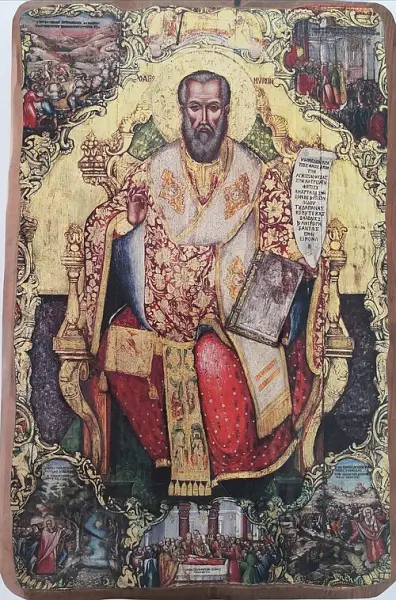
Myron of Crete, honored in the Orthodox tradition as Saint Myron the Wonder Worker, served as archbishop of Crete in the early generations of the island's Christian life. He was born around 250 at Aurakia, a settlement near Knossos, and his path to holiness began not in a church office but in the fields: he worked as a farmer and became known for open-handed generosity to the poor. Tradition places his public flourishing under the emperor Decius, an era that tested Christian leaders, and in time he shepherded the Cretan church from the town of Rhaukos. Stories gathered around him put charity before spectacle. Finding thieves one night at his threshing floor, he helped them lift a sack of grain onto their shoulders, and the unexpected kindness so shamed them that they gave up thieving for honorable work. Among the many wonders credited to him, the most celebrated was his mastery of the Triton River, whose flood he was said to have halted before walking across the water as if it were solid ground. Though liturgical books style him a holy martyr, ancient testimony reports that he died a natural and quiet death in 350, near his hundredth year. The land itself preserved his memory: the village of Rhaukos was renamed Agios Myron in his honor.
The Complete Life
A Farmer Near Knossos
Myron was born around the year 250 at Aurakia, a village near Knossos on the island of Crete, a place whose ancient name already carried the memory of centuries before the gospel reached the island. Nothing in the surviving accounts suggests that he came from rank or privilege. His formative years were passed in agricultural work, and the traditions that remember him paint a picture of a landowner whose fields fed more than his own household. He gained a reputation, recorded in the old directories of the saints, for being deeply charitable to those in need, and he seems to have treated the produce of his land as a trust held for neighbors as much as a livelihood. The most famous story of this period belongs to his threshing floor, where thieves broke in by night to carry off his grain. Instead of resisting them, Myron helped the men hoist a heavy sack onto their shoulders so that they could leave more easily. That single gesture of unguarded generosity accomplished what force never could: the ashamed thieves abandoned their raids and took up honorable lives. Such episodes made his name known well beyond his village long before any office in the church found him.
§ Myron of Crete
From the Fields to the Episcopate
The church of Crete called Myron out of his fields and eventually to its highest office. The sources place his public activity under the reign of the emperor Decius, in the middle of the third century, a period remembered chiefly for its persecution of Christians and one that demanded unusual courage from anyone who accepted leadership in the church. From his base at Rhaukos, a Cretan town whose name would eventually be exchanged for his own, he rose to become archbishop of Crete, bearing responsibility for the whole island's faithful. The transition from farmer to archbishop was not a break with his former life so much as a widening of it: the same liberality that had marked his treatment of the poor at his threshing floor now governed his care of the churches entrusted to him. Later writers counted him among the wonder workers, the thaumaturgoi whose prayers were believed to avail mightily for the people they served. Whatever the exact sequence of his ordination and elevation, the tradition is unanimous that the man who governed the Cretan church remained, in spirit, the charitable farmer of Aurakia, generous with grain, with counsel, and with himself.
§ Myron of Crete
Signs of Charity and Power
The wonders attributed to Myron belong to a tradition in which sanctity and power over nature went hand in hand, and in his legends the two are never separated from mercy. The men he caught stealing from him left as changed persons, converted not by punishment but by the shock of being helped. It was this reputation for holiness in daily dealing that gave weight to the greater signs remembered after his death. The most celebrated of these concerned the Triton River, which in flood threatened the surrounding country. According to the account preserved in Orthodox memory, Myron stopped the rushing water and then did what no rescuer would dare: he walked across the riverbed as though it were dry land. The story is told of him precisely because his neighbors already believed that the God who had softened his heart toward thieves could also subject a river to his word. Such deeds made him a figure of recourse for ordinary people facing floods, failed harvests, and the small violences of rural life. In the memory of the Cretan church he stands as a bishop whose power was gathered from charity, and whose charity was confirmed by signs.
§ Myron of Crete
A Name Settled into the Land
Myron is remembered as dying in the year 350, at about the age of one hundred, and the old records are careful to say that his end was natural and quiet, even though liturgical tradition continues to call him a holy martyr. His body was honored at Rhaukos, and reportedly found its way within roughly a century of his death to Eynesbury in Huntingdonshire, one of several places far from Crete that claimed his relics. His cult did not remain a local Cretan affair. In the ninth century the Holy Neot, the Cornish saint, dedicated a village in Cornwall to his memory, and Eynesbury itself venerated him as its patron. On Crete the homage was more direct: the village of Rhaukos took the name Agios Myron, Saint Myron, and bears it to this day, so that a traveler on the island walks through a place that is itself a memorial. The Orthodox Church keeps his feast on August 8, and the village church and the calendar together preserve what the sparse documents cannot: the continuous affection of a people for a farmer-archbishop who gave away his grain, shamed thieves into honesty, and was believed to walk on flooded waters.
§ Myron of Crete
Timeline
- 250
Born at Aurakia, near Knossos, on the island of Crete.
§ Myron of Crete
- 350
Died at about one hundred years of age, reportedly a natural and quiet death.
§ Myron of Crete
In Their Own Words
very charitable to the poor
died a natural and quiet death
as upon dry land
The Record
- Canonization
- Pre-congregation; venerated from antiquity as a holy martyr, though he is recorded as dying a natural death.
Prayer
Bibliography
Show 3 sources
- Holweck, Frederick George (1924). A Biographical Dictionary of the Saints: With a General Introduction on Hagiology. B. Herder Book Company. p. 726.
- Pashley, Robert (1837). Travels in Crete. Cambridge and London: J. Murray. p. 234.
- Orthodox Church in America, "Saint Myron the Wonderworker, Bishop of Crete"
Profile text adapted from the Wikipedia article, licensed CC BY-SA 4.0.
Pray with this saint every day
Save St. Myron of Crete to your favorites, read the full profile, and get feast-day reminders in the Saints app.
Get the Saints AppFree on the App Store for iPhone and iPad