
1st century·Feast Third Sunday of Pascha
The Holy Myrrhbearers
Women who carried myrrh to the empty tomb
Overview
In Eastern Orthodox Christian tradition the Myrrhbearers are the men and women whom the New Testament shows directly involved in the burial of Jesus or the discovery of his empty tomb. The name belongs chiefly to the women who came to the tomb early in the morning carrying myrrh to anoint the body and found it empty, but it also embraces Joseph of Arimathea and Nicodemus, who took the Lord down from the cross, anointed him with myrrh and aloes, wrapped him in clean linen, and laid him in a new tomb. The women had followed Jesus during his ministry in Galilee, supporting him and his followers from their own resources, and they stayed loyal through the terror of his arrest and execution, standing by the cross and following him to burial. Because the Sabbath was beginning, the burial preparations had been brief, and at the first moment after the Sabbath the women returned to finish their work of love. There the Resurrection was revealed to them, and they were sent to tell the Apostles, which is why tradition calls them, in effect, the apostles to the Apostles, and honors Mary Magdalene above all as equal to the Apostles. The Orthodox churches keep their feast on the Third Sunday of Pascha, the Sunday of the Myrrhbearers.
The Complete Life
Followers from Galilee
The women remembered as Myrrhbearers were not bystanders who happened upon the tomb, but disciples formed over the length of Jesus' ministry. The Gospels relate that they followed him during his preaching in Galilee and provided for him and for his other followers out of their own means, a service of material support that made them partners in the work from its beginning. When the ministry ended in arrest and execution, they did not withdraw as most of the disciples did. They remained faithful during the most dangerous hours, standing near the cross while he died, and they did not abandon him at death either: they accompanied the burial party, watched where the body was laid, and noted the location of the tomb. Burial, in the custom of the time, had to be hurried because the Sabbath was imminent, and Jewish practice called for mourners to revisit the grave on each of the three days following death. So the women's love had a liturgical shape as well as an emotional one: they went home to keep the Sabbath, prepared spices and myrrh, and returned at the earliest permitted moment to complete the anointing. Alongside them the tradition honors Joseph of Arimathea, a wealthy and probably council-ranking disciple who had kept his faith secret, and Nicodemus the Pharisee, who had first come to Jesus by night and now came in daylight to honor him.
§ Narrative and tradition
Witnesses of the Empty Tomb
The mission of the Myrrhbearers begins where grief expected to find a corpse. When the Sabbath had passed, the women returned to the tomb at the first possible moment, carrying myrrh to anoint the body, and it was there, at the grave, that the Resurrection was revealed to them. From that discovery flowed a commission: they were sent to carry the news to the Apostles, and the tradition draws the conclusion plainly, calling them in effect the apostles to the Apostles, and granting the myrrhbearing women, Mary Magdalene above all, the title equal to the Apostles. The Gospel lists preserve the names of this company with care: Mary Magdalene; Mary the mother of James and Joses; Mary the wife of Cleopas; Martha and Mary of Bethany, sisters of Lazarus; Joanna, wife of Chuza, steward of Herod Antipas; Salome, mother of James and John, the two sons of Zebedee; and Susanna, together with others whose names are not known. The evangelists do not tell the story uniformly. Mark ends abruptly with frightened silence, Matthew's women announce the news joyfully, Luke has the women telling the eleven apparently unprompted, and John focuses everything on Mary Magdalene's report to Peter and the Beloved Disciple. Through all the variation, the women remain the first human heralds of the Resurrection.
§ Names of the Myrrhbearers
The Credibility of Women's Testimony
Beyond devotion, the Myrrhbearers stand at the center of a long discussion about the historical character of the Resurrection accounts. In the synoptic Gospels, women repeatedly appear as the grammatical subjects of verbs of seeing, presented deliberately as eyewitnesses of the death, the entombment, and the discovery of the empty tomb. Scholars have observed that having women as the chief witnesses strengthens the credibility of the testimony, because a fabricator writing in the Jewish or Greco-Roman culture of the day would be expected to invent male, and numerous and important male, witnesses rather than leave the most crucial discovery to grieving women. C. H. Dodd judged the fourth Gospel's narrative self-authenticating on precisely this ground, arguing that no one would make up an appearance of the risen Jesus to Mary Magdalene, a little known woman. Richard Bauckham has added that the evangelists name precisely the women they knew as witnesses, scene by scene, with a scrupulous care that betrays an interest in accuracy. Objections have their answers as well: although some Mishnah passages restrict women's testimony, others permit it when no male witness is available, Josephus relied on female witnesses, and Mark's own theme is that only the outsiders, the women at the tomb included, ever really understood who Jesus was.
§ Role
The Sunday of the Myrrhbearers
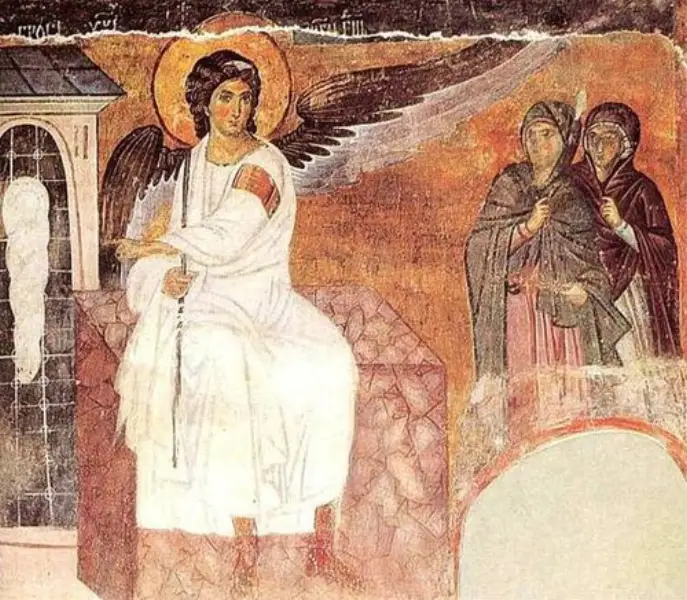
The churches of the East wove the Myrrhbearers permanently into the paschal season. In the Eastern Orthodox and Greek Catholic Churches the third Sunday of Pascha, the second after Easter, is kept as the Sunday of the Myrrhbearers, with appointed readings at Matins, the Divine Liturgy, and the Epistle and Gospel that underline the part these men and women played in the death and Resurrection of Jesus. Because the day commemorates the entombment as well as the empty tomb, hymns from Holy Saturday return, among them the troparion beginning with the noble Joseph and the vespers doxastikhon joining Joseph with Nicodemus; the following week is kept as the Week of the Myrrhbearers, and many of the individual women also have separate feasts in the Menaion. Every Sunday of the year carries their trace in the Hypakoë, the hymn whose name means sent, chanted at Matins and the Midnight Office in memory of the women dispatched to announce the Resurrection. Their memory filled art and architecture as well, from the White Angel of Mileševa in thirteenth-century Serbia to Orthodox cathedrals that bear their name and keep the Sunday of the Myrrhbearers as their patronal feast. In 2022 the Episcopal Church added Joanna, Mary, and Salome to its calendar as the myrrh-bearing women, with a feast on August 3.
§ Liturgical references
Timeline
- 1235
The White Angel fresco, depicting the myrrhbearers at Christ's grave, was created at Mileševa monastery in Serbia.
§ Myrrhbearers
- 2022
Joanna, Mary, and Salome were added to the Episcopal Church liturgical calendar as the myrrh-bearing women, with a feast on August 3.
§ Liturgical references
In Their Own Words
self-authenticating
scrupulous care
The Record
- Symbols
- Jar of myrrh
- Canonization
- Pre-congregation; honored in Eastern Orthodox, Greek Catholic, and, since 2022, Episcopal Church calendars.
Prayer
Bibliography
Show 8 sources
- Behrens, Hermann (1989). "Mark and the Female Witnesses". In Behrens, Hermann; Loding, Darlene; Roth, Martha T. (eds.). DUMU-E2-DUB-BA-A: Studies in honor of Åke W. Sjöberg. Philadelphia: Samuel Noah Kramer Fund, University Museum. ISBN 9780934718981.
- Bauckham, Richard (2006). Jesus and the eyewitnesses: The Gospels as eyewitness testimony. Grand Rapids, Mich. USA: Eerdmans. ISBN 978-0802863904.
- Byrskog, Samuel (2001). Story as history – History as story: The Gospel tradition in the context of ancient oral history. Tübingen: Mohr Siebeck. ISBN 3-16-147305-1.
- Witherington, Ben III (2006). What have they done with Jesus. San Francisco: Harper Collins.
- Dodd, C. H. (1953). The Interpretation of the Fourth Gospel. Cambridge: Cambridge University Press.
- Flavius Josephus. The Wars of the Jews. Book VII, section 389; Book IV, section 81.
- Ehrman, Bart D. (March 28, 2006). William Lane Craig and Bart Ehrman Debate "Is There Historical Evidence for the Resurrection of Jesus?". College of the Holy Cross, Worcester, Massachusetts.
- "General Convention Virtual Binder". www.vbinder.net. Retrieved 2022-07-22.
Profile text adapted from the Wikipedia article, licensed CC BY-SA 4.0.
Pray with this saint every day
Save The Holy Myrrhbearers to your favorites, read the full profile, and get feast-day reminders in the Saints app.
Get the Saints AppFree on the App Store for iPhone and iPad