
died after 462·Feast October 27
St. Namatius
Bishop of Clermont and builder of its first cathedral
Overview
Namatius governed the church of Clermont, then called Arvernis, as its eighth or ninth bishop, holding the see from 446 to 462. His episcopate is remembered above all for a great work of building: the first cathedral of the city, raised within the walls. Gregory of Tours, writing in the following century, preserved a striking account of the finished church, describing its cruciform plan, its nave fifty feet high, its seventy columns and forty-two windows, and the brightness and fragrance the devout perceived within it. When the building stood complete in its twelfth year, the bishop sent priests to Bologna in Italy to obtain relics of the martyrs Agricola and Vitalis, who had been crucified for the name of Christ, and brought them to his new foundation. Where and when he was born is not recorded, and he died at an unknown date after 462. The Catholic Church keeps his memory on October 27.
The Complete Life
A Bishop in Fifth-Century Arvernis
In the middle of the fifth century the city of Clermont in the Auvergne was still known by its ancient name of Arvernis, and there Namatius took up the office of bishop. He was the eighth or ninth man to occupy the see, succeeding Rusticus, and he governed it from 446 to 462, a span of sixteen years that carried the local church through some of the hardest decades of the late Roman world. The episcopal list preserved with his story places Eparchius after him, so that his sixteen years stand as a defined era in the life of the Christian community of the Auvergne. Nothing survives about his family, his upbringing, or the path that brought him to orders; his memory rests instead on what he did as a bishop rather than on where he came from. That record is substantial. A fifth-century bishop was the principal builder, administrator, and teacher of his city's Christians, and Namatius discharged that charge on a scale large enough that a historian of the next generation judged the work worth describing in detail for readers who could still walk through the building and see it with their own eyes.
§ Hagiography
The First Cathedral of Clermont
The great enterprise of Namatius's episcopate was the construction of Clermont's first cathedral, the older church that Gregory of Tours could still describe as standing within the city walls in his own day. It was a building of remarkable ambition for its time and place: a hundred and fifty feet in length and sixty in width, its nave rising fifty feet to the vault, closed by a round apse and flanked by finely built aisles, the whole laid out in the shape of a cross. Gregory counted forty-two windows and seventy columns in it, and eight doors opening into its space. He also recorded what the devout experienced there: a fear of God, a great brightness, and in the springtime a fragrance like spices hanging in the air. Around its altar the builder had ranged walls of varied workmanship, rich with many sorts of marble. Twelve years went into the work, and when it stood finished Namatius turned immediately to its consecration in spirit as well as stone, dispatching priests to Bologna in Italy to procure relics of Saints Agricola and Vitalis, martyrs whom the Church held to have been crucified in the name of Christ. Their remains came back to Clermont and were enshrined in the new cathedral, joining the bishop's architecture to the memory of the city's heavenly patrons.
§ Hagiography
Memory in Stone and Glass
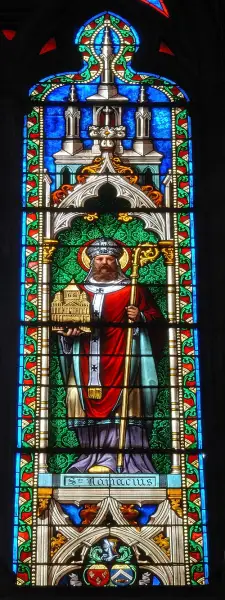
Namatius's cathedral outlived him by centuries, or at least it outlived the memory of him, for Gregory of Tours wrote his description while the church was still standing and in use. Through that description the bishop's achievement passed into the written inheritance of the Frankish church, one of the clearest surviving pictures of a great fifth-century basilica in Gaul, down to its measurements, its windows, its columns, and its eight doors. His own cult endured in a quieter register. The Catholic Church and the Eastern Orthodox Church both number him among the saints, and his feast is kept on October 27. Artistic memory of him persists at Clermont-Ferrand itself: a stained glass window in the Church of Saint-Eutrope there shows the saint, keeping his face before the faithful of the city whose first cathedral he raised. The line of the bishops of Clermont ran on after him through Eparchius and many successors, but the builder of the first church within the walls remained a fixed point in that succession, remembered as the man who gave the Arverni a worthy house for the worship of God and the relics of his martyrs.
§ Hagiography
Timeline
- 446
Became bishop of Clermont, then called Arvernis, as the eighth or ninth occupant of the see.
§ Hagiography
- 462
His episcopate of sixteen years came to an end; he died at an unknown later date.
§ Hagiography
In Their Own Words
He undertook the task of building the older church which is still standing and is contained within the walls of the city, one hundred and fifty feet in length, sixty in width
The Record
- Major works
- First cathedral of Clermont
- Canonization
- Pre-congregation; honored as a saint since antiquity by the Roman Catholic and Eastern Orthodox churches.
Prayer
Bibliography
Show 1 sources
- Gregory of Tours, History of the Franks, 2.16
Profile text adapted from the Wikipedia article, licensed CC BY-SA 4.0.
Pray with this saint every day
Save St. Namatius to your favorites, read the full profile, and get feast-day reminders in the Saints app.
Get the Saints AppFree on the App Store for iPhone and iPad