
3rd century – 363·Feast Unknown
St. Nana
Queen of Iberia converted by Saint Nino
Overview
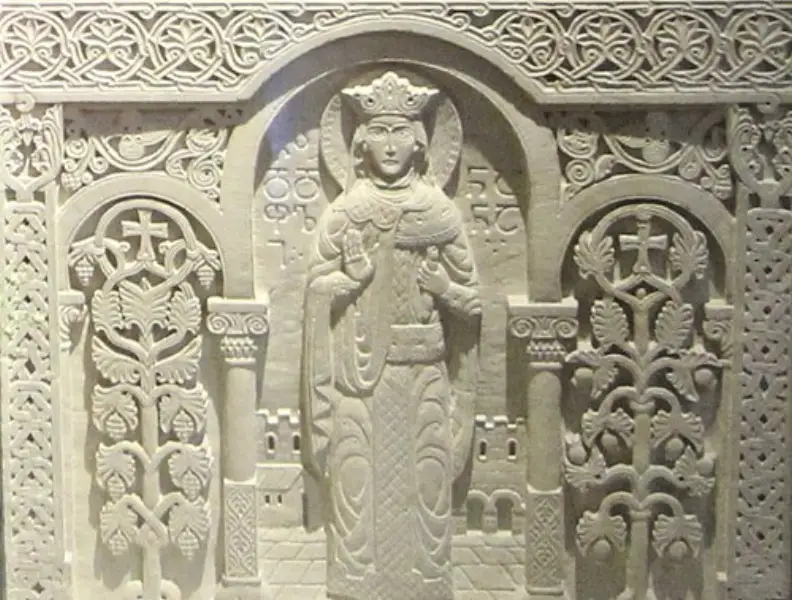
Nana reigned as the second wife of Mirian III, king of the ancient Caucasian realm of Iberia, in the fourth century, and for her part in her people's conversion to Christianity the Georgian Orthodox Church venerates her as Saint Equal to the Apostles Queen Nana. The Georgian chronicles describe her as coming from a Greek territory, Pontus, as the daughter of Oligotos, and scholars have connected her origin with the Bosporan Kingdom, a client state of the Roman Empire; some identify her father with a Bosporan dynast, others make her a daughter of the Bosporan king Theothorses. She married Mirian after the death of his first wife and bore him sons and a daughter who linked the royal house to the first Mihranid dynasty. A staunch pagan in her early queenship, she despised Christian preaching until a grave illness brought her to the missionary Nino, whose prayer restored her and whose instruction converted her. Through her, and through Nino's ministry, Mirian himself accepted Christianity around 337, and Iberia made the faith its official religion. She survived her husband by two years, dying in 363, and was laid to rest at Samtavro in Mtskheta.
The Complete Life
A Princess of Pontus
The Georgian chronicles give Nana a foreign origin: she came, they say, from a Greek territory, from Pontus, and her father was named Oligotos. What Pontus means in this record has occupied historians for generations. It may point to the Bosporan Kingdom on the northern shore of the Black Sea, then a client state of the Roman Empire, and the Bosporan connection is treated as the most likely reading of her birthplace. Cyril Toumanoff suggested that Oligotos preserves, in Georgian form, the name of Olympius or Olympus, a dynast of the Bosporus whose son, Aurelius Valerius Sogus Olympianus, held Rome's governorship at Theodosia and appears in a Greek inscription of the year 306, dedicated to the Most High God at the building of a Jewish prayer house. Christian Settipani, working along another line, identifies Nana instead as a younger daughter of Theothorses, a king of the Bosporus. Either reconstruction makes her a princess of a Hellenized royal house at the edge of the Roman world, born into the third century, whose marriage would carry her from the Black Sea to the mountain kingdom of Iberia in the Caucasus.
§ Family
Conversion Through Sickness
As queen of Iberia, Nana began as a fierce opponent of the faith she would one day spread. The medieval Georgian sources are plain about this: she was a staunch pagan who despised Christian preaching and wanted nothing to do with the message carried in her kingdom. Her change came not through argument but through affliction. Struck by a terrible disease, she was given no relief until she was brought to Nino, the Cappadocian Christian missionary then laboring in Iberia, whose prayer obtained her cure and whose teaching brought her to baptism and belief. The conversion of the queen was the prelude to the conversion of the kingdom. The Western tradition preserves an independent witness to the event: a full fifty years after Iberia's turning to Christ, Rufinus the Roman scholar set down his history from what Bacurius the Iberian had reported to him by word of mouth, and he likewise speaks of an unnamed queen of the Iberians restored to health by a Christian woman held in captivity. Nana's turn to Christ, first in her own body and then in her soul, set in motion the Christianization of the royal house and, through it, of the whole nation.
§ Conversion
A Kingdom Brought to Christ
A converted queen meant a converted court. Through the ministry of Nino, King Mirian himself came to faith around 337, and with the king's baptism Christianity became the official religion of Iberia, one of the earliest nations to make that choice. Nana's place in this transformation is the reason the Georgian Church honors her with the title Equal to the Apostles, a rank reserved for those whose witness brought entire peoples to the Gospel. Her marriage had already woven together the dynasties of the region: she bore Mirian two sons, Rev II and Varaz-Bakur, and a daughter given in marriage to Peroz, first of the Mihranid line to rule over Gugark, so that the line descending from the Christian royal couple shaped the politics of the Caucasus for generations. By birth a member of the Tiberian-Julian dynasty and by marriage of the Chosroid, she stood at the junction of the Bosporan, Iberian, and Persian worlds, and it was from that junction that the faith radiated. The queen who had once scorned the missionaries ended her life as the mother of a Christian kingdom, her name joined forever with Nino's and Mirian's in the story of Georgia's evangelization.
§ Conversion
Widowhood and Death at Mtskheta
The last chapter of Nana's life was spent in widowhood. Mirian III died in 361, and Nana survived him by two years, dying in 363 according to the chronology worked out by Cyril Toumanoff. She died in Mtskheta, the ancient capital and spiritual heart of the kingdom her faith had helped to convert, in what was by then a Christian Iberia. The couple were traditionally buried together at the Samtavro convent in Mtskheta, and their tombs were still shown there in later centuries, a place where the origins of Georgian Christianity could be touched and venerated. Her burial among the Iberians, far from the Bosporan shore of her birth, marks how completely her life had been transplanted: the foreign princess became, in death as in life, wholly the queen of her adopted people. The sarcophagus associated with her is preserved at Samtavro Monastery, and the convent remains a center of her cult. Her tenure as consort, reckoned from 292 to 361, had spanned most of the revolutionary decades in which Iberia turned from the old gods to Christ, and she died having seen that work brought to completion.
§ Conversion
Equal to the Apostles
The Georgian Orthodox Church canonized Nana and gave her one of the highest titles in its calendar of saints: Saint Equal to the Apostles Queen Nana, the honor it reserves for those who accomplished the work of apostles in their own lands. In her case the title rests on concrete history, for the conversion of Iberia that followed her healing made Christianity the national faith of the Georgian people, a faith they have kept through every later trial. Her memory is inseparable from that of Saint Nino, the missionary whose prayers cured her, and of King Mirian, whose baptism she preceded and whose reign made the Church official; the three names form the founding trio of Georgian Christianity. Pilgrims to Samtavro Monastery in Mtskheta can still stand where she and Mirian are traditionally believed to lie buried, and the medieval chroniclers' account of her, preserved and studied by modern historians from Lang to Toumanoff and Thomson, keeps her story in continuous transmission. The queen from Pontus who despised the preaching of Christ became, by the end, one of the great figures through whom her adopted nation received him, and Georgia has never forgotten the gift.
§ Conversion
Timeline
- 292
Married King Mirian III of Iberia after the death of his first wife.
§ Family
- 337
Converted through Saint Nino, and King Mirian accepted Christianity, making it Iberia's official religion.
§ Conversion
- 363
Died in Mtskheta, outliving her husband Mirian III by two years, according to Toumanoff's chronology.
§ Conversion
In Their Own Words
from a Greek territory, from Pontus, the daughter of Oligotos
The Record
- Canonization
- Canonized by the Georgian Orthodox Church as Saint Equal to the Apostles Queen Nana.
Prayer
Bibliography
Show 6 sources
- Lang, David Marshall (1956), Lives and legends of the Georgian saints, pp. 13-39. London: Allen & Unwin
- Machitadze, Archpriest Zakaria (2006), "The Feast of the Robe of our Lord, the Myrrh-streaming and Life-giving Pillar, Equals-to-the-Apostles King Mirian and Queen Nana, and Saints Sidonia and Abiatar (4th century)", in The Lives of the Georgian Saints. Pravoslavie.Ru
- Thomson, Robert W. (1996), Rewriting Caucasian History, p. 112. Oxford University Press, ISBN 0-19-826373-2
- Toumanoff, Cyril (1969), "Chronology of the Early Kings of Iberia", Traditio 25, pp. 21-23
- Settipani, Christian (2006), Continuité des élites à Byzance durante les siècles obscurs. Les princes caucasiens et l'Empire du VIe au IXe siècle, p. 406. De Boccard, ISBN 2-7018-0226-1
- Amidon, Philip R. (1997), The church history of Rufinus of Aquileia, books 10 and 11, p. 48. Oxford University Press, ISBN 0-19-511031-5
Profile text adapted from the Wikipedia article, licensed CC BY-SA 4.0.
Pray with this saint every day
Save St. Nana to your favorites, read the full profile, and get feast-day reminders in the Saints app.
Get the Saints AppFree on the App Store for iPhone and iPad