
1832 – 1869·Feast August 30
St. Narcisa de Jesús
Ecuadorian virgin and Dominican tertiary of Lima
Overview
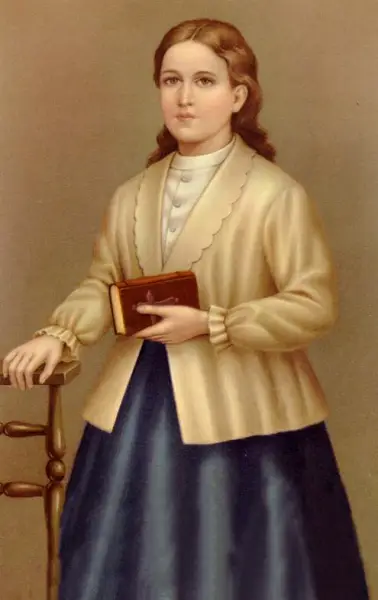
Narcisa de Jesús Martillo Morán was an Ecuadorian virgin and a member of the Third Order of Saint Dominic, remembered for her strict devotion to Jesus Christ and for a life of charity, prayer, and penance marked by austere mortification. Born in 1832 in the village of San José in Nobol, in the Ecuadorian province of Guayas, she was the sixth of nine children of a devout landowning couple. Left motherless as a child, she ran her father's household, and after his death she moved to Guayaquil, where she supported herself as a seamstress while caring for the poor, the sick, and abandoned children. Later drawn toward a life of greater solitude, she stayed for a time in Cuenca among devout households before settling in 1868 in Lima, Peru, at the advice of her Franciscan spiritual director. There, living near the Dominican convent of Patrocinio, she kept eight hours of prayer and contemplation daily, fasted rigorously, and was sometimes seen in ecstasy. She died on 8 December 1869, as the First Vatican Council was opening. Beatified in 1992 by Pope John Paul II, she was canonized by Pope Benedict XVI on 12 October 2008.
The Complete Life
A Childhood in Nobol
Narcisa de Jesús Martillo Morán came into the world on 29 October 1832 at San José, a small village of Nobol in Ecuador's coastal province of Guayas, the sixth of nine children of Pedro Martillo and Josefina Morán. Her parents were landowners, and her father worked so hard that he amassed considerable wealth; he was a devout man with a special attachment to Saint Mariana de Jesús de Paredes and to Hyacinth of Poland, a devotion that colored the household in which Narcisa grew up. When her mother died in 1838, the girl, then six years old, took over much of the domestic work of the home, helped by an elder sister who was a teacher and who taught her to read and write and to sing and play the guitar; she also learned to sew and to cook, skills that would later support her charitable work. She received confirmation on 16 September 1839 and turned a small room of the family house into a domestic chapel, the first clear sign of the interior life that would govern her. She was blonde, tall, strong, and agile, with bright blue eyes, and her disposition was peaceful, sweet, thoughtful, obedient, and generous; she was well known and loved throughout her village. Near her home stood a guava tree to which she went for contemplation in solitude, a place that has since become a large pilgrimage destination.
§ Life
Choosing the Hidden Life
The pattern of Narcisa's vocation declared itself early. She chose Mariana de Jesús, the Quito saint, as her patron and model, and strove to imitate in her own body and day the penitential intensity of that Ecuadorian virgin. In January 1852 her father died, and the event released her from the household into the wider world of charity. She went on to Guayaquil and lodged with prominent nobles of the city, and there her calling took on visible form: she threw herself into aid for the needy and the infirm and for children left with no one to look after them, funding it by her own labor as a seamstress while still supporting her eight brothers and sisters. Yet neither the workload nor the charity could still her longing for God, and before long she went on to Cuenca, staying a number of months there and moving between the homes of those willing to receive her, among them Mercedes de Jesús Molina, so that she could give more time to silent contemplation and penance. Her director's illness struck in 1865 and his death followed in 1868; the bishop of the place then offered her a home among the Discalced Carmelites, though she came to see that this was not where God wanted her; her vocation was to be a solitary in the midst of the world, and in time a tertiary of Saint Dominic.
§ Life
Charity in Guayaquil, Solitude in Lima
Narcisa's mission had two faces, active and contemplative, and she held them together for nearly two decades. In Guayaquil she was the seamstress of the poor: earning her bread by her needle, she gave her money to the needy, nursed the sick, and looked after children who had no one to care for them, all while helping to sustain her numerous siblings. June of 1868 brought the move to Lima in Peru, undertaken on the counsel of Father Pedro Gual, a Franciscan who had become her spiritual director. There she took up residence with the Dominicans at Patrocinio, though she never formally joined the convent as a member. Her days settled into a demanding rhythm that visitors found astonishing: eight hours of prayer and contemplation, offered in silence and solitude, embedded in a life of severe fasting and bodily penance. Her mortification of the flesh was constant, and those around her were sometimes witnesses to ecstasies that overtook her in prayer. To the people of Lima she was a hidden saint, a woman from the coast of Ecuador who had crossed the border to pray for the world; the fame that now surrounds her shrine began only after her death, when pilgrims started to come to the tomb of the woman who had done so much for the poor in secret.
§ Life
Prayer, Penance, and Detachment
The spirituality of Narcisa de Jesús joined Dominican contemplation to a severity of penance that recalls the great mystics of the order. Her devotion to Jesus Christ was strict and total: she lived as a virgin, refusing marriage so that her heart would belong to God alone, and she understood the Christian life as a sharing in the Cross through the mortification of the flesh. Eight hours of prayer and contemplation daily, kept in silence and solitude at Patrocinio in Lima, formed the skeleton of her spirituality; fasting gave it its discipline; and ecstasy in prayer was, for those who saw her, the visible sign of an interior union with God. Yet this rigor never curdled into harshness toward others. Contemporaries knew her as sweet and thoughtful, peaceful and generous, obedient to those around her, loved in her village and remembered with affection in Lima. Her model was Mariana de Jesús of Quito, another Ecuadorian virgin who had offered her life in penance for her people, and like her model Narcisa joined penance for sinners to practical charity for the poor. Her final illness she treated as her last penance: when high fevers seized her in late September 1869, medical remedies could do little, and she accepted death as she had accepted everything else, in peace, dying before midnight on 8 December 1869.
§ Life
Lima and a Holy Death
The final eighteen months of Narcisa's life were spent in Lima, where she had moved in June 1868 under the direction of Father Pedro Gual. Living at the Dominican house of Patrocinio without being a member of the convent, she gave herself to the schedule of prayer and mortification that marked her maturity, unknown to the world but known, as her informants later testified, to those who lived around her. When late September of 1869 arrived, burning fevers took hold of her against which every remedy proved useless, and for more than two months her strength drained away. She died before midnight on 8 December 1869, thirty-seven years old, on the very days on which the First Vatican Council was opening in Rome. A nun reported that at her death a pleasant and sweet odor filled the room, the first of the signs that would make the faithful revere her memory. Almost at once the faithful were gathering to pray at her Lima tomb. When her body was exhumed in 1995 it showed no trace of decay, and after being transferred from Peru it came home to Ecuador, to the village of Nobol, which now bears her name; there, on 22 August 1998, a new altar was consecrated there to receive her reliquary, within the sanctuary raised in her honor.
§ Life
From Cause to Canonization
The road to the altars ran for nearly half a century after the opening of her cause. The informative process began collecting documentation on 26 September 1961 and closed on 10 July 1962; on 8 July 1965 her writings passed theological examination; the historians' board gave its assent on 8 May 1974; and Paul VI set the cause formally in motion on 27 September 1975. The Congregation for the Causes of Saints approved the cause in 1987, and on 23 October of that year Pope John Paul II declared her Venerable, having recognized her heroic virtue. For beatification, a healing attributed to her intercession was investigated in a diocesan tribunal, validated on 30 June 1984 and confirmed by its medical consultants on 27 June 1991; the papal approval followed on 7 March 1992, and on 25 October of that same year John Paul II raised her to the altars in Saint Peter's Square. The second miracle concerned a seven-year-old child with a congenital defect healed in 1992 after praying at her shrine; the Congregation validated it on 4 October 2002, Pope Benedict XVI approved it on 1 June 2007, and on 12 October 2008 he canonized Narcisa de Jesús in Saint Peter's Square, enrolling the Ecuadorian tertiary among the saints of the universal Church.
§ Beatification and canonisation
Saint of Ecuador and Peru
Narcisa de Jesús belongs equally to two nations. Ecuador claims her as its daughter, born in Nobol and formed in its devout coastal villages; Peru venerates her as the hidden penitent who died in Lima and whose tomb there first drew the pilgrims' prayers. Her sanctuary at Nobol, a town that now calls itself by her name, has become a center of national devotion, built around the reliquary altar dedicated in 1998, and the guava tree near her childhood home, where she once went to contemplate in solitude, draws large numbers of pilgrims each year. Among the Third Order of Saint Dominic she is numbered with the order's saints and blesseds, a tertiary who showed that the Dominican life of prayer can be lived outside the cloister. Her canonization in 2008 placed her in the long line of virgin saints of the Catholic Church and gave Latin America one of its modern saints, a woman of the nineteenth century whose holiness was worked out not in miracles or foundations but in sewing, almsgiving, nursing, and prayer. For the poor of Guayaquil and the faithful of Lima she remains what she was in life: proof that heroic sanctity can hide inside an ordinary working life.
§ Beatification and canonisation
Timeline
- 29 Oct 1832
Born in the village of San José in Nobol, Guayas, Ecuador, the sixth of nine children.
§ Life
- 1838
Her mother, Josefina Morán, died, and Narcisa took over most of the household chores.
§ Life
- 16 Sep 1839
Received the sacrament of confirmation.
§ Life
- Jan 1852
After her father's death in January, relocated to Guayaquil and began her mission of charity.
§ Life
- 1865
Her spiritual director fell ill; she soon moved on from Guayaquil toward a more contemplative life.
§ Life
- Jun 1868
Relocated to Lima, Peru, at the advice of her Franciscan spiritual director Pedro Gual.
§ Life
- Sep 1869
Developed high fevers in late September that remedies could do little to relieve.
§ Life
- 8 Dec 1869
Died before midnight in Lima, as the First Vatican Council opened; a nun reported a sweet odor in her room.
§ Life
- 26 Sep 1961
The informative process for her beatification began collecting documentation.
§ Beatification and canonisation
- 10 Jul 1962
The informative process was closed.
§ Beatification and canonisation
- 8 Jul 1965
Her writings received theological approval.
§ Beatification and canonisation
- 8 May 1974
Historians approved her cause.
§ Beatification and canonisation
- 27 Sep 1975
Pope Paul VI formally introduced her cause.
§ Beatification and canonisation
- 30 Jun 1984
The Congregation for the Causes of Saints validated the diocesan process on a miracle for beatification.
§ Beatification and canonisation
- 23 Oct 1987
Declared Venerable after Pope John Paul II recognized her heroic virtue.
§ Beatification and canonisation
- 27 Jun 1991
Medical consultants on the cause judged a healing attributed to her intercession beyond natural explanation.
§ Beatification and canonisation
- 7 Mar 1992
Pope John Paul II approved the miracle needed for her beatification.
§ Beatification and canonisation
- 25 Oct 1992
Beatified by Pope John Paul II in Saint Peter's Square.
§ Beatification and canonisation
- 1995
Her remains were exhumed and found to be incorrupt.
§ Life
- 22 Aug 1998
An altar containing her reliquary was dedicated in Nobol.
§ Life
- 4 Oct 2002
The Congregation validated the process on a second miracle, the healing of a seven-year-old child in 1992.
§ Beatification and canonisation
- 1 Jun 2007
Pope Benedict XVI approved the second miracle required for canonization.
§ Beatification and canonisation
- 12 Oct 2008
Canonized by Pope Benedict XVI in Saint Peter's Square, Vatican City.
§ Beatification and canonisation
The Record
- Canonization
- Canonized by Pope Benedict XVI on 12 October 2008 in Saint Peter's Square, Vatican City; beatified by Pope John Paul II on 25 October 1992.
Prayer
Bibliography
Show 5 sources
- "Saint Narcisa de Jesús Martillo-Morán", Saints SQPN, 25 August 2015, retrieved 1 April 2017
- "Narcisa de Jesús Martillo Morán (1832–1869)", Holy See, retrieved 1 April 2017
- "Saint Narcisa de Jesús", Santi e Beati, retrieved 1 April 2017
- "Ecuador awaits canonization of 19th century Blessed", Catholic News Agency, 19 January 2007, retrieved 1 April 2017
- "Santa Narcisa de Jesús Martillo Morán", ACI Prensa
Profile text adapted from the Wikipedia article, licensed CC BY-SA 4.0.
Pray with this saint every day
Save St. Narcisa de Jesús to your favorites, read the full profile, and get feast-day reminders in the Saints app.
Get the Saints AppFree on the App Store for iPhone and iPad