
1st century·Feast October 31
St. Narcissus of Athens
Bishop of Athens among the Seventy Disciples
Overview
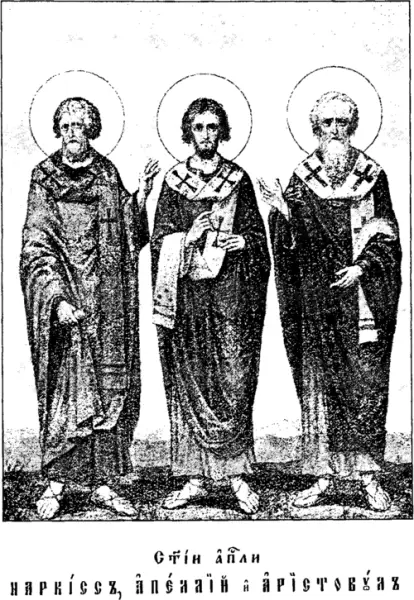
Narcissus of Athens is numbered among the Seventy Disciples whom the Church sent out in the apostolic age. His name appears in the greetings of Saint Paul's letter to the Romans, alongside Urban of Macedonia, Stachys, Ampliatus, Apelles of Heraklion, and Aristobulus of Britannia, a cluster of names in which the Christian tradition has recognized the fellow workers of the apostolic generation. Tradition holds that he assisted Saint Andrew in his labors, and that the Apostle Philip ordained him bishop of Athens, making him one of the first shepherds of the church in that ancient city. In the episcopal list of Athens he stands between Dionysius the Areopagite, the convert of Saint Paul's preaching, and Publius, his successor in the see. His feast is kept on October 31, and the Orthodox Church in America also commemorates him on January 4 among the apostles and their fellow workers. He belongs to the first generation of Christians, a companion of apostles and a link between the churches of Jerusalem, Macedonia, and Greece.
The Complete Life
Among the Seventy
Narcissus belongs to the apostolic generation, one of the Seventy Disciples whom the Lord's Church sent out to carry the Gospel beyond the Twelve. His name is Greek and his city was Athens, so that from the beginning he was associated with the Hellenic world in which so much of early Christian thought would be argued and articulated. The tradition counts him among that band of fellow workers whose names Saint Paul strings together in the closing chapter of his letter to the Romans: Urban of Macedonia, Stachys, Ampliatus, Apelles of Heraklion, and Aristobulus of Britannia, all mentioned by the Apostle in Romans 16:8-11, a convergence of names that the tradition holds cannot be casual. In that company Narcissus stands as one of the quiet figures of the first Christian generation, a man whose work the New Testament records only as a greeting and a household, but whom the Church remembered as a laborer worthy of the apostles themselves. He is said to have assisted Saint Andrew in his ministry, sharing in the evangelization that carried the faith from Jerusalem to Greece, and his commemoration among the Seventy places him with those who answered the Lord's sending before any written Gospel had begun to circulate.
§ Sources
Bishop of Athens
The office that fixed Narcissus's place in history was the episcopate of Athens. Tradition records that the Apostle Philip ordained him bishop of that city, entrusting to him the Christian community of one of the greatest centers of Greek philosophy and pagan worship. In the ancient list of the bishops of Athens, his name comes after Dionysius the Areopagite, the philosopher converted by Saint Paul's sermon on the Areopagus, and before Publius, who succeeded him; the sequence makes Narcissus the third known bishop of a see whose first shepherd had been planted by Paul's own preaching. What his years in Athens held the sources do not say in detail, but the office itself tells the story: he was the man responsible for holding together a Christian flock in the city of Plato and the Parthenon, for teaching converts baptized out of paganism, and for handing on the apostolic faith he had received from the apostles' own companions. The episcopal succession of Athens, which runs unbroken from Dionysius through Narcissus and Publius down through centuries of metropolitans and archbishops, rests on the work of men like him, who governed the young church long enough to pass it on intact.
§ Sources
Memory and Commemoration
The Church never forgot Narcissus. In the East he is commemorated among the Seventy on January 4, in the great synaxis of the apostles and their fellow workers kept by the Orthodox Church in America, and again on October 31, the day that stands in the calendars as his own feast. His name is preserved in the Orthodox tradition through sources such as the Prologue of Saint Nikolai Velimirovic, which carries the memory of the apostolic saints to later generations, and the article tradition itself is handed on through OrthodoxWiki and kindred compilations of the lives of the saints. In the episcopal lists of Athens his name holds its fixed place between the Areopagite and Publius, so that every reading of the history of that ancient see renews his memory. For the faithful he remains one of the unnamed many of Romans 16 made visible: the household of Narcissus, greeted by Saint Paul as being in the Lord, became in tradition the man and the bishop who shepherded Athens. His commemoration on two days of the year testifies to the double character of his vocation, apostle in his sending and bishop in his charge, and both titles have remained attached to him since the earliest memory of the Church.
§ Sources
In Their Own Words
Greet those in the household of Narcissus who are in the Lord.
The Record
- Canonization
- Pre-congregation; venerated as a saint from the apostolic age onward.
Prayer
Bibliography
Show 3 sources
- Bible Gateway website, Romans 16:8-11 (NIV)
- St. Nikolai Velimirovic, The Prologue from Ohrid
- "Apostle Narcissus of the Seventy", Orthodox Church in America (OCA), commemorations of January 4 and October 31
Profile text adapted from the Wikipedia article, licensed CC BY-SA 4.0.
Pray with this saint every day
Save St. Narcissus of Athens to your favorites, read the full profile, and get feast-day reminders in the Saints app.
Get the Saints AppFree on the App Store for iPhone and iPad