
c. 99 – c. 216·Feast October 29
St. Narcissus of Jerusalem
Bishop of Jerusalem and worker of miracles
Overview
Narcissus of Jerusalem was an early patriarch of the church of Jerusalem, venerated as a saint by the Western and Eastern Churches alike. Of Greek origin and born, as tradition holds, around the year 99, he was already more than eighty years old when he was raised to the see as its thirtieth bishop. His episcopate is remembered above all for the council of the bishops of Palestine which he presided over at Caesarea, and which decreed that Easter was to be kept always on a Sunday rather than with the Jewish Passover. Eusebius records that he was famous for miracles, the most celebrated being the change of water into oil at the Easter Vigil so that all the lamps of the church could burn. Falsely accused by members of his own community, he forgave his accusers and withdrew into seclusion for several years, during which three bishops governed the see in succession. The people later brought him back unanimously, and in his extreme old age he took Alexander of Jerusalem as coadjutor bishop. He served his flock by prayer and exhortation until his death around 216, at about the age of one hundred and seventeen.
The Complete Life
Born in the Holy City
Narcissus was born, as tradition holds, around the year 99 in Aelia Capitolina, the Roman city built on the site of Jerusalem, and he was of Greek origin. The city of his birth was itself a monument to the upheavals of the Jewish war: refounded under a pagan name and barred to the people of the old covenant, it was nonetheless becoming, in his lifetime, the seat of a Christian church that traced its descent from the first bishops of Jerusalem. The church into which he was baptized had recently passed through the martyrdom of its second bishop, Simeon, who died under the emperor Trajan in the year 117 after an episcopate of nearly half a century, and the short reigns of the bishops who followed him showed how often persecution cut the succession short. Of Narcissus's own family, education, and early service in that church the sources are silent; they resume only when, as a man of more than eighty years, he was called from the ranks of the faithful to the episcopate itself. What is clear is that he grew old in the Christian community of the holy city, formed by its liturgy and its memories, before he was asked to govern it.
§ Life
The Thirtieth Bishop of Jerusalem
Narcissus became the thirtieth bishop of Jerusalem, a succession that ran from James, the brother of the Lord, through Simeon and a long line of shepherds whose average tenure was short. He took up the office at an age when most men have long laid down their burdens: tradition holds that he was at least eighty when he was made bishop, so that his episcopate was in a sense a second vocation accepted in old age. As bishop of Jerusalem he also bore the title connected with the church of Caesarea in Palestine, and his most consequential act of governance came there: he presided over a council of the bishops of Palestine held at Caesarea, which decreed that Easter was to be kept always on a Sunday, and not with the Jewish Passover. The decision bound the churches of Palestine to the Sunday observance of the resurrection and remains the act for which his administration is best documented. Eusebius, the historian of the early church, preserves the picture of an aged prelate whose authority rested not only on his office but on the extraordinary gifts that the faithful attributed to him, chief among them the wonders recorded of his celebration of the Easter mysteries.
§ Life
Signs and Wonders
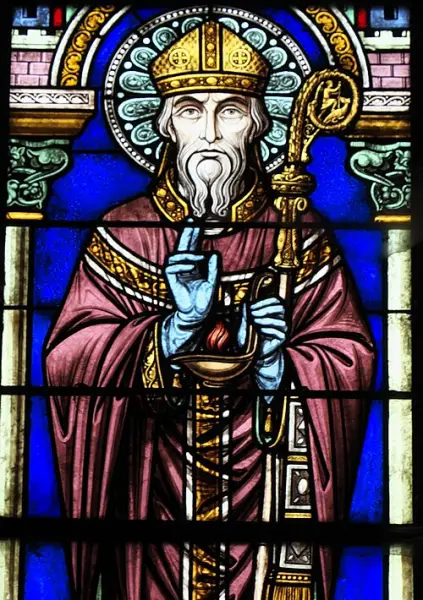
According to Eusebius, Narcissus performed many miracles, and the bishop's fame in the ancient church rested on them. The wonder on which Eusebius lingered unfolded at the Easter Vigil itself: water, at the bishop's prayer, became oil, and every lamp of the church burned that night in abundance. The story fixed itself in the memory of the Church as an Easter sign, a paschal transformation in which the weakness of the community's poverty was turned into an overflow of light at the resurrection feast. The faithful of later generations retold it as a parable of episcopal intercession: where human provision failed, the prayer of a holy bishop made the house of God shine. Later art caught the same associations: painters and glaziers gave him a blossoming thistle in his hand, set a pitcher of water close beside him, and showed an angel bearing his soul heavenward. His ministry, as the tradition sums it up, reached past the borders of his own diocese: neighboring churches felt the help of his unceasing intercession, and he urged their members toward concord and peace, so that his episcopate was a work of prayer as much as of governance.
§ Life
Forgiveness and Seclusion
The deepest test of Narcissus's spirituality came not from pagans but from his own community. Members of his own Christian flock at Jerusalem leveled a series of grave charges against him, accusations weighty enough to drive a bishop from his see; in the event, every one of them proved hollow. His response to his accusers became the pattern for which he is remembered: he forgave them, and rather than contest his innocence he withdrew from the city and lived in seclusion for several years, leaving the judgment of his cause to God. During his absence the see of Jerusalem was governed by three bishops in succession, so that his exile was no brief hiding but a long silence at the height of what should have been his mature authority. The tradition reads those years as the flowering rather than the failure of his spiritual life: a man who had changed water into oil for the Easter lamps now offered the oil of forgiveness for the wounds of calumny, praying in retirement for a church that believed ill of him. When at last he returned, he did so without resentment, resuming the office his people begged him to take up again and binding the wound of division by the gentleness of his government.
§ Life
Return, Coadjutor, and Death
The end of Narcissus's exile came from the people he had left. When he came back to the holy city, the whole Christian population converged on him with one voice, begging him to take up his pastoral charge again — a restoration that speaks both to his innocence and to the love his people had kept for him. He consented, but he was now an extremely old man bowed under the weight of the church's cares, and he arranged for the good of the see what his strength could no longer supply alone: he took Alexander of Jerusalem as his coadjutor bishop, giving the church a second shepherd while he lived. To the very end he kept serving, both the flock of the holy city and the churches beyond his jurisdiction, through unceasing intercession and his unfailing urging of the faithful toward concord and peace. He died around the year 216 in the city of his birth, at about the age of one hundred and seventeen, having governed, in one way or another, the church of Jerusalem across the final decades of the second century and the first years of the third. Alexander succeeded him in the see, the thirty-first in the line that ran from the apostolic age, and the memory of the aged bishop passed at once into the communion of the Church's saints.
§ Life
Two Feasts, One Saint
Narcissus is one of the early bishops of Jerusalem whose memory both halves of Christendom keep. In the Roman Catholic Church his feast falls on October 29 in the General Roman Calendar, while the Eastern Orthodox Church commemorates him on August 7; the Oriental Orthodox churches likewise number him among the saints. In the long list of the bishops and patriarchs of Jerusalem his name stands thirtieth, between Dolichianus and Dius, and his institution of a coadjutor in Alexander is remembered as part of the orderly succession of that ancient see. The story of the Easter Vigil oil, carried in Eusebius's Ecclesiastical History, made him a figure in the historiography of the early church, one of the second-century bishops whose sanctity was recorded by contemporaries rather than reconstructed by later hagiographers. Medieval and modern collectors of the saints, from Butler's lives to the calendar compendia of the twentieth century, retold the account of the miracle and the calumny, and artists rendered him as the bishop with the thistle and the pitcher of water. For Jerusalem's Christians he stands as proof that the church of the holy city produced shepherds worthy of its first bishop, James: a man who governed with miracles, endured slander with forgiveness, and died full of years in the peace of the Church.
§ Life
Timeline
- 9 Mar 99
Born in Aelia Capitolina (Jerusalem), according to tradition, of Greek origin.
§ Life
- 117
Simeon, the second bishop of Jerusalem, was martyred under the emperor Trajan, an early sign of the see's trials.
§ Life
- 216
Died in Aelia Capitolina at about the age of one hundred and seventeen.
§ Life
The Record
- Major works
- Decree of the Council of Caesarea fixing the celebration of Easter on a Sunday
- Symbols
- Bishop holding a thistle in blossom·Pitcher of water·Angel carrying his soul to Heaven
- Canonization
- Pre-congregation; venerated by the Catholic, Eastern Orthodox, and Oriental Orthodox churches.
Prayer
Bibliography
Show 4 sources
- Hoever, Hugo (ed.) (1955). Lives of the Saints, For Every Day of the Year. New York: Catholic Book Publishing Co., pp. 423-424
- Eusebius, Ecclesiastical History, Book VI, ch. IX
- Butler, Albert (1894). Lives of the saints, with reflections for every day in the year. New York: Benziger Brothers, p. 346
- "Saint of the Day, October 29: Narcissus of Jerusalem", SaintPatrickDC.org, retrieved 2012-03-06
Profile text adapted from the Wikipedia article, licensed CC BY-SA 4.0.
Pray with this saint every day
Save St. Narcissus of Jerusalem to your favorites, read the full profile, and get feast-day reminders in the Saints app.
Get the Saints AppFree on the App Store for iPhone and iPad