
died 345·Feast August 27
St. Narnus
First bishop of Bergamo
Overview
Saint Narnus, called San Narno in his native Italian, stands at the head of the church of Bergamo as its first bishop. Tradition ascribes his consecration to that dignity to the Apostolic Age itself, at the hands of Saint Barnabas, though the man himself probably lived later than that pious memory allows. The oldest source that speaks of him is the work of Branca da Gandino, a friar writing in the thirteenth century, who places Narnus's episcopate in the reign of the emperor Diocletian in the fourth century, at the time of the last great persecution of the church. Villa d'Ogna, in the Bergamasque valleys, has been considered the place of his birth. His death came in 345, and his body was laid to rest in the crypt of a Bergamo church honoring Saint Alexander. Demolition of that building in 1561 led to his relics, together with those of his successor Saint Viator, were translated to the church of San Vincenzo, which is today the cathedral of Bergamo, and there they still rest. His feast is kept on August 27, and he remains the patriarch figure of the Bergamasque church, its first shepherd and the head of its episcopal line.
The Complete Life
First Bishop of a Young Church
Narnus holds the first place in the episcopal list of Bergamo, the northern Italian city of which he is remembered as the founding bishop. The Christian tradition of the city reached back to the apostles for his consecration: it held that he was made a bishop during the Apostolic Age by Saint Barnabas, the companion of Paul whose missionary travels were remembered across northern Italy. The claim belongs to the legendary register that many ancient sees wove around their origins, and the record itself suggests a later reality, since Narnus probably lived after the apostolic era. The earliest author to write of him, the thirteenth-century friar Branca da Gandino, dated his bishopric to the reign of Diocletian at the opening of the fourth century, which would place his shepherding of the Bergamasque church in the years of the great persecution, when a Christian community needed a leader of courage more than of fame. Villa d'Ogna, a village in the Serio valley north of the city, has been considered the place of his birth, linking the first bishop of Bergamo to the mountain country whose faith he was believed to have planted. He died in 345, closing an episcopate that the whole later list of Bergamasque bishops presupposes.
§ Veneration
Relics in the Cathedral of Bergamo
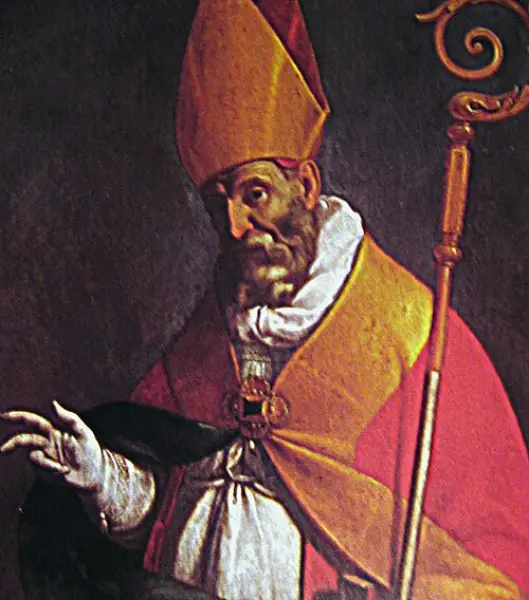
The memory of Narnus settled first of all on his tomb. He was buried in the crypt of a Bergamo church dedicated to Saint Alexander of Bergamo, the soldier martyr whose name the city itself carried in one of its titles, and for centuries the first bishop lay there among his people. In 1561 the church of Saint Alexander was demolished, and the relics of Narnus were translated, together with those of Saint Viator, his successor in the see, to the church of San Vincenzo, which became the cathedral of Bergamo. There the two early bishops still rest, their remains beneath the high church of the diocese they founded and governed, so that every pilgrimage to the cathedral of Bergamo is in some sense a visit to the first of its shepherds. His feast is kept on August 27, and his figure survives in the sacred art of the region: Carlo Ceresa painted him as a bishop in a canvas preserved in the Church of San Giovanni Apostolo at Villa d'Ogna, the village of his supposed birth, where the local memory of the saint remained vivid centuries after his death. As the first occupant of the see, he stands at the head of the long episcopal succession of Bergamo, the origin point of one of Lombardy's ancient churches.
§ Veneration
Timeline
- 345
Died at Bergamo after governing the see as its first bishop.
§ Veneration
- 1561
His relics, with those of Saint Viator, were translated to the church of San Vincenzo when the church of Saint Alexander was demolished.
§ Veneration
The Record
- Canonization
- Pre-congregation; venerated as the first bishop of Bergamo since antiquity.
Prayer
Bibliography
Show 1 sources
Profile text adapted from the Wikipedia article, licensed CC BY-SA 4.0.
Pray with this saint every day
Save St. Narnus to your favorites, read the full profile, and get feast-day reminders in the Saints app.
Get the Saints AppFree on the App Store for iPhone and iPad