
died 564·Feast January 27
St. Natalis of Ulster
Sixth-century Irish abbot and founder of monasteries
Overview
Natalis, also honoured as Saint Naile or Naal, was an Irish monk of the sixth century whose death is placed in the year 564. He came of a distinguished line: his father Aenghus stood third in descent from Lughaidh, King of Munster. As a young man he put himself under the spiritual direction of Columba, and in time he established monastic houses across Ulster. He ruled as abbot at St Naul's Abbey at Inver in County Donegal, at Kinawley in County Fermanagh, at Inver Naile near Raphoe, and on Devenish Island, where he followed Saint Molaise in leadership. The landscape of his monasteries kept his memory alive: a holy well rises in his honour beside the church at Kinawley, and the handle of his bell was preserved there into the nineteenth century. A Life of the saint composed around 1520 survives among the unpublished Irish vitae, and Gerald of Wales recalled his name in the strange tale of the werewolves of Ossory, whose village suffered a transforming curse attributed to him. His feast is kept on 27 January.
The Complete Life
A Monk of Columba's Making
Natalis belonged by birth to the highest rank of Irish society. His father Aenghus traced his lineage to Lughaidh, King of Munster, counting three generations between them, and the boy might have expected a life of noble privilege. Instead he sought the discipline of the monastery and became a spiritual pupil of Columba, the great abbot whose schools formed a generation of Irish missionaries and churchmen. Under that formation Natalis grew into a founder in his own right. Monasteries rose across Ulster under his hand and his rule: the abbey of St Naul at Inver in County Donegal, the house at Kinawley in County Fermanagh that still bears his name in its Gaelic form Cill Naile, and the settlement of Inver Naile near Raphoe. On Devenish Island, one of the holiest sites of the Erne waterway, he succeeded Saint Molaise himself in the governance of the community. To hold abbatial authority in so many houses at once speaks of a reputation for wisdom that reached beyond a single locality. The monk of a noble house ended his days as one of the principal fathers of Ulster monasticism.
§ Natalis of Ulster
Wells, Bells, and a Saint's Long Memory
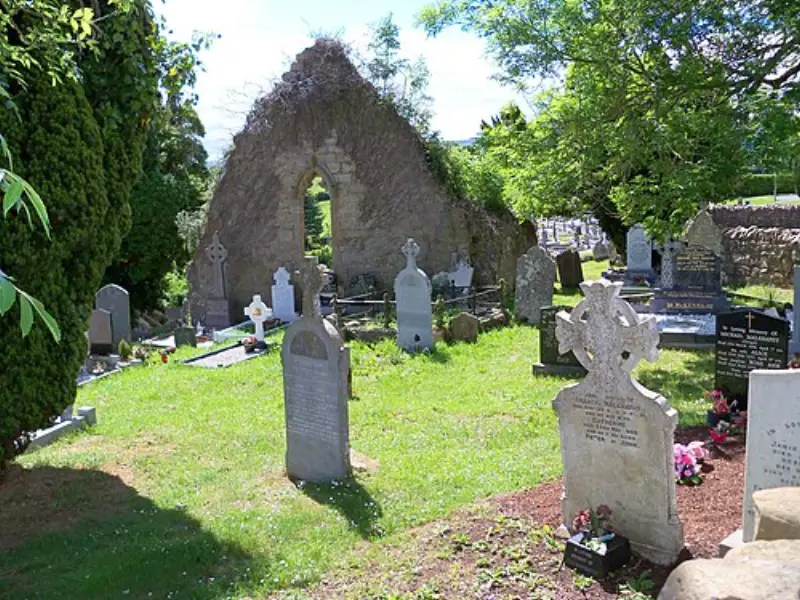
Few Irish saints of the sixth century left so clear a trace upon the places they served. At Kinawley, where his monastery stood, a well in his memory still rises beside the church, and there the handle of his bell was kept with reverence until the nineteenth century, a rare survival of the actual equipment of an early Irish abbot. His name entered literature as well as landscape: Gerald of Wales, writing his Topographia Hibernica, made him a figure in the tale of the werewolves of Ossory, in which a pair of villagers are changed into wolves for seven years at a time under a retributive curse laid upon them by Natalis. Whatever one makes of the story, its survival shows that his name carried weight centuries after his death. A formal Life of Naile, dating from about 1520, was preserved among the unpublished Lives of the Irish saints in the collection Miscellanea hagiographica Hibernica, where Plummer later printed it. The Church keeps his feast on 27 January, and the ruins of the old church of Naile at Kinawley still mark the ground where his monks prayed.
§ Natalis of Ulster
The Record
- Major works
- St Naul's Abbey, Inver, County Donegal·Monastic foundation at Kinawley (Cill Naile)·Inver Naile, Raphoe, County Donegal·Monastic leadership on Devenish Island
- Symbols
- Bell
- Canonization
- Pre-congregation; venerated as a saint in the Catholic tradition
Prayer
Bibliography
Show 3 sources
- "St Natalis". Catholic Online. Retrieved 8 July 2016.
- Gerald of Wales. Topographia Hibernica.
- Plummer, C., "Betha Naile: Life of Naile", in Miscellanea hagiographica Hibernica (1925).
Profile text adapted from the Wikipedia article, licensed CC BY-SA 4.0.
Pray with this saint every day
Save St. Natalis of Ulster to your favorites, read the full profile, and get feast-day reminders in the Saints app.
Get the Saints AppFree on the App Store for iPhone and iPad