
died 678·Feast January 8
St. Nathalan
Seventh-century bishop and church-builder of Aberdeenshire
Overview
Nathalan, also called Nachlan, was a priest and bishop who laboured in what is now Aberdeenshire in Scotland and died in 678. Born in the village of Tullich, over which he would eventually preside as bishop, he came to holiness by a startling reversal: the sixteenth-century Aberdeen Breviary depicts him as a rich nobleman who resolved to work the soil with his own hands and give himself to God as a hermit. He held a large estate, tilled it personally, and shared the harvest generously with the poor. His monuments were churches. He founded the earliest place of Christian worship at Tullich in the seventh century, raised further churches at Bothelim and at Colle, and is credited with the first little chapel on the exposed clifftop at Cowie. A memorable legend tells how, having cursed the rain that hindered his harvest, he repented of the words by padlocking his right arm to his right leg, dropping the key into the River Dee, and setting out on foot for Rome. There, at supper, the very key was found inside a fish set before him. He is recognised as a saint by the Catholic and Eastern Orthodox Churches.
The Complete Life
A Nobleman of Tullich
Nathalan first appears in history as a native of Tullich, a village among the hills of what is now Aberdeenshire, and the place with which his whole story would remain bound. The fullest early portrait of him comes from the Aberdeen Breviary of the sixteenth century, which presents him as a wealthy nobleman, a man of broad lands and comfortable station. What makes the portrait memorable is the use he made of that station. Rather than administering his estate through tenants and servants, he chose to cultivate the ground himself, taking on the physical labour of the harvest, and he bound that labour to a deliberate consecration of himself to God in the manner of a hermit. The combination is striking: a lord who farmed, a hermit who owned and worked a great estate. Out of that double vocation came a characteristic generosity, for he distributed what his land produced liberally to the poor around him. In time the church of his home village recognised his gifts by raising him to the episcopate, so that the nobleman of Tullich ended his life as bishop of the very place of his birth, dying in 678.
§ Life
Churches Across the Grampian Coast
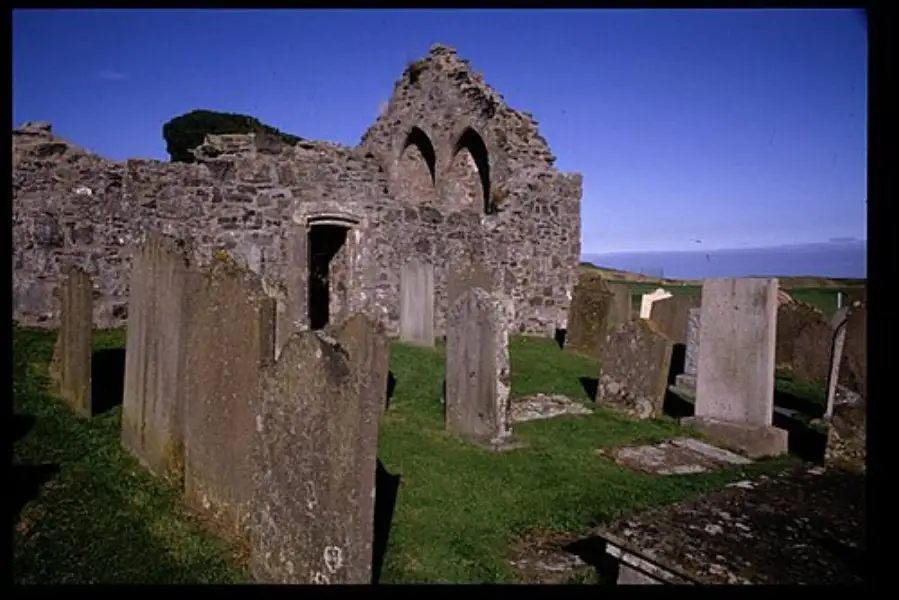
The lasting work of Nathalan's life was in stone. In the seventh century he founded the earliest church at Tullich, planting Christian worship at the centre of his own community, and he went on to build churches at Bothelim and at Colle, extending the faith's foothold through the district. Another foundation carried his name down the coast: he is reputed to have raised the first little chapel high on the wind-scoured clifftop at Cowie, ground of raw exposure above the North Sea, where a chapel of St Mary and St Nathalan would stand in later ages. These were not the acts of a distant patron signing deeds but of a man accustomed to work with his hands, and tradition remembers him overseeing each site personally. As bishop he exercised oversight of the district around Tullich, linking the scattered churches of the region to the episcopal office he held. The pattern of his foundations, from the inland village of his birth to the clifftop at Cowie, traces the shape of an apostolate that followed the settlements of early Christian Deeside and the coastal routes of the Mearns, leaving dedicated places of prayer where none had stood before.
§ Life
The Key in the Fish
The story told most often of Nathalan concerns a failure rather than a triumph, which is perhaps why it endured. One very rainy summer, as the downpours threatened to ruin the harvest he had laboured over, the saint, in a moment of weakness, called down a curse upon the rains that were spoiling his work. Recognising in that flash of temper a sin against God's creation, he resolved on a penance of extraordinary severity: he fastened his right arm to his right leg with a padlock, threw the key into the River Dee, and set out to walk to Rome to seek forgiveness. Months later, arrived in the city and seated at supper, he cut open the fish set before him and found within it the very key he had cast into the Dee in Scotland. To this day a stretch of the River Dee close by is called the key pool in remembrance of the story. The legend belongs to the large family of penitential pilgrimage stories, but its particular force lies in its proportion: a single rash word against the weather answered by a journey of a thousand miles, and a God who returns the penitent's key by a longer and stranger road than the one it was thrown down.
§ Legend
Memory in Glass, Stone, and Murals
The places Nathalan founded kept his name alive in their very dedication. The earliest church at Tullich stood on ground he had chosen, and a chapel at Cowie carried his name alongside that of St Mary into the later middle ages. Modern institutions renewed the old bond. St Nathalan Roman Catholic Church at Ballater bears his name today, and in the baptistery of the church of St James the Great at Stonehaven a coloured-glass window pays him honour. Even a Masonic lodge claimed his patronage: the lodge founded at Ballater in May 1815 took the title The Lodge of St Nathalan of Tullich-in-Mar and appears on the Grand Lodge of Scotland's roll as lodge number 259. In the twentieth century he was included among the saints depicted in the Millennium Murals at St Mary's Cathedral in Aberdeen, placing the seventh-century bishop beside the great figures of Scottish Christianity. The Catholic Church and the Orthodox Church both recognise him as a saint, and his feast is kept on 8 January, the day on which Catholics have traditionally commemorated the bishop of Tullich.
§ Legacy
Timeline
- 678
Died after a life of hermitage, farming, and church-building in Aberdeenshire.
§ Life
- May 1815
A Masonic lodge at Ballater was founded under the name The Lodge of St Nathalan of Tullich-in-Mar.
§ Legacy
The Record
- Major works
- Church at Tullich·Churches at Bothelim and Colle·Chapel on the clifftop at Cowie, Aberdeenshire
- Canonization
- Pre-congregation; recognised as a saint in the Catholic and Eastern Orthodox Churches
Prayer
Bibliography
Show 8 sources
- Duffy, Patrick (8 January 2012). "Jan 8 – St Nathalan of Tullicht near Aberdeen (died 678 AD)". Catholic Ireland.
- "Tullich Church". Deeside Walks.
- "Nathalan". The Oxford Dictionary of Saints. Oxford University Press. January 2011. ISBN 978-0-19-959660-7.
- "Millennium Murals" (PDF). St. Mary's Cathedral, Aberdeen.
- Butler, Alban (1866). The Lives of the Fathers, Martyrs, and Other Principal Saints. J. Duffy Publishing.
- "Cowie Chapel, St. Mary's of the Storms, Cowie Kirkyard". Banff and Buchan Arts Forum.
- "St Nathalan Roman Catholic Church Ballater, Glenmuick, Tullich, and Glengairn Grampian". Scottish Churches.
- Watt, Archibald (1985). Highways and Byways round Kincardineshire. Aberdeen, Scotland: Gourdas House. ISBN 0907301096.
Profile text adapted from the Wikipedia article, licensed CC BY-SA 4.0.
Pray with this saint every day
Save St. Nathalan to your favorites, read the full profile, and get feast-day reminders in the Saints app.
Get the Saints AppFree on the App Store for iPhone and iPad