
c. 830 – 910·Feast May 20 and December 23 (Gregorian calendar); January 5 and July 3 (Julian calendar)
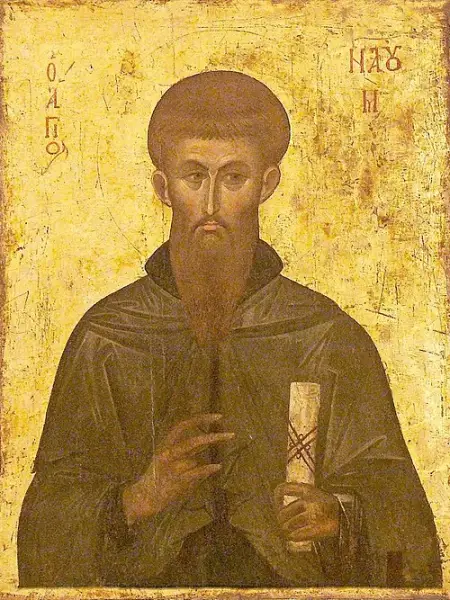
St. Naum of Ohrid
Wonderworker, missionary and apostle of the Slavs
Overview
Naum, known also as Naum of Ohrid and Naum of Preslav, was a medieval Bulgarian writer and missionary who stands among the Seven Apostles of the First Bulgarian Empire. Born around 830 in Moesia, he grew up in a land whose very name was the Byzantine designation for Bulgaria, and almost nothing else is recorded of his youth. He rose to prominence as one of the disciples of Cyril and Methodius, joining their historic mission to Great Moravia in 863 and spending over two decades translating Scripture into Old Church Slavonic. Driven from Moravia by hostile German clerics after the death of the mission's patrons, he found a welcome in Bulgaria under Knyaz Boris, where he helped establish the Pliska Literary School and later directed the school at Ohrid. In these years the Cyrillic script took shape in the Preslav school, an achievement possibly following his initiative. In 905 he raised a monastery beside Lake Ohrid, the house that still carries his name, and he died there on 23 December 910. His canonization, begun by Clement of Ohrid, made him the first native saint of Bulgaria, and his monastery remains one of the great shrines of the Orthodox Balkans.
The Complete Life
A Son of Moesia
The early years of Naum are wrapped in the obscurity that surrounds most ninth-century missionaries. He was born around the year 830 in Moesia, a territory whose ancient name served the Byzantines as a designation for Bulgaria, and the sources say almost nothing of his family, his education, or the circumstances that drew him toward the missionary life. The Second Life of Saint Naum records simply that he grew up in that land, and a tradition preserved in another source notes family ties reaching into both Moesia and Dalmatia, with the suggestion that he had escaped for safety to Belgrade, then the capital of Moesia Prima within Bulgaria. Whatever the details of his formation, it produced a man of rare linguistic and scholarly gifts, suited to the most demanding missionary enterprise of his age. By the early 860s he had attached himself to the circle of Cyril and Methodius, the Thessalonian brothers who were then preparing to carry the Gospel to the Slavs in the Slavs' own voice. For a youth from the Bulgarian lands, joining that company meant leaving home for a frontier of empire and faith, and it set the course of a life that would spend itself entirely on making the Scriptures speak the language of the Slavic peoples.
§ Life
Disciple of Cyril and Methodius
In 863 Naum joined the momentous mission to Great Moravia, setting out alongside Cyril and Methodius and with their fellow disciples Gorazd, Clement of Ohrid, Angelar, and Sava. For the next twenty-two years he gave himself to the work of that mission, translating the Bible into Old Church Slavonic and promoting the new liturgy throughout Great Moravia and the Principality of Lower Pannonia. To serve the mission, the brothers had devised the Glagolitic alphabet, the first script fashioned to match the particular sounds of the Slavic tongue, from which the Cyrillic script, still used across half of Europe today, would later descend. The missionaries also composed the first Slavic Civil Code for use in Great Moravia. The work drew furious opposition from German clerics who resented a Slavic liturgy on their doorstep. In 867 or 868 Naum traveled to Rome with his companions and was ordained a priest there, along with Gorazd and Clement, by the bishops Formosus and Gauderic, a sign of the mission's favor with the papacy. But the political ground was shifting: by 885 Rastislav of Moravia, Prince Koceľ of Lower Pannonia, and both Cyril and Methodius were dead, and the German pressure turned hostile. Naum endured a brief imprisonment before slipping away with Clement and Angelar toward Bulgaria.
§ Great Moravia and Lower Panonia
Building the Literary Schools of Bulgaria
In 886 the disciples of Cyril and Methodius were received with honor at Belgrade by the Bulgarian governor, and Naum passed into the service of Knyaz Boris, the ruler who had accepted Christianity in 864. Boris had watched the religious ceremonies of his newly Christian land being conducted in Greek by a Byzantine clergy, and, fearing the pull of Byzantine influence, he saw in Old Church Slavonic a means of preserving Bulgaria's political independence. He therefore arranged for two literary academies where theology would be taught in the Slavonic tongue, one in the capital at Pliska and the other at Ohrid in the region of Kutmichevitsa. Naum moved first to Pliska with Clement and Angelar, and possibly Gorazd, and labored there from 886 to 893 as one of the founders of the Pliska Literary School. The flourishing of Slavic letters proved decisive: it shielded the Bulgarians from assimilation into neighboring cultures and fostered a distinct national identity. In 893 the new ruler, Simeon the Great, summoned an ecclesiastical council at the new capital of Preslav, where Clement was made bishop of Drembica and Velika; to fill Clement's place at Ohrid, Simeon sent Naum. There he continued the school's work, and in these same years the Cyrillic letters took shape within the school of Preslav and won adoption across Bulgaria, possibly at Naum's own initiative.
§ First Bulgarian Empire
The Monastery by the Lake
The closing chapter of Naum's life unfolded on the shores of Lake Ohrid, where in 905 he founded a monastery that would forever after bear his name. The foundation crowned a career spent building institutions: having helped to create schools of translation at Pliska, Preslav, and Ohrid, the aging missionary now raised a house of prayer that joined learning to the monastic life. There, at Sveti Naum, he lived out his final years in the peace of his own foundation, freed at last from the imprisonments, rivalries, and forced migrations that had marked the decades of mission. He died at the monastery on the twenty-third of December in the year 910, having spent his last twenty-five years altogether in the service of Bulgaria. His body was laid to rest in the house he had built, which became from that day forward a place of pilgrimage. The monastery still stands on the lake's shore, in what is now North Macedonia, and the cult of its founder has never ceased in the region of Ohrid. The memory of the wonderworker remains so vivid that even members of the Bektashi order have made pilgrimage to his tomb, honoring in their own way the holiness that radiates from that shore.
§ First Bulgarian Empire
The First Native Saint of Bulgaria
Naum's passage into sainthood began immediately after his death, for it was Clement of Ohrid, his fellow disciple and lifelong collaborator, who set the canonization process in motion in 910. Thus Naum came to be honored as the first home-grown saint of Bulgaria, a distinction of deep significance for a young Christian nation still forming its identity: the Bulgarian Orthodox Church, founded in the ninth century, numbered him among the very first saints it declared. The title of wonderworker attached itself early to his memory, and his veneration took deep root in the region of Ohrid above all. His original feast day was the twenty-third of December, the day of his death, but in 1727 the Archbishop of Ohrid transferred it to the twentieth of June, and the double observance has continued in the calendars of the Orthodox Church, which keeps his memory on both dates according to the Julian reckoning and on complementary days in the revised and Gregorian calendars. The Catholic Church likewise venerates him, listing him among its missionary saints. Few founders receive so immediate and so enduring a canonization, and none mark more clearly the moment when a people newly evangelized began to produce holiness of its own.
§ First Bulgarian Empire
From Ohrid to Athos and Antarctica
The cult of St. Naum has shown remarkable vitality across the centuries. Revered especially in the region of Ohrid, it spread notably in the first half of the eighteenth century, when the city of Moscopole rose as a center of Orthodox culture and the Archbishopric of Ohrid flourished. From there his fame traveled astonishing distances, reaching the monasteries of Mount Athos and even Vienna, carried by pilgrims and merchants of the Orthodox world. His monastery on Lake Ohrid became a meeting point of faiths as well as a Christian shrine: even adherents of the Bektashi order made pilgrimage to the spot, persuaded that their own saint, Sarı Saltık, rested in its grave. The Church's memory of him was fixed in her liturgy, with the transfer of his feast in 1727 confirming a devotion too strong to be confined to a single day. Science and geography added their own tributes: St. Naum Peak on Livingston Island in the South Shetland Islands of Antarctica bears his name, a far cry from the Balkan lake where he prayed. Above all, the scripts and schools he labored for survived every political catastrophe of the Balkans, and the Cyrillic letters descended from his mission's work continue to carry the written word to hundreds of millions.
§ Legacy
Timeline
- 830
Born around this year in Moesia, in the First Bulgarian Empire.
§ Life
- 863
Joined the historic mission to Great Moravia alongside Cyril and Methodius and their disciples.
§ Life
- 867
Received priestly ordination in Rome, in 867 or 868, along with Gorazd and Clement of Ohrid, at the hands of bishops Formosus and Gauderic.
§ Great Moravia and Lower Panonia
- 885
After a brief imprisonment in the conflict with German clerics, departed Moravia for Bulgaria.
§ Great Moravia and Lower Panonia
- 886
Welcomed at Belgrade by the Bulgarian governor; moved on to the capital Pliska and helped found the Pliska Literary School, where he worked until 893.
§ First Bulgarian Empire
- 893
Sent by Simeon the Great from Preslav to Ohrid to continue Clement's work at the literary school there.
§ First Bulgarian Empire
- 905
Established a monastery beside Lake Ohrid, the house that would afterwards take his name.
§ First Bulgarian Empire
- 23 Dec 910
Died at his Lake Ohrid monastery; Clement of Ohrid initiated the process of his canonization.
§ First Bulgarian Empire
- 1727
The Archbishop of Ohrid changed his feast day from December 23 to June 20.
§ Legacy
The Record
- Major works
- Translation of the Bible into Old Church Slavonic·Association with the creation of the Glagolitic and Cyrillic scripts·Co-founding of the Pliska Literary School·Direction of the Ohrid Literary School·First Slavic Civil Code, written with the other missionaries·Monastery of Saint Naum on Lake Ohrid, founded 905
- Canonization
- Canonized by the Bulgarian Orthodox Church among its first saints after its ninth-century foundation; Clement of Ohrid initiated the process in 910
Prayer
Bibliography
Show 7 sources
- John Van Antwerp Fine, The Early Medieval Balkans: A Critical Survey from the Sixth to the Late Twelfth Century, University of Michigan Press, 1991, ISBN 0472081497, pp. 127-128.
- Obolensky, Dimitri (1994). Byzantium and the Slavs. St Vladimir's Seminary Press. pp. 48–49. ISBN 0-88141-008-X.
- Monks and Laymen in Byzantium, 843-1118, Rosemary Morris, Cambridge University Press, 2003, ISBN 0-521-31950-1, p. 25.
- Historical dictionary of the Republic of Macedonia, Dimitar Bechev, Scarecrow Press, 2009, ISBN 0-8108-5565-8, p. 159.
- Kantor, Marvin (1983). Medieval Slavic Lives of Saints and Princes. The University of Michigan Press. p. 65.
- Curta, Florin, Southeastern Europe in the Middle Ages, 500–1250, Cambridge University Press, 2006, ISBN 0521815398, pp. 221–222.
- Robert Elsie, The Christian Saints of Albania; Balkanistica, issue 13 (2000), pp. 35-57.
Profile text adapted from the Wikipedia article, licensed CC BY-SA 4.0.
Pray with this saint every day
Save St. Naum of Ohrid to your favorites, read the full profile, and get feast-day reminders in the Saints app.
Get the Saints AppFree on the App Store for iPhone and iPad