
c. 1459 – 1521·Feast September 26
St. Neagoe Basarab
Voivode of Wallachia, prince, writer, and Orthodox saint
Overview
Neagoe Basarab, Voivode of Wallachia from 1512 until his death in 1521, rose from the boyar house of Craiovești to become one of the most capable rulers in the country's history and, four centuries after his death, a canonised saint of the Romanian Orthodox Church. Born around 1459, the son of Pârvu Craiovescu or, by a disputed claim, of Basarab Țepeluș cel Tânăr, he climbed through a series of court offices before replacing Vlad cel Tânăr on the throne. His reign encouraged crafts and trade, balanced the heavy Ottoman tribute with friendship toward Hungary, and reached out diplomatically to Venice and to the Papacy, even offering to act as a go-between for the Eastern and Western churches in the hope of a Christendom united against the Turk. A devout son of the Orthodox Church, he embraced the Byzantine tradition of princely patronage, enriching monasteries throughout Wallachia and the Balkans and raising the monastery of Curtea de Argeș, completed in 1517. To his son Theodosie he addressed a manual of princely conduct in Church Slavonic, among the first literary achievements of Wallachia, treating philosophy, diplomacy, morals, and ethics. He died on 15 September 1521 and was buried in the cathedral he had built at Curtea de Argeș.
The Complete Life
The Slow Climb of a Courtier
The youth of Neagoe is wrapped in obscurity, and his rise to power came slowly and through service rather than blood-right. He belonged to the Craiovești, the great boyar family whose political influence would reach its zenith under him, and his first advancement owed much to his grandfather Neagoe Craiovescu, who pushed from 1508 onward for his ascent to the throne. His early career unfolded through a sequence of court offices. Under Radu the Great he held the office of reckoner — a kind of private secretary — to Patriarch Nephon II; the patriarch himself, it is said, came to Neagoe for teaching and soul food. From Christmas Day 1501 until June 1509 he served as High Seneschal, and from April 1510 he held the post of High Equerry under Vlad cel Tânăr. Politics soon turned violent. Mihnea fled the country in 1510 pursued by the Craiovești faction; Mircea left after a battle near Cotmeana against an Ottoman army under Neagoe's command; and in November 1511 Neagoe helped capture Mircea and expel him. When Vlad cel Tânăr broke with the Craiovești, forcing the boyars to swear Neagoe was no lord's son, they deserted him, crossed the Danube, and returned with Ottoman forces. Vlad was taken prisoner at Văcărești, and on 23 January 1512 Neagoe was placed on the throne.
§ Early life
Prince Between Empires
Wallachia in the sixteenth century preserved its independence only by paying an exorbitant tribute to the Ottoman Empire, and the art of Neagoe's reign lay in surviving that arrangement without surrendering to it. He encouraged the development of crafts and trade at home, giving the country an economic base, while cultivating good relations with Hungary, Wallachia's other powerful neighbour, so that no single foreign court could dictate to him. His diplomacy looked further afield still. He cultivated ties with Venice and with the Papacy, and he even put himself forward as an intermediary in the quarrel dividing Orthodoxy from Rome, hoping to draw the quarrelling Christian powers into unity against the Ottoman threat. The proposal belonged to a larger vision of the voivode as a Christian prince whose crown obliged him to serve Christendom as a whole. Contemporaries noted his abilities and competence, and his reign has been judged the climax of Craiovești influence. In an age when Wallachian thrones changed hands by assassination and invasion, Neagoe held his for nine years, and the stability he maintained made possible the buildings, the book, and the ecclesiastical policy for which he is remembered.
§ Reign
Builder, Patron, and Teacher of His Son
Neagoe's piety took the forms traditional to Orthodox rulers: patronage, building, and instruction. Following Byzantine example he made generous donations to Orthodox monasteries, not only within Wallachia but throughout the Balkans, binding the small principality spiritually to the wider Orthodox world. His great foundation was the monastery of Curtea de Argeș, raised during his reign and completed in 1517, a church whose beauty gathered legend around it, naming the master craftsman Meșterul Manole and fusing Neagoe himself with the story of Prince Radu, who doomed Manole by ordering the scaffolding removed so that none might repeat his craft. He likewise commissioned the first building works upon Târgoviște's old Metropolitan church, the city where an edition of the Gospels appeared in 1512, and on the church of St Nicholas at Șcheii Brașovului, carrying his patronage beyond his borders. His most enduring labour, however, was written rather than built. In Church Slavonic he composed the Teachings to his son Theodosie, a mirror for princes and one of the earliest literary works of the country, instructing the heir in philosophy, diplomacy, morals, and ethics. In it the soldier and courtier appears as a father of the Church, handing on the faith as the first duty of a crown.
§ Reign
Death, Family, and the Cathedral Tomb
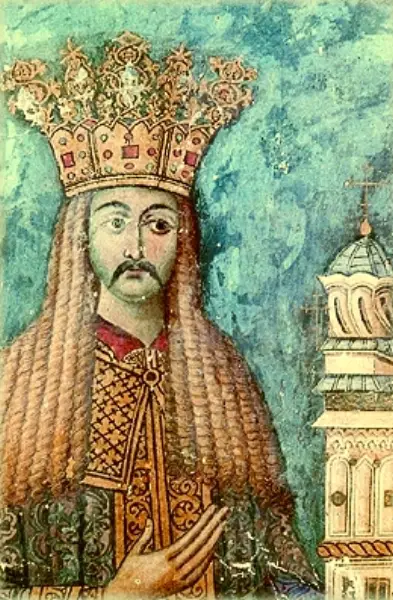
Neagoe died on 15 September 1521, aged about sixty-two, after nine years on the throne, and was buried in the cathedral of his own foundation at Curtea de Argeș, where his grave remains. His family joined the two worlds he had joined himself. He had married Milica Despina, a daughter of the Serbian ruling house, and among their children were Theodosie, who succeeded him as voivode, and Ruxandra, who married in turn two later princes of Wallachia, Radu of Afumați and Radu Paisie. Through these marriages the house he founded continued to shape the politics of the principality after his death, even as his son's brief reign ended the direct line of his rule. The Teachings he left to Theodosie outlived the dynasty, read by later generations as the voice of a Wallachian father to his heir. In the cathedral church at Curtea de Argeș, his image together with that of his wife and children was painted upon the monastery murals, fixing in colour the family that canonisation would later raise together into the communion of saints honoured by the Romanian Orthodox Church.
§ Family
The Holy Voivode Raised to the Altars
Four centuries and a half after his death, the Romanian Orthodox Church formally recognised what popular devotion had long asserted. On 8 July 2008 the Holy Synod, meeting in Bucharest, officially canonised Neagoe Basarab, inscribing the medieval voivode in the calendar of saints together with companions of that solemn act. His feast is celebrated each year on 26 September. In the iconography of his cult he is shown with the emblems of his double vocation: crown, cross, sword, and scroll, the last recalling the written instruction by which he taught his son. He is also honoured under the figure of the hesychast, the praying ascetic, joining the ideal of inner prayer to the outward duties of a reigning prince. His major shrine is the Cathedral of Curtea de Argeș, the church he built and in which he lies buried, where the faithful of Romania venerate him as intercessor and patron of the nation. The canonisation of a reigning prince, a man who fought battles and conducted the diplomacy of a tributary state, testifies to the Romanian Church's conviction that holiness can govern, and that the throne and the altar may be served by one faithful heart.
§ Canonisation
A Prince Remembered by Church and Nation
The memory of Neagoe Basarab has grown with the centuries rather than faded with them. As a writer he holds a founding place in Romanian letters, for the Teachings to his son Theodosie stands among the earliest literary works composed in the principality, studied as much for its political thought as for its piety. As a builder he gave the country its cathedral of cathedrals at Curtea de Argeș, a church so admired that legend rewrote its history around the craftsman Meșterul Manole. As a saint he enters the calendar of the Romanian Orthodox Church on 26 September, invoked as the holy voivode and prince of peace. The nation has claimed him in its own way: a military formation of modern Romania, the 26th Infantry Battalion, carries his name, and scholars continue to examine his writings beside those of Erasmus, Luther, and Machiavelli as a document of European Christian humanism. Few medieval rulers have been so fully claimed by both the altar and the academy. The crown, cross, sword, and scroll of his icons summarise the whole: a sovereign who prayed, a father who taught, and a builder whose church became his tomb and shrine.
§ Reign
Timeline
- 25 Dec 1501
Began service as High Seneschal of Wallachia.
§ Early life
- 19 Jun 1509
His tenure as High Seneschal came to an end.
§ Early life
- 26 Jan 1510
Mircea fled Wallachia after a battle near Cotmeana against an Ottoman army led by Neagoe Basarab.
§ Early life
- 2 Apr 1510
Took up the office of High Equerry under the reigning Vlad cel Tânăr.
§ Early life
- 28 Nov 1511
Helped capture Mircea and drive him out of the country.
§ Early life
- 23 Jan 1512
Ascended the throne as Voivode of Wallachia after the defeat of Vlad cel Tânăr at Văcărești.
§ Early life
- 1512
An edition of the Gospels was published at Târgoviște, the city where he ordered early works on the old Metropolitan church.
§ Reign
- 1517
The Curtea de Argeș Monastery was completed during his reign, legend naming Meșterul Manole as its chief craftsman.
§ Reign
- 15 Sep 1521
Died aged about sixty-two and was buried at the Curtea de Argeș Cathedral.
§ Reign
- 8 Jul 2008
Canonised by the Holy Synod of the Romanian Orthodox Church meeting in Bucharest.
§ Canonisation
In Their Own Words
teaching and soul food
The Record
- Major works
- The Teachings of Neagoe Basarab to his son Theodosie (Church Slavonic)·Curtea de Argeș Monastery·Early works on the old Metropolitan church, Târgoviște·St. Nicholas Church, Șcheii Brașovului
- Patron of
- Romania
- Symbols
- Crown·Cross·Sword·Scroll
- Canonization
- Canonized 8 July 2008 by the Holy Synod of the Romanian Orthodox Church in Bucharest
Prayer
Bibliography
Show 5 sources
- "Trecerea în rândul sfinţilor a domnitorului Neagoe Basarab, a lui Dionisie cel Smerit si a mitropolitului Iachint de Vicina" (in Romanian). Basilica (Romanian Orthodox Church news agency). 2008-07-08.
- Sundhaussen, Holm; Clewing, Konrad, eds. (2016). Lexikon zur Geschichte Südosteuropas [Dictionary of Southeast-European History] (in German). Vienna: Böhlau Verlag. p. 1025. ISBN 978-3205786672.
- Basarab, Neagoe (2022). Neagoe Basarb's Teachings to his Son Theodore. Translated by Skoubourdis, Christina Anna. Virgin Mary of Australia and Oceania. pp. 7–12. ISBN 9798444189443.
- Grigore, Mihai-D. (2015). Neagoe Basarab - Princeps Christianus: Christianitas-Semantik im Vergleich mit Erasmus, Luther, Machiavelli (1513-1523). Erfurter Studien zur Kulturgeschichte des Orthodoxen Christentums, Volume 10 (in German). Frankfurt: Peter Lang. p. 433. ISBN 9783631665077.
- "Sfântul Voievod Neagoe Basarab, prinţ al păcii" ("Holy Voivode Neagoe Basarab, Prince of Peace", in Romanian), Alexandru Briciu for Ziarul Lumina newspaper of the Romanian Orthodox Church, Bucharest, 26 September 2009.
Profile text adapted from the Wikipedia article, licensed CC BY-SA 4.0.
Pray with this saint every day
Save St. Neagoe Basarab to your favorites, read the full profile, and get feast-day reminders in the Saints app.
Get the Saints AppFree on the App Store for iPhone and iPad