
c. 468 – c. 510·Feast June 17
St. Nectan of Hartland
Welsh prince, hermit of Devon, and martyr
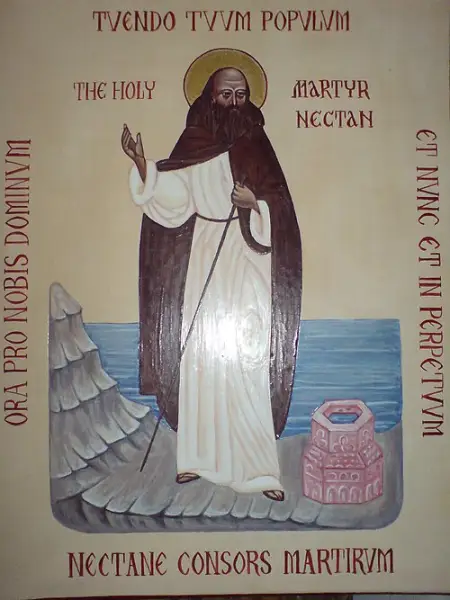
Overview
Saint Nectan of Hartland was a holy man of the fifth century whose hermitage, martyrdom, and shrine made the coast of Devon a place of pilgrimage throughout the Middle Ages. Born around 468, the eldest, according to his medieval Life, of the twenty-four children of King Brychan of Brycheiniog, he heard of Anthony, the great father of the Egyptian desert, and resolved to imitate his way of life. With companions he left Wales by boat, settling wherever providence cast them: the northern coast of Devon at Hartland, then a Brythonic-speaking land. There, in a forest solitude and later a remote valley with its own spring, he lived as a hermit, helping a swineherd recover his lost pigs and receiving two cows in return. When those cows were stolen, Nectan found the thieves and tried to convert them; they beheaded him in answer, and tradition says he carried his head back to his well before dying. Miracles began at his tomb, foxgloves were said to spring up where his blood fell, and a cult supported by Saxon kings and Norman lords flourished at his shrine. He remains the patron saint of Hartland, Devon.
The Complete Life
A Prince's Son Who Sought the Desert
The story of Nectan reaches us through a medieval Life, handed down together with a report of how his body was found and a gathering of miracle tales in a fourteenth-century manuscript kept today at Gotha; the narrative itself is judged to come from the close of the twelfth century. On its testimony he was the eldest of the twenty-four children of King Brychan of Brycheiniog, the great Brythonic royal house of what is now Brecknock in Wales, and he moved with his family from Ireland to Wales as a young child. Whatever the precise facts of so distant a childhood, the Life fixes the decisive influence of his youth: he heard of Anthony, the renowned hermit of the Egyptian desert, and was fired to copy his manner of life. The ambition set a prince's son on the road of renunciation. Rather than remaining at the court of Brycheiniog or taking up the warrior's role his birth entitled him to, he began to shape his whole existence around solitude, prayer, and simplicity, and the rest of his story is the working out of that resolve on the far side of the Bristol Channel, among the woods and valleys of the Devon coast.
§ Life
Landfall at Hartland
Seeking a solitude beyond even the wilds of Wales, Nectan and a band of companions put out to sea with the resolve to settle wherever their boat chanced to land. It came ashore on the northern coast of Devon at Hartland, and there the little community made its home, living for several years in the depths of a dense forest. The saint's family did not forget him; they would visit his retreat on the last day of each year, keeping the ties of a royal household across the water. In time he sought still greater seclusion, moving to a remote valley watered by a spring, where the ordinary graces of his life took shape. A swineherd who had lost his animals found them again through the hermit's help and gave him two cows in thanks, a gift that would prove the occasion of his death. Cornwall also claims a season of his life: at St Nectan's Glen near Trethevy, close to Tintagel, he is believed to have kept a hermitage above the waterfall, and legend tells that in stormy weather he rang a silver bell to caution vessels away from the dangerous rocks by the mouth of the Rocky Valley.
§ Life
The Imitation of Anthony
Every detail of Nectan's vocation points back to the desert father who inspired it. Anthony had abandoned wealth and family for the Egyptian wilderness; the Welsh prince abandoned a kingdom's expectations for a Devonian forest. Anthony had lived where demons might test him; Nectan lived where robbers would. Yet the hermit of Hartland was no mere copyist, for the form his imitation took was shaped by the country around him. He did not flee humanity altogether: he helped the swineherd of the neighbourhood recover his lost pigs, accepting from the poor man only two cows, and he kept a spring and valley where those in need might find him. His family's annual visits on the last day of the year preserved the bonds of kinship that Irish and Welsh sanctity always honoured rather than severed. Even the silver bell of the Cornish legend, rung in storms to save ships from the rocks, belongs to this pattern of a solitude turned outward in mercy. Nectan's spirituality was thus the eremetical ideal domesticated to the Celtic west: a man alone with God in a green desert, whose loneliness never hardened into indifference and whose retreat never closed the door of charity.
§ Life
Martyrdom at the Well
The death of Nectan came from the very gift the swineherd had given him. Thieves carried off his two cows, and the hermit went after them, found the animals, and then did what no robber expected: he attempted to convert the thieves to the Christian faith. Their answer was the sword, or the knife, for the account relates that they cut off his head. What followed made the story immortal. The same authority relates that the martyr took up his head and carried it back to his well, sinking down and dying there, a wonder told of only a handful of saints in Christendom. The man who had struck the blow went out of his mind at the sight, while his fellow thief, moved where his companion was broken, buried the saint's body. From that time onward, miracles were reported at St Nectan's tomb, and local tradition added its own seal: wherever the blood from the severed head had fallen, foxgloves were said to spring from the ground. The date of his death is traditionally placed around 510, and 17 June, the day kept as his feast in Devon, is remembered as the day of his martyrdom.
§ Life
Shrine of Kings, Wells, and Foxgloves
A considerable cult gathered around Nectan's shrine after his death and remained popular through the whole of the Middle Ages, upheld by Saxon kings and Norman lords alike. After his apparition and healing of a young man before the Battle of Brunanburh in 937, King Athelstan visited Hartland and gave property to the saint's church. Bishop Lyfing of Crediton approved the translation of the martyr's body as an accomplished fact, supplying the church with bells, roofing lead, and a reliquary of carved work, while the saint's staff was adorned with gold, silver, and jewels, and manors were granted to endow the church against pirates. From the twelfth century until the Reformation the church and shrine were in the care of the Augustinian canons of the neighbouring Hartland Abbey. Dedications spread: besides the great church of St Nectan at Stoke by Hartland, ancient churches honour him at Welcombe and probably Ashton in Devon, with a medieval chapel near St Winnow in Cornwall and a church at Ashcombe. His feast of 17 June was kept at Launceston, Exeter, and Wells, with other dates on 18 May, 14 February, and 4 December, the day of his translation; on the feast the faithful still carry foxgloves to his well.
§ Veneration
Timeline
- 423
According to his medieval Life, he moved from Ireland to Wales as a young child with the family of King Brychan.
§ Life
- 468
Born around this year, reckoned the eldest of King Brychan of Brycheiniog's twenty-four children.
§ Life
- 510
Martyred by robbers near his hermitage at Newton, Hartland, traditionally around this year.
§ Life
- 937
Reported to have appeared on the eve of the Battle of Brunanburh, healing a plague-stricken young man of Hartland.
§ Life
The Record
- Major works
- Hermitage at Hartland, Devon·Hermitage at St Nectan's Glen, Trethevy, Cornwall
- Patron of
- Hartland, Devon
- Symbols
- Foxgloves
- Canonization
- Pre-congregation; venerated as a martyr in the Catholic, Anglican, and Eastern Orthodox Churches
Prayer
Bibliography
Show 7 sources
- Jankulak, Karen (2000). The Medieval Cult of St Petroc. Woodbridge: Boydell. pp. 3–4.
- Doble, G. H. (1997). The Saints of Cornwall 5: Saints of Mid-Cornwall. Felinfach: Llanerch. p. 64.
- "Martyr Nectan of Hartland", Orthodox Church in America.
- Simpson, Jacqueline; Roud, Steve (2000). A Dictionary of English Folklore. Oxford University Press. p. 134. ISBN 0-19-860398-3.
- "St. Nectan's Glen History", St. Nectan's Glen.
- Loughrey, Anita. "The Legend of St Nectan". Historic UK. Retrieved 24 August 2014.
- Farmer, David Hugh. "Nectan" The Oxford Dictionary of Saints. Oxford University Press 2003. Oxford Reference Online.
Profile text adapted from the Wikipedia article, licensed CC BY-SA 4.0.
Pray with this saint every day
Save St. Nectan of Hartland to your favorites, read the full profile, and get feast-day reminders in the Saints app.
Get the Saints AppFree on the App Store for iPhone and iPad