
1846 – 1920·Feast November 9
St. Nectarios of Aegina
Metropolitan of Pentapolis and Wonderworker of Aegina
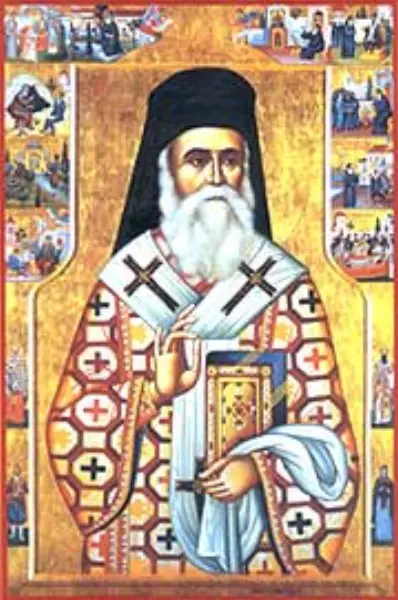
Overview
Nectarios of Aegina, baptized Anastasios Kephalas, became one of the most widely honored saints of the modern Eastern Orthodox Church. Born into a poor but devout family in Selymbria in 1846, he left home at fourteen to work and study in Constantinople, and at twenty took a teaching post on the island of Chios. In 1876 he embraced monastic life at the Monastery of Nea Moni, was ordained a deacon under the name Nectarios, and completed studies at the University of Athens in 1885. Sent to Egypt, he ministered at the Church of Saint Nicholas in Cairo and was consecrated Metropolitan of Pentapolis in 1889. Unfounded jealousy among colleagues brought accusations of ambition against the Patriarch, and he was suspended without explanation. Returning to Greece in 1891, he preached for several years and then directed the Rizarios Ecclesiastical School in Athens for fifteen years. In 1904 he founded Holy Trinity Monastery for nuns on Aegina, and in 1908 he withdrew there permanently, spending his last years in prayer, writing, and manual labor. He died of cancer on 8 November 1920 and was glorified as a saint in 1961.
The Complete Life
A Poor Boy of Selymbria
The child who would become Saint Nectarios entered the world on 1 October 1846 in Selymbria, a town in the Constantinople Vilayet of the Ottoman Empire, and was baptized with the name Anastasios Kephalas. His parents, Dimos and Maria Kephalas, were devout Christians of slender means, and the household they raised was marked by faith rather than comfort. Poverty shaped the boy's earliest years, but so did the religious seriousness of a family that practiced its Christianity without pretense. When Anastasios was fourteen, he made the consequential decision to leave Selymbria for Constantinople, the great imperial city that is Istanbul today, in search of both employment and education. He was a working student, supporting himself while he pursued his studies, and the years in the capital gave the provincial boy a wider horizon. At the age of twenty, in 1866, he moved again, this time to the island of Chios, where he secured a teaching post. Teaching suited him; it joined his gifts of mind to a life of service, and on Chios he spent years forming the young while quietly deepening his own desire for a stricter consecration to God.
§ Life
The Monk and Deacon
By the time Anastasios reached his thirtieth year, the pull toward the ascetic life he had long felt could no longer be deferred. On 7 November 1876 he became a monk at the Monastery of Nea Moni on Chios, a celebrated house of Orthodox monasticism, and there he took on the habit he had desired for so many years. Three years after his tonsure he was ordained a deacon, and from that point he was known by the monastic name Nectarios, the name under which the rest of his life would unfold. Recognizing his ability, the Church directed him toward formal theological education, and in 1885 he graduated from the University of Athens. His studies completed, he traveled to Alexandria in Egypt, the ancient see of the Patriarchate that had shaped so much of Christian Africa. There he was ordained a priest and was assigned to serve the Church of Saint Nicholas in Cairo, a congregation in the busy Egyptian capital where his preaching and pastoral diligence quickly drew notice. The trajectory from village boy to metropolitan was now nearly complete, and in 1889 Patriarch Sophronios consecrated him Metropolitan bishop of Pentapolis, an ancient diocese in Cyrenaica in what is now Libya.
§ Life
Bishop, Preacher, and Educator
Nectarios served as a bishop in Cairo for about a year, and his popularity with the people proved to be the seed of his misfortune. Colleagues grew jealous of the esteem he enjoyed, and they persuaded his superior that Nectarios harbored designs of displacing the Patriarch himself. On the strength of these insinuations he was suspended from his post without any explanation offered, a humiliation he bore without protest or recrimination. In 1891 he returned to Greece and entered a new field of labor: for roughly three years, from 1891 to 1894, he worked as a preacher, carrying catechesis and exhortation to the faithful. His gifts for teaching did not go unnoticed, and he was appointed director of the Rizarios Ecclesiastical School in Athens, the institution charged with the education of priests. For fifteen years he led that school, forming generations of clergy for the Greek Church while continuing his own scholarly and literary production. His influence on the formation of the Greek priesthood in those decades was profound, and it was during these Athens years, in 1911, that he ordained two women as deaconesses, employing an ancient Byzantine ritual text whose usage was later revived by others.
§ Life
The Ascetic Teacher
Nectarios combined the scholar's desk with the monk's cell, and this union of learning and asceticism defined his spiritual character. He had entered monastic life out of a long-cherished desire for the ascetic way, and even as a bishop and school director he remained at heart a monk. His literary work flowed from this integration: among his writings translated into English are Repentance and Confession and Christology, works that treat the soul's return to God and the Church's doctrine of her Lord. He also composed the hymn Agni Parthene, O Virgin Pure, which became one of the most beloved chants in Greek Orthodox devotion. Perhaps the most telling expression of his spirituality was his willingness to ordain deaconesses in 1911 according to the ancient Byzantine rite, an act of pastoral imagination grounded in the Church's own tradition. When at last he was free to live as he had always wished, he chose the plainest possible existence: tending gardens, carrying stones for construction, hearing confessions, and writing. Those who sought him found a man of accessible holiness, uninterested in privilege, who regarded manual work, prayer, and scholarship as a single undivided offering to God.
§ Life
The Convent on Aegina
In December 1908, at the age of sixty-two, Nectarios laid down his post as director of the Rizarios Ecclesiastical School and withdrew to the Holy Trinity Convent on Aegina, the women's monastery he had founded four years earlier at the request of several nuns. There he lived out the remainder of his life as a monk among the sisters whose community he had brought into being. He was never idle: he wrote and published, preached, and heard confessions, while also taking his turn at humble physical labor. He tended the monastery gardens, carried stones alongside the builders, and helped raise the monastery buildings, which were constructed with funds from his own resources. In his final illness he was hospitalized for prostate cancer and endured two months of treatment before death came on 8 November 1920, when he was seventy-four years old. His body was conveyed to the Holy Trinity Convent, where his closest friend, Savvas of Kalymnos, buried him; Savvas later painted the first icon of the man he had loved. The funeral drew multitudes of mourners from every part of Greece and from Egypt, a spontaneous tribute to a bishop whom the Church hierarchy had once cast aside but whom the people had never ceased to trust.
§ Life
Glory and Restoration
Veneration of Nectarios grew swiftly after his death, and the Church moved to acknowledge what the faithful already knew. His relics were removed from the grave at the Holy Trinity Convent on 2 September 1953. On 20 April 1961, Patriarch Athenagoras I of Constantinople formally glorified Nectarios as a saint, the act of canonization taking place in Saint George's Cathedral in Istanbul, not far from the city where the boy Anastasios had once arrived penniless to seek his education. His feast day was fixed for 9 November, the day after his repose. A remarkable postscript followed in the land of his greatest humiliation. On 15 September 1998 the synod of the Alexandrian patriarchate, gathered under Pope Petros VII, formally restored the ecclesiastical standing of Nectarius, more than a century after his expulsion from that church. The synod's written decision appealed for forgiveness for the opposition the saint had suffered and granted him all due honors, explicitly citing his innumerable miracles and the place he had won in the devout conscience of Orthodox believers everywhere. It stands as a rare official reversal of an injustice rendered within a hierarch's own lifetime.
§ Veneration
Wonderworker of Aegina
Nectarios is remembered today as one of the most renowned of Greek saints, and his reputation rests chiefly on his role as a healer. He is honored as a patron of people suffering from disease, and the faithful invoke him especially in cases of cancer, heart trouble, joint pain, epilepsy, and arthritis. His principal shrine is the monastery he founded on Aegina, where his relics remain and where pilgrims continue to arrive in great numbers. His literary and musical works endure in the Church's life: his treatises on confession and on the doctrine of Christ circulate in English translation, and his hymn to the Mother of God is sung wherever Greek Orthodox Christians pray. The Holy Trinity Monastery on Aegina remains a living community, the tangible continuation of his labor. His story has also reached beyond the Church: the film Man of God, released in 2021 under Yelena Popovic's direction, carried the story of the slandered and vindicated bishop to viewers around the world. Perhaps his most consequential legacy is institutional memory within Orthodoxy, for the deaconess ritual he preserved and employed in 1911 was later invoked by other bishops, ensuring that the question of restored female ministry in the Orthodox Church still bears his name.
§ Veneration
Timeline
- 1 Oct 1846
Born Anastasios Kephalas in Selymbria, to a poor and pious Christian family.
§ Life
- 1866
Moved to the island of Chios at age twenty to take up a teaching post.
§ Life
- 7 Nov 1876
Became a monk at the Monastery of Nea Moni, fulfilling a long-held desire for the ascetic life.
§ Life
- 1885
Graduated from the University of Athens before departing for Egypt.
§ Life
- 1889
Consecrated Metropolitan bishop of Pentapolis by the Greek Orthodox Patriarch Sophronios.
§ Life
- 1891
Returned to Greece after being suspended from his see, and began work as a preacher.
§ Life
- 1904
Established Holy Trinity Monastery for nuns on the island of Aegina at the request of several women.
§ Life
- Dec 1908
Resigned as director of the Rizarios Ecclesiastical School and withdrew to the Holy Trinity Convent on Aegina.
§ Life
- 1911
Ordained two women as deaconesses using an ancient Byzantine ritual text.
§ Life
- 8 Nov 1920
Died on Aegina at age seventy-four after two months of hospital treatment for prostate cancer.
§ Life
- 2 Sep 1953
His relics were removed from the grave at the Holy Trinity Convent.
§ Veneration
- 20 Apr 1961
Glorified as a saint by Patriarch Athenagoras I of Constantinople in Saint George's Cathedral, Istanbul.
§ Veneration
- 15 Sep 1998
The Patriarchate of Alexandria and all Africa formally restored his ecclesiastical order.
§ Decision of Holy Synod of the Patriarchate of Alexandria
In Their Own Words
We hereby restore the ecclesiastical order of the Saint of our Century, Saint Nektarios, and grant to him all due credits and honours.
The Record
- Major works
- Agni Parthene (hymn)·Repentance and Confession·Christology
- Patron of
- Aegina·people suffering from diseases, including cancer, heart trouble, joint pain, epilepsy, and arthritis
- Symbols
- sakkos·omophorion about the shoulder·book·epanokalimavkion
- Canonization
- Glorified by Patriarch Athenagoras I of Constantinople on 20 April 1961 in Saint George's Cathedral, Istanbul.
Prayer
Bibliography
Show 8 sources
- "Saint Nektarios of Egina (1846-1920)", OrthodoxPhotos.com
- "Shrine of St. Nektarios of Aegina", St. George Greek Orthodox Cathedral
- "The Life of St. Nectarios", St. Nectarios Greek Orthodox Church
- Zagano, Phyllis (7 February 2005). "'Grant Her Your Spirit'", America Magazine
- Adrahtas, Dr Vassilis (4 December 2022). "The Ordination Of Women In The Orthodox Church: Revealing The Truth"
- Mirabela, Capilna (11 May 2022). "Saint Nectarios. Who is Nectarios of Aegina?", DoorToEden
- "St. Nektarios of Aegina", OrthodoxPhotos.com
- Sotos Chondropoulos. SAINT NEKTARIOS: The Saint of Our Century. Translated by Peter and Aliki Los. ISBN 978-960-7374-43-1
Profile text adapted from the Wikipedia article, licensed CC BY-SA 4.0.
Pray with this saint every day
Save St. Nectarios of Aegina to your favorites, read the full profile, and get feast-day reminders in the Saints app.
Get the Saints AppFree on the App Store for iPhone and iPad