
died c. 300·Feast December 9
St. Nectarius of Auvergne
Missionary Martyr of Saint-Nectaire
Overview
Saint Nectarius of Auvergne, honored also as Nectarius of Saint-Nectaire, Nectarius of Limagne, and Necterius of Senneterre, is venerated as a missionary and martyr of the fourth century in the Roman Catholic and Eastern Orthodox Churches. The traditions surrounding him vary, but all place him among the first preachers of the Gospel in Gaul. One legend relates that after the death of his wealthy parents he was accused of taking part in a conspiracy, fled to Rome, encountered the Christians there, and was baptized by Saint Peter, who then dispatched him and his brothers to evangelize Gaul. Gregory of Tours preserves a different lineage: Nectarius was one of the seven missionaries whom Pope Fabian sent from Rome to spread Christianity across Gaul, alongside Gatianus of Tours, Trophimus of Arles, Paul of Narbonne, Martial of Limoges, Denis of Paris, and Saturninus of Toulouse. Accompanied by the priests Baudimius and Auditor, traditionally his brothers, he labored in the Massif Central, where he transformed a temple of Apollo on the hill of Cornadore into a Christian church at the site now called Saint-Nectaire. There the pagan leader Bradulus put him to death around the year 300.
The Complete Life
From Rome to the Nations
The origins of Nectarius are wrapped in legend, and the medieval sources preserve more than one account of how a Christian preacher came to the mountains of Auvergne. In the most colorful tradition, Nectarius was the son of wealthy parents whose death left him exposed to an accusation of conspiracy; rather than face his accusers he fled to Rome. In the imperial capital he fell in with the Christian community, was taken in and cared for, and received baptism at the hands of Saint Peter himself, who then sent the new convert and his brothers out as missionaries to the lands of Gaul. A different and more sober pedigree comes from Gregory of Tours, the great historian of the Frankish Church, who counted Nectarius among the seven missionary bishops dispatched by Pope Fabian from Rome to evangelize Gaul, in the company of Gatianus of Tours, Trophimus of Arles, Paul of Narbonne, Martial of Limoges, Denis of Paris, and Saturninus of Toulouse. A third tradition, finally, holds that it was Saint Austremonius who dispatched Nectarius and Antoninus to bring the Christian faith to the Limagne plain, deep in the Massif Central. Whatever the true chain of commission, all the traditions agree that his life was given to carrying the Gospel across the mountains into pagan territory.
§ Life
Apollo's Hill Becomes Christian
Nectarius did not labor alone. He was accompanied by two priests, Baudimius and Auditor, whom tradition describes as his own brothers, making the Auvergne mission in a sense a family undertaking. Their field of labor lay in the volcanic country of central France, where paganism held the high places. On the hill known as Cornadore above the settlement now called Saint-Nectaire stood a temple dedicated to Apollo, and there Nectarius wrought his most enduring conversion: he transformed the pagan shrine into a Christian church, the Church of Notre Dame du Mont Cornadore, a building that today bears the martyr's own name. To seize a cult site and rededicate it to Christ was a characteristically bold stroke of early evangelization, announcing to the surrounding population that the old gods had yielded their ground. The hilltop church anchored the preaching of the missionaries in the plain of Limagne and the surrounding highlands. This work could not go unanswered by the guardians of the old order, and the sources record that the local pagan leader, a man named Bradulus, took the decisive and bloody step of killing Nectarius, thus sealing the missionary's work with martyrdom around the year 300.
§ Life
The Saint in Stone and Cheese
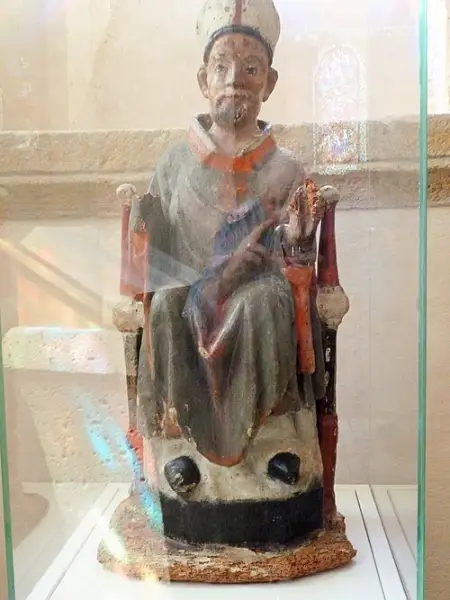
The cult of Nectarius is attested from the tenth century onward, and a tomb at the priory of the Benedictines in St-Nectaire drew medieval pilgrims in growing numbers. The name of the place itself drifted through the forms Sennecterre and Senneterre before settling as Saint-Nectaire, and the borough that grew up around the priory flourished in ways the martyr could not have foreseen: it became known for its mineral waters and for the manufacture of the celebrated cheese that carries the town's name to tables across France. In the town's church, the major shrine of the saint, a statue of Nectarius keeps his memory before the faithful, and a reliquary bust of Saint Baudimius, the brother traditionally at his side, recalls the companionship of the original mission. Nectarius shares the patronage of Saint-Nectaire with Saint Auditor, his fellow missionary, although for reasons no one now can explain, Auditor ranks as the town's principal patron. The martyr's feast is kept on 9 December in both the Roman Catholic and Eastern Orthodox Churches. His story endures as one of the foundation legends of Christianity in Auvergne, joining the seven missionaries of Gregory of Tours to the volcanic landscape they were said to have conquered for Christ.
§ Veneration
The Record
- Patron of
- Saint-Nectaire, Puy-de-Dôme (together with Saint Auditor)
- Canonization
- Pre-congregation martyr, venerated since the early Church in the Roman Catholic and Eastern Orthodox Churches.
Prayer
Bibliography
Show 4 sources
- A. van den Akker s.j. (2009). "Nectarius van St-Nectaire", Heiligen-3s, retrieved April 23, 2009
- Goyau, Georges. "Diocese of Clermont." The Catholic Encyclopedia Vol. 4. New York: Robert Appleton Company, 1908
- Odden, Per Einar. "Den hellige Nectarius av Auvergne (d. ~300)", Den katolske kirke, October 4, 2011
- See Senneterre, Quebec
Profile text adapted from the Wikipedia article, licensed CC BY-SA 4.0.
Pray with this saint every day
Save St. Nectarius of Auvergne to your favorites, read the full profile, and get feast-day reminders in the Saints app.
Get the Saints AppFree on the App Store for iPhone and iPad