
died 27 September 397·Feast October 11
St. Nectarius of Constantinople
Archbishop of the Imperial City and President of the Second Ecumenical Council
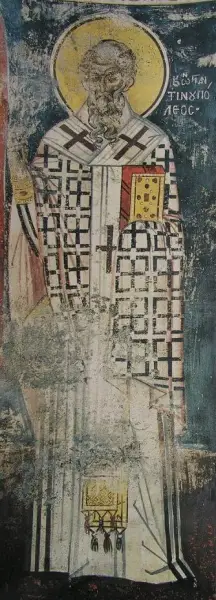
Overview
Nectarius of Constantinople governed the archbishopric of the imperial capital from 381 until his death on 27 September 397, succeeding Saint Gregory of Nazianzus and preceding John Chrysostom in the see of the new Rome. Born in Tarsus in Cilicia to a noble family noted for admirable character, he was serving as praetor of Constantinople when the First Council of Constantinople needed a new president-bishop after Gregory's resignation. A chance encounter with Diodorus, bishop of Tarsus, led to his name being placed at the bottom of the candidate list offered to Emperor Theodosius I, and to the amazement of the assembled Fathers the emperor chose the still-unbaptized catechumen. Nectarius was baptized, clothed as a bishop, and at once made president of the ecumenical council, whose canons bear his name at the head of 150 signatures. Under his presidency the third canon assigned Constantinople the first rank of honor after Rome. He ruled the church for sixteen years, steered the imperial capital through the contests with Arians and Pneumatomachians, maintained communion with the West after initial dissent over his election, and reformed penitential discipline by abolishing the office of presbyter penitentiary. He died in office and was succeeded by John Chrysostom.
The Complete Life
A Nobleman of Tarsus
Nectarius came from Tarsus, the chief city of Cilicia and the birthplace of the Apostle Paul, and he belonged to a noble family whose good standing was matched by a reputation for admirable character. By the year of Gregory of Nazianzus's resignation from the see of Constantinople, Nectarius had advanced in imperial service to the position of praetor of Constantinople, a civil post in the capital of the Eastern Empire. He was, at this decisive moment, still only a catechumen, a convert preparing for baptism rather than a member of the clergy. The turn of providence that carried him to the episcopate began with a journey home: preparing to travel to Tarsus, he paid a courtesy call on Diodorus, the bishop of that city, to ask whether he might carry letters for him. Diodorus, who was attending the First Council of Constantinople, was so struck by the praetor's appearance and manners that he resolved on the spot that this layman should be advanced as a candidate for the bishopric. Under the pretext of attending to some other business, Diodorus brought Nectarius to meet Meletius of Antioch, and the machinery of his astonishing elevation began to move.
§ Life
The Catechumen Chosen by an Emperor
When Gregory of Nazianzus stepped down from the archbishopric, Emperor Theodosius I asked the bishops gathered at the council to propose new candidates from among whom he would pick the next bishop of the capital. Nectarius's name, entered by the bishop of Antioch, stood at the foot of the slate of candidates. Having perused the lists, the emperor announced that Nectarius was the man he wanted. The assembled Fathers were astonished and pressed to discover who and what this Nectarius might be, for he was still only a catechumen and had never sought the office. Astonishment rippled through the assembly, but the people of Constantinople received the news with delight, and the whole council came to share their joy. What followed was without parallel: Nectarius was baptized, his lay garments were swapped for the vestments of the capital's chief bishop, and without delay he became president of the First Council of Constantinople, one of the great ecumenical councils of the Church. A civil official of noble birth found himself in a single sequence of days a baptized Christian, a bishop, and the presiding officer of the assembly charged with defining the doctrine of the Holy Spirit.
§ His unexpected appointment
Shepherding the Capital Through Controversy
Nectarius governed the church of Constantinople for more than sixteen years, and posterity has reckoned his leadership good. He stands first among the 150 signatories of that council's canons, whose third canon, issued during his presidency, assigned the bishop of the capital the first rank of honor after Rome's bishop, on the ground that his city ranked as the new Rome. His election, however, did not go unchallenged: the Western episcopate refused to accept the outcome and demanded a joint synod of both halves of Christendom to rule on the succession. In response, Theodosius convened another gathering of bishops at Constantinople in early summer 382, reassembling nearly all the bishops of the earlier council. Though invited by the synod of Milan to a general council at Rome, they pleaded the length of the journey and instead sent three delegates with a synodal letter to Pope Damasus I, Saint Ambrose, and the Roman council. Recognition eventually arrived: the emperor dispatched envoys to Rome to plead his synod's cause, and his fifteenth letter, written to the Illyrian bishops, reports that Rome's church at length consented to acknowledge both Nectarius and Flavian I of Antioch. In 383, with Arians and Pneumatomachians still spreading their doctrines, the emperor summoned all parties to a great June discussion, and Nectarius, anxious at the task, took counsel from the philosopher-theologian Sisinnius, whose strategy of appealing to the testimony of the pre-Arian Fathers shaped the disputation before the emperor.
§ Dissent threatens
Discipline of Penance and the Bonds of Friendship
Six letters from Nectarius remain extant among the correspondence of his predecessor Gregory of Nazianzus, and they open a small window into his soul. The opening letter offers warm good wishes for Gregory's episcopate; the final one, the most weighty of the six, warns him against showing excessive tolerance toward the Apollinarians, the party that denied Christ's true human mind. The letter shows a shepherd vigilant for the purity of the faith, yet his discipline was not harshness but a pastoral realism most visible in his reform of penance. Towards the close of his episcopate he abolished the office of presbyter penitentiary, the priest whose duty was to receive confessions before communion, and nearly all other bishops followed his example. The post had been inscribed in the church's rolls near the era of the Novatianist rupture, when that sect broke communion with believers who had fallen away during the Decian persecution; as reconciliations of the lapsed grew fewer, the penitentiary's duties had drifted toward the preparation of communicants. A scandal connected with the office moved Nectarius to abolish it outright, a decision that reshaped the practice of penance across the Church and reveals a bishop attentive both to the honor of the clergy and to the conscience of the penitent.
§ Life
Imperial Funerals and a Quiet End
The closing years of Nectarius's episcopate intertwined his office with the sorrows of the imperial house. In 385 the emperor's wife Aelia Flaccilla died, together with their daughter Pulcheria, and the archbishop asked Gregory of Nyssa, the finest preacher of the age, to proclaim the funeral sermons for both, entrusting the court's grief to one of the great theologians of the century. He also presided over the aftermath of the 383 disputation, in which the emperor required each party to present a written confession of its doctrine. Theodosius retired to his study with the documents, rejected and destroyed all but the orthodox confession on the ground that the others introduced division into the Holy Trinity, and then prohibited every dissenting group save the Novatianists from celebrating services, spreading their teaching, or ordaining ministers, on pain of harsh civil punishment. Towards the close of his episcopate Nectarius carried out his final and most consequential reform, the abolition of the presbyter penitentiary. He died in office on 27 September 397, after upwards of sixteen years of rule, and the succession that followed his death would prove one of the most famous in the history of the see: the imperial capital chose for itself the golden-mouthed preacher John Chrysostom.
§ Dissent threatens
A Saint of the First Millennium
The Eastern Orthodox Church holds Nectarius to be a saint, and his memory is kept each year with a feast on 11 October. The veneration is ancient rather than modern: he was honored as a saint within the first millennium of Christianity, the era in which he himself had lived and governed, and the feast of 11 October is recorded in the liturgical typicon of the Great Church, the document of Constantinople's own cathedral rite preserved by Juan Mateos in his edition of 1962. No formal canonization process stands behind his cult, for he belongs to the company of bishops whose sanctity the Church recognized by tradition and liturgical observance rather than by decree. His place in the orthodox memory of the capital rests on the facts of his ministry: the man who signed the canons of the Second Ecumenical Council as its president, who held the church of the new Rome steady while its rank among the patriarchates was being settled, and who guided the imperial city through its great contests with Arian teaching. Orthodox Christians commemorate him in the unbroken list of the archbishops and patriarchs of Constantinople, where his name stands between Gregory the Theologian and John Chrysostom.
§ Veneration
The Rank of New Rome
The most enduring monument of Nectarius's episcopate is institutional. The third canon of the First Council of Constantinople, promulgated under his presidency and bearing his name at the head of its signatures, assigned the bishop of Constantinople the first rank of honor after the bishop of Rome on the ground that his city was the new Rome. That ruling set the course of ecclesiastical geography for the rest of Christian history, underpinning the eventual emergence of the patriarchate of Constantinople as the second see of Christendom and the religious center of the Byzantine world. His own conduct in office supplied the model the see required: a nobleman without clerical ambition, chosen by an emperor, confirmed by a council, and eventually accepted by the West, who governed the capital peaceably for sixteen years and was judged by posterity a good prelate. His correspondence with Gregory of Nazianzus survived to instruct later readers in the vigilance owed to the faith, and his abolition of the presbyter penitentiary altered the discipline of penance in nearly every church of his day. He lies in the chain of succession between two of the greatest names of Greek Christianity, Gregory of Nazianzus before him and John Chrysostom after him, a quiet but decisive link between the age of the great councils and the golden age of Constantinopolitan preaching.
§ Life
Timeline
- Jun 381
Installed as archbishop of Constantinople in June 381 after the emperor's unexpected choice, and at once made president of the First Council of Constantinople.
§ His unexpected appointment
- 382
Assembled with the bishops at a fresh synod in Constantinople convened by Theodosius I to answer Western dissent over his election.
§ Dissent threatens
- Jun 383
Opened a third synod at Constantinople amid continuing spread of Arian and Pneumatomachian teaching.
§ Dissent threatens
- 385
Asked Gregory of Nyssa to preach the funeral sermons for Empress Aelia Flaccilla and her daughter Pulcheria.
§ Dissent threatens
- 27 Sep 397
Died in office on 27 September 397 after roughly sixteen years governing the church of Constantinople.
§ Dissent threatens
In Their Own Words
The teachers who lived before the Arian division?
The Record
- Major works
- Six extant letters to Gregory of Nazianzus, preserved in Gregory's correspondence files
- Canonization
- Pre-congregation saint; venerated as a saint in the first millennium, with his feast kept on 11 October in the Eastern Orthodox Church.
Prayer
Bibliography
Show 8 sources
- Sinclair, W. M. (1911). "Nectarius, archbishop of Constantinople". In Wace, Henry; Piercy, William C. (eds.). Dictionary of Christian Biography and Literature to the End of the Sixth Century (3rd ed.). London: John Murray
- Fortescue, Adrian (1911). "Nectarius". Catholic Encyclopedia. New York
- William Smith (1842), A Dictionary of Greek and Roman biography and mythology, London, John Murray
- Alan Butler and Paul Burns (1995), Butler's Lives of the Saints, Vol. 10, A & C Black, ISBN 9780860122593
- "Orthodox Calendar 2018", orthochristian.com
- Mateos, Juan (1962). Le Typicon de la Grande Église. Vol. 1. Rome: Pont. Institutum Orientalium Studiorum, p. 66
- Karl Josef von Hefele, Hist. Christ. Councils, tr. Oxenham (Edinburgh 1876), Vol. II, pp. 344, 347, 378, 380, 382
- Socrates Scholasticus, H. E.; v, viii; Sozomenus H. E.; vii, viii; Theodoret H. E.; v, viii
Profile text adapted from the Wikipedia article, licensed CC BY-SA 4.0.
Pray with this saint every day
Save St. Nectarius of Constantinople to your favorites, read the full profile, and get feast-day reminders in the Saints app.
Get the Saints AppFree on the App Store for iPhone and iPad