
died 303·Feast January 21
St. Neophytos of Nicaea
Martyr of Nicaea Under Diocletian
Overview
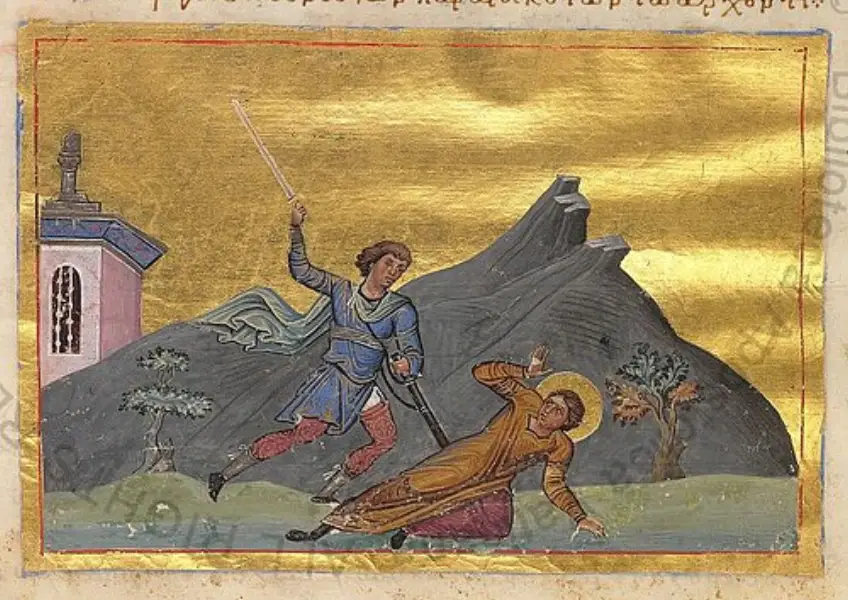
Neophytos of Nicaea was a Christian martyr who died under Roman persecution in the year 303. Born in Nicaea of Bithynia to Christian parents, Theodore and Florentia, he grew up in one of the great cities of Asia Minor, the same town that would later give its name to the Church's creed. When the Diocletianic Persecution, the last and fiercest assault of the empire upon Christianity, reached his homeland, Neophytos made his way to Nicaea and there denounced the pagan religion openly, refusing the accommodation the authorities demanded of Christians. For this defiance Roman soldiers killed him in A.D. 303, a full decade before the Edict of Milan gave the Christian faith permanent toleration across the empire's territory. He was commemorated from antiquity with a feast on January 21. His memory received an unexpected archaeological echo in 2014, when the underwater Byzantine Basilica of Saint Neophytos, suspected to have been dedicated in his honor, was discovered beneath Lake İznik, which covers the site of ancient Nicaea. The basilica had been raised on the shore of the lake at the place where the martyr was put to death, and it later sank beneath the water after an earthquake.
The Complete Life
A Christian Son of Nicaea
Neophytos belonged to the Christian community of Nicaea, the celebrated city of Bithynia that stood on the eastern shore of its lake in what is now northwestern Turkey. His parents, Theodore and Florentia, were themselves Christians, and the faith they handed to their son was the faith for which he would one day die. To be a Christian in Nicaea at the close of the third century was to belong to a community that had known suspicion and danger for generations, meeting in the houses and shrines of a city where the old gods of the empire still received public honors. The great trial of that community came with the Diocletianic Persecution, the empire-wide suppression of Christianity ordered at the end of the third century, which struck at churches, scriptures, and believers with a severity the Church had never before endured. When the persecution reached Bithynia, it demanded precisely what the young Christian of Nicaea refused to give: a public acknowledgment of the pagan faith. Rather than keep silent, Neophytos went to Nicaea and denounced the pagan religion openly, turning himself from a hunted believer into a public witness.
§ References
The Bold Denunciation
The act for which Neophytos is remembered was a public and deliberate provocation to the authorities of the persecution: he came to Nicaea and, in defiance of the imperial edicts, boldly denounced the pagan faith. In an age when many Christians lapsed, fled, or hid their books, the open repudiation of the imperial cult was a confession of Christ made at the risk of everything. The response of the Roman state was swift and lethal: soldiers killed him in A.D. 303, making him one of the early victims of the Diocletianic Persecution, the same year in which the great persecution was launched. His death came a decade short of the Edict of Milan, which would permanently secure toleration for Christianity inside the empire's borders, so that he died at the very darkest hour, without seeing the dawn that followed. The Church of the East honored him among its martyrs and fixed his commemoration on January 21. His witness did not fade from the memory of Nicaea's Christians, who treasured the place of his death on the shore of the lake and, in the Byzantine era, marked it with a basilica in his name.
§ References
The Basilica Beneath the Lake
The memory of Neophytos surfaced again in a remarkable way in modern times. In 2014, the underwater Byzantine Basilica of Saint Neophytos, believed to have been dedicated in his honor, was discovered lying beneath the waters of Lake İznik, the lake that preserves the outline of ancient Nicaea in modern-day Turkey. The identification of the building carries the martyr's story to its place of origin: the basilica had been built on the shore of the lake at the very spot where Neophytos was killed by Roman soldiers, so that his shrine stood as a permanent sermon in stone upon the ground of his witness. In the centuries after its construction the church was swallowed by the lake, sinking beneath the water after an earthquake, and there it remained intact beneath the surface, its walls and traces of its frescoes recorded by archaeologists. Plans have been discussed for the submerged basilica to become an underwater museum, through which visitors might approach the site of the martyrdom as divers or by walkways. For the Church, the discovery joined archaeology to hagiography: the martyr commemorated on January 21 now has his place of passion mapped on the lake bed, a rare instance in which the death of an early martyr and the modern search for the past coincide so exactly.
§ References
Timeline
- 303
Killed by Roman soldiers at Nicaea after boldly denouncing the pagan faith during the Diocletianic Persecution.
§ References
- 2014
Discovery of the underwater Byzantine Basilica of Saint Neophytos beneath Lake İznik, built where he was killed and submerged after an earthquake.
§ References
The Record
- Canonization
- Pre-congregation martyr, commemorated as a saint from the earliest centuries of the Church.
Prayer
Bibliography
Show 3 sources
- MYSTAGOGY: Saint Neophytos the Martyr of Nicaea
- Martyr Neophytus of Nicea - Orthodox Church in America
- Basilica in Lake Iznik to become underwater museum, Hürriyet Daily News, 2015-04-07
Profile text adapted from the Wikipedia article, licensed CC BY-SA 4.0.
Pray with this saint every day
Save St. Neophytos of Nicaea to your favorites, read the full profile, and get feast-day reminders in the Saints app.
Get the Saints AppFree on the App Store for iPhone and iPad