
died 11 August 1508·Feast August 11
St. Nephon II of Constantinople
Thrice-elected Ecumenical Patriarch and monk of Mount Athos
Overview
Nephon II, born Nicholas in the Peloponnese, served three times as Ecumenical Patriarch of Constantinople at the close of the fifteenth century. Of Albanian paternity and Greek maternal descent, he became a monk at Epidaurus, supported himself with calligraphy and the copying of manuscripts, and rose through the monastic and episcopal ranks of the late Byzantine Church under Ottoman rule. Elected Metropolitan of Thessaloniki in 1482, he was raised to the patriarchal throne in 1486 with the backing of the Wallachian prince Vlad Calugarul, an alliance that began the era of Wallachian influence over patriarchal elections. His first two reigns were cut short by intrigue and exile, yet his reputation for holiness grew steadily. Refusing a third election in 1502, he instead shepherded the Church of Wallachia in practice, braved a prince's anger over an unlawful marriage, excommunicated its groom, and preached through the towns of Macedonia before withdrawing to Mount Athos. He died at the Monastery of Dionysiou in 1508, was honored as a saint almost immediately, and was formally glorified nine years later, with his feast kept on 11 August.
The Complete Life
A Monk of Two Peoples
Nicholas was born on the Peloponnese peninsula in the south of Greece, his father Albanian and his mother Greek, a child of two peoples whose fortunes would later be bound up with his ministry. He embraced the monastic life while still young, receiving the tonsure at Epidaurus and taking the religious name Nephon. In the monastery he was trained as a calligrapher and gave long hours to copying manuscripts, a discipline that joined patient labor with the preservation of the sacred texts. Seeking a deeper spiritual guide, he attached himself to a monk named Zacharias and followed him to the Monastery of the Theotokos in Ohrid. When Zacharias was elevated to the archbishopric of Ohrid, Nephon continued his search for solitude on Mount Athos, the great center of Orthodox monasticism. There he was ordained a hieromonk, joining priestly ministry to the monastic vocation. His reputation for learning and piety soon carried him beyond the cloister: in 1482 the Church elected him Metropolitan of Thessaloniki, one of the most important sees of the Greek East, setting him on the road that would lead to Constantinople.
§ Life
The First Patriarchate
The turning point of Nephon's career came at the end of 1486, when he was elected Patriarch of Constantinople. His elevation was secured by Vlad Calugarul, the wealthy Prince of Wallachia, whose patronage inaugurated a new chapter in which Wallachian rulers took a direct part in shaping the elections of the Church under Ottoman domination. The first patriarchate lasted some eighteen months before scandal forced his fall. His predecessor Symeon I had died without leaving a will, and Iskender Bey, a convert to Islam who served the Sultan as treasurer and was a son of Symeon's sponsor George Amiroutzes, demanded that the dead patriarch's inheritance, including its ecclesiastical possessions, pass to the imperial treasury. To shield the Church's property, Nephon presented a nephew of Symeon as the lawful heir, procuring false testimony from three monks. When the truth emerged, Sultan Bayezid II confiscated the estate, punished the clergy involved, and exiled Nephon to an island off Sozopol in the Black Sea; his deposition followed in the early months of 1488. The historian Steven Runciman would later judge him a foolish and unsatisfactory patriarch, though the veneration of the faithful told another story.
§ Life
Exile, Restoration, and Refusal
In the summer of 1497 Nephon was restored to the patriarchal throne, again through the support of a Wallachian ruler, Radu IV the Great. His second tenure proved briefer than his first: in August 1498 the young Joachim I, backed by King Constantine II of Georgia, overthrew him, and Nephon was sentenced to life imprisonment and banished to Adrianople. Imprisonment only deepened his renown. When Radu visited the jailed patriarch he bowed down before him, and soon afterward obtained his release on bail from the Ottoman Sultan. Nephon moved to Wallachia, where clergy and laity welcomed him warmly and where he promptly ordained two bishops. When 1502 arrived, the synod chose him once more for the patriarchal throne and dispatched messengers to summon him home, but he refused the honor resolutely and never returned to the imperial city. Between 1503 and 1505 he instead led the Church of Wallachia in practice, shepherding a flock far from Constantinople and showing that his idea of ministry was bound to people and parishes rather than to patriarchal rank.
§ Life
Conscience Before a Prince
The firmness of Nephon's conscience appeared most vividly in his conflict with Prince Radu over a prohibited marriage. Radu's elder sister Calpea was to wed Bogdan Logothete, a Moldovan boyar who already had a living wife, and Nephon refused to celebrate the union. Threatened by the prince, the aged patriarch did not yield: he gathered the people, preached to them, and excommunicated the groom, prophesying the misfortunes that would follow. Leaving his patriarchal vestments on the altar, he walked out of the church and withdrew to a deserted hut. Radu, fearing the outcry of his subjects, tried every device of appeasement, soft words, pledges, and presents, pleading with him to pardon his brother-in-law; Nephon would not be moved. He left Wallachia for Macedonia with two of his disciples, passing through all the towns of the region and preaching as a missionary to the people. Returning at last to Mount Athos, he arrived so changed by ascetic hardship that the monks of the Monastery of Dionysiou took him for a simple herdsman and did not recognize their distinguished visitor. The episode reveals the man: a hierarch who valued the law of God above a prince's favor.
§ Life
The Last Year at Dionysiou
Nephon spent his final days at the Monastery of Dionysiou on Mount Athos, the Athonite house that had first received him as a stranger and knew him only after his return from the Macedonian mission. There, far from the patriarchal court he had thrice occupied and twice lost, he died on 11 August 1508. His end was that of a monk rather than a courtier: the man who had been honored by princes, imprisoned at a sultan's command, and acclaimed by synods closed his life in the quiet of the Holy Mountain. The monks who had mistaken him for a herdsman buried him among their own, and the monastery became the keeper of his memory. His mortal journey had traced the geography of a Church living under Ottoman rule, from the Peloponnese and Thessaloniki to Constantinople, the Black Sea, Adrianople, Wallachia, and Macedonia, and it ended on Athos, the one place he had chosen freely for himself and the place where his bodily remains have rested ever since.
§ Life
A Saint Within Nine Years
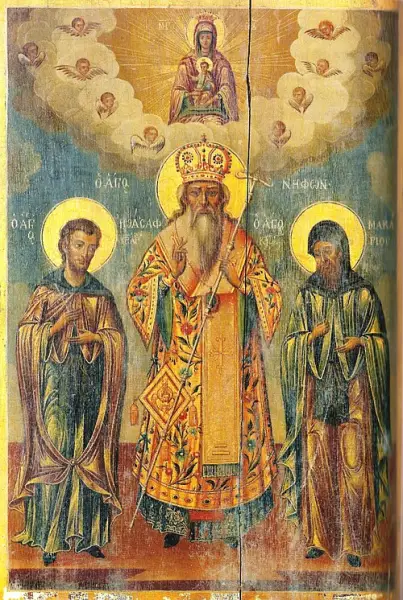
Veneration of Nephon began at once. In the regions that had known him he was honored as a saint immediately after his death, and just nine years later, in 1517, the Eastern Orthodox Church formally recognized him among the saints, appointing 11 August as his feast day, a date that falls on 24 August of the Gregorian calendar. The speed of his glorification, remarkable by any measure, reflects the affection in which he was held by the monks of Athos and the faithful of Wallachia alike. His relics were enshrined at the Monastery of Dionysiou, where the brethren raised a chapel in his name beside the shrine that holds them. For a man whose career had been punctuated by deposition and exile, canonization within a decade of his death completed a striking reversal: the patriarch whom one scholar could dismiss as unsatisfactory was received by the Church as a saint, and the fresco painted at Dionysiou in 1547, scarcely a generation after his falling asleep, shows him honored in the midst of the Athonite fathers.
§ Life
Memory on the Holy Mountain
Nephon's legacy endures on two planes. As a hierarch he left a structural mark on Orthodox history, for his elevation through Wallachian patronage opened the period in which the Danubian principalities influenced the affairs of the Patriarchate of Constantinople, and his de facto guidance of the Church of Wallachia between 1503 and 1505 prefigured the enduring ties between Constantinople and the Romanian lands. As a monk he left the more lasting memorial: the shrine at Dionysiou, the chapel that bears his name, and the fresco of 1547 that still shows him among the monks of the Holy Mountain. His life became an example of fidelity under pressure, a bishop who endured two depositions and a sentence of lifelong confinement, declined a third election to the premier see of Orthodoxy, excommunicated a boyar rather than bless an unlawful marriage, and ended his days looking like a herdsman among monks. Orthodox Christians keep his memory each 11 August, honoring a saint who occupied the throne of Constantinople three times yet belonged, in the end, to Mount Athos.
§ Life
Timeline
- 1482
Elected Metropolitan of Thessaloniki, one of the chief sees of the Greek East.
§ Life
- 1486
Elected Ecumenical Patriarch of Constantinople for the first time, supported by Prince Vlad Calugarul of Wallachia.
§ Life
- 1488
Deposed and exiled to an island in the Black Sea off Sozopol after the inheritance scandal under Sultan Bayezid II.
§ Life
- 1497
Elected patriarch for a second term through the patronage of Radu IV the Great of Wallachia.
§ Life
- Aug 1498
Overthrown by Joachim I, who was backed by King Constantine II of Georgia; condemned to lifelong confinement and banished to Adrianople.
§ Life
- 1502
Chosen patriarch a third time by the Holy Synod, but refused the appointment and stayed in Wallachia.
§ Life
- 1503
Assumed de facto leadership of the Church of Wallachia, a role he held until conflict with the prince arose.
§ Life
- 1505
Left Wallachia for Macedonia with two disciples after refusing to bless the unlawful marriage of Calpea and Bogdan Logothete.
§ Life
- 11 Aug 1508
Died at the Monastery of Dionysiou on Mount Athos and was buried there.
§ Life
- 1517
Formally recognized as a saint by the Eastern Orthodox Church, with his feast appointed for 11 August.
§ Life
The Record
- Canonization
- Recognized as a saint by the Eastern Orthodox Church in 1517, nine years after his death
Prayer
Bibliography
Show 6 sources
- Kiminas, Demetrius (2009). The Ecumenical Patriarchate. Wildside Press. p. 37. ISBN 978-1-4344-5876-6.
- Runciman, Steven (1985). The Great Church in captivity. Cambridge University Press. ISBN 978-0-521-31310-0.
- "Nifon II". Ecumenical Patriarchate. Retrieved 13 August 2011.
- Stavrides, Theoharis (2001). The Sultan of Vezirs - the Life and Times of the Ottoman Grand Vezir Mahmud Pasha Angelovic. Boston: Brill Publishers. p. 89. ISBN 978-90-04-12106-5.
- Moustakas Konstantinos. "Symeon I of Constantinople". Encyclopaedia of the Hellenic World, Asia Minor. Retrieved 15 August 2011.
- Vergatti, Radu-Stefa. "Le regne de Radu le Grand". Simpozionul International, Cartea Romania, Europa, 20-23 September 2008. pp. 168-169.
Profile text adapted from the Wikipedia article, licensed CC BY-SA 4.0.
Pray with this saint every day
Save St. Nephon II of Constantinople to your favorites, read the full profile, and get feast-day reminders in the Saints app.
Get the Saints AppFree on the App Store for iPhone and iPad