
died c. 306·Feast October 27
St. Nestor of Thessaloniki
Young wrestler-martyr and companion of St. Demetrius
Overview
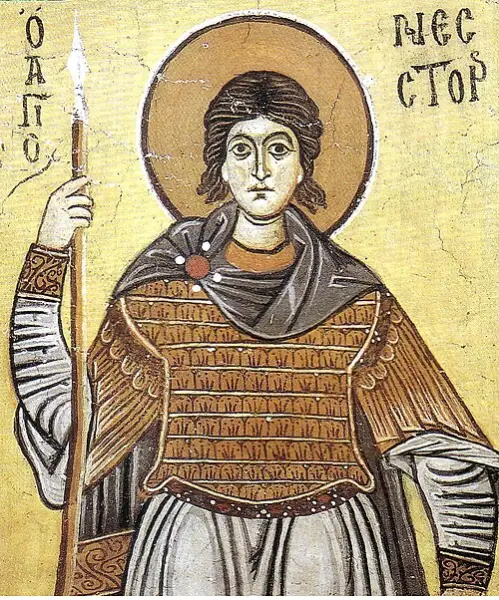
Nestor of Thessalonica was a young Christian of that Macedonian city, remembered above all as the faithful companion of the Great Martyr Demetrius. Tradition sets his death around the turn of the fourth century, with the year reported variously as 290, 296, or 306, and his feast is kept on 27 October, the day after that of his mentor. When the mighty gladiator Lyaeus, the most feared fighter of the Roman arena, used his victories to mock and torment the Christians, Nestor could not stand by in silence. He went to the imprisoned Demetrius, asked for his blessing to contend with the champion, and, strengthened by that blessing and by faith in God, entered the arena and mortally struck him down. The emperor Maximian, enraged at seeing a Christian youth humble the pride of the games, ordered that Nestor be slain with the imperial sword. He was barely twenty years old. Patron of wrestlers and athletes, he is portrayed in the icons wearing the attire of a warrior, and an eleventh-century miniature in the Menologion of Basil II records his martyrdom for all the Christian world to see.
The Complete Life
A Youth of Thessalonica
Nestor was born at Thessalonica, the great Macedonian metropolis where the Christian faith had taken early and deep root. There he came under the influence of St. Demetrius, the soldier-saint whose ministry in the city would cost him imprisonment and death, and the bond between the elder martyr and the young Christian became the defining relationship of Nestor's brief life. He belonged to the generation that faced the last and fiercest of the Roman persecutions, an age when the games of the arena served not only as entertainment but as an instrument of contempt, in which the enemies of the church were mocked and tormented before the crowds. Of his family, his trade, and his training the ancient sources say little; what they record is his disposition, a faith strong enough to move him to act when others despaired, and a physical courage suited to the wrestling grounds whose patron he would one day become. From Demetrius he learned that strength of body finds its meaning only when joined to faith in God.
§ Biography
The Contest with Lyaeus
Lyaeus towered over the games of the empire as its most feared gladiator, and he made his victories a platform for blaspheming the Christians, humiliating and tormenting them in the arena while the spectators applauded. Nestor, moved to confront this scourge of the church, went first not to the training ground but to the prison. There Demetrius lay in chains, and there the young man asked for the blessing to fight and defeat the champion. With the martyr's blessing upon him and his trust placed in God, Nestor entered the arena and mortally struck Lyaeus, toppling before all the city the strongest argument the empire could raise against the Christians. The triumph lasted only moments. Emperor Maximian, enraged that his champion had fallen to a Christian youth, decreed death for Nestor by the imperial blade; the execution was carried out around the feast of 27 October, in a year the traditions place at 290, 296, or 306. Nestor was about twenty years old, a martyr before he had finished growing old enough for any other title.
§ Biography
Feast, Patronage, and Image
The Church canonized Nestor by receiving his cult from the first generations of the faithful, and his memory has remained joined to that of his mentor: his feast falls on 27 October, immediately following the commemoration of St. Demetrius on 26 October. He is honored as the patron of wrestlers and of athletes, the saint who showed that the arena could become a place of witness, and athletes have invoked him ever since as one who knows both the discipline of training and the cost of victory. In the iconographic tradition he appears dressed in warrior attire, and the Menologion of Basil II, the sumptuous eleventh-century manuscript made for the Byzantine emperor, preserves a miniature of his martyrdom, fixing his image beside those of the great saints of the East. The church of Thessalonica numbers him among her glories, a son of the city who, with the blessing of its great martyr, defeated the terror of the games and won the crown that outlasts every laurel of the stadium.
§ Feast day
The Record
- Patron of
- Wrestlers·Athletes
- Symbols
- Warrior attire
- Canonization
- Pre-congregation martyr venerated since antiquity in the Eastern Orthodox and Catholic traditions
Prayer
Bibliography
Show 4 sources
- "Martyr Nestor of Thessalonica". OCA (Orthodox Church in America).
- "Nestor the Martyr of Thessaloniki". GOARCH (Greek Orthodox Archdiocese of America).
- Woods, David (tr.). "The Passion (BHL 2122) and Miracles (BHL 2123) of St. Demetrius by Anastasius the Librarian".
- "Nestor of Thessalonika". OrthodoxWiki. CC-BY-SA and GFDL.
Profile text adapted from the Wikipedia article, licensed CC BY-SA 4.0.
Pray with this saint every day
Save St. Nestor of Thessaloniki to your favorites, read the full profile, and get feast-day reminders in the Saints app.
Get the Saints AppFree on the App Store for iPhone and iPad