
c. 1056 – c. 1114·Feast October 27
St. Nestor the Chronicler
Monk and Hagiographer of Kievan Rus'
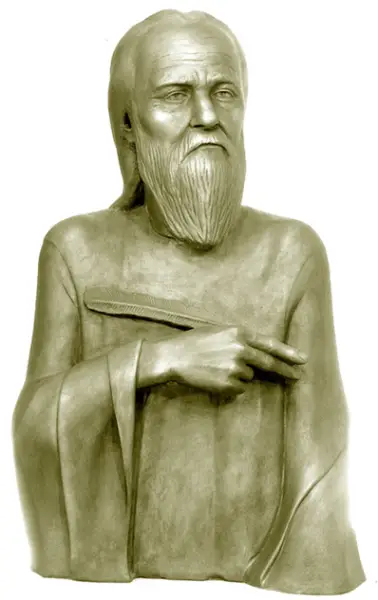
Overview
Nestor lived out his monastic life inside the Monastery of the Caves at Kiev, and he stands among the earliest authors of Kievan Rus' whose work still carries a name. Born around 1056, he entered the monastery as a seventeen-year-old novice near 1073, received the monastic tonsure under Stephen, the successor of Theodosius, and was raised to the rank of hierodeacon. In 1091 he was among the monks commissioned to find the relics of St. Theodosius, and their successful uncovering became one of the treasured events of the Lavra's memory. Two hagiographies are firmly credited to him: the Life of the Venerable Theodosius of the Kiev Caves and the account of the life and martyrdom of the passion bearers Boris and Gleb. For centuries he was also named as the compiler of the Primary Chronicle, the Tale of Bygone Years, and the epithet 'the Chronicler' fixed itself to his memory; most modern scholars, however, doubt that attribution, and some historians now prefer to call him Nestor the Hagiographer. He died around 1114, was buried in the Near Caves of the monastery, and his remains are preserved among the relics of the Kiev Pechersk Lavra, where he is honored with the other fathers of the Caves.
The Complete Life
A Novice at the Caves
Nestor belonged to the generation that grew up in Kiev only decades after the great flowering of monastic life at the Monastery of the Caves. Tradition, preserved by the Kiev Caves Patericon, dates his arrival at the monastery to about 1073, when he was seventeen years old. He came, therefore, as a young man into a community whose founder's memory was still fresh, for Theodosius, the great abbot of the Caves, had died within living memory and his way of life continued to shape the brotherhood. The monastery perched above the Dnieper was by then the spiritual heart of Kievan Rus', drawing novices, patrons and pilgrims, and its chronicles and saints' lives were beginning to give the young Christian civilization of the eastern Slavs a written voice. Into this world Nestor was received as a novice, learning the psalmody, the readings and the manual labor that belonged to the Caves tradition. The Patericon's notice of his age and year of entry is among the few personal details that survive, but it places him at the beginning of a monastic career that would unfold entirely within the walls whose saints he would later commemorate in writing.
§ Biography
Tonsure, Diaconate, and the Finding of the Relics
Nestor advanced from novice to full membership of the brotherhood when he received the monastic tonsure from Stephen, the abbot who succeeded Theodosius as head of the Caves monastery. In time he was ordained a hierodeacon, a deacon among the monks, so that his service joined liturgical ministry at the altar to the ascetical discipline of the community. The Kiev Caves Patericon, the chief source for these details, presents him as a faithful son of the house founded by Anthony and built up by Theodosius. The most memorable episode of his middle years came in 1091, when the abbot commissioned Nestor and two other monks to find the relics of St. Theodosius, which had been hidden. The search succeeded: the remains of the monastery's revered father were uncovered, and the event was remembered as a confirmation of Theodosius' holiness and of the Lavra's continuity with him. Nestor thus stood, as a deacon of the Caves, at the very place where the memory of Theodosius was honored in stone and bone. His later devotion to that memory, in the biography he wrote of Theodosius, grew from this lived connection to the saint whose relic he had helped to bring to light.
§ Biography
Hagiographer of Kievan Rus'
Whatever uncertainty surrounds the great chronicle long linked to his name, two works are firmly credited to Nestor, and both are lives of saints. The first is the Life of the Venerable Theodosius of the Kiev Caves, written in the 1080s, which recounts the career of the monastery's celebrated abbot and stands among the earliest monuments of East Slavic literature. The second is the account of the life and martyrdom of the blessed passion bearers Boris and Gleb, the sons of St. Vladimir who were killed in the succession struggles after their father's death and were venerated as the first native saints of Rus'. The dating of this second work is heavily disputed, with proposals ranging from the late eleventh to the early twelfth century. In both works Nestor worked as a hagiographer in the strict sense: he gathered the traditions, testimonies and miracles that circulated about holy men of his own monastery and of his own people, and gave them polished narrative form. It is for this literary sanctification of Russian holiness that modern historians who doubt the chronicle attribution prefer to call him Nestor the Hagiographer, a title that honors what is certain about him rather than what is contested.
§ Known works
Veneration in the Lavra of the Caves
Nestor was never the subject of a single dramatic act of canonization; he entered the calendar of the Eastern Orthodox Church by enrolling his name in that synaxis which gathers all the venerable fathers of the Caves monastery — the assembled choir of holy monks made perfect within the one house. His feast falls on October 27, kept together with Nestor of Thessaloniki and Nestor of the Far Kiev Caves. Around this principal commemoration the Church gathers him into a series of synaxes: on September 28 with the Venerable Fathers of the Kiev Near Caves, on July 15 with all the Saints of Kiev, on May 25 and October 10 with the Saints of Volhynia in different jurisdictions, and on the Second Sunday of Great Lent with all the venerable fathers of the Kiev Caves. Liturgical hymns in his honor survive in the Orthodox tradition, including a troparion in the fourth tone that celebrates his recording of the deeds of Russian princes and the lives and miracles of the Pechersk fathers, and a kontakion in the second tone that greets him as a disciple of Theodosius and true imitator of his way of life, who was found worthy to behold and carry the saint's honorable relics.
§ Veneration
The Chronicler Question
The epithet under which Nestor is best known rests on an attribution that scholarship has increasingly set aside. From early times writers spoke of the Chronicle of Nestor, and the compilation now called the Primary Chronicle, or Tale of Bygone Years, was long regarded as his work; because of this he was given the title 'the Chronicler'. Belief in his authorship of many surviving Rus' chronicles grew from the seventeenth century onward, even embracing texts describing events long after his death. A single word in one manuscript, the Khlebnikov Codex, seemed to name him, but researchers have shown that the word was added by an editor and appears in none of the other main versions, and so cannot serve as evidence. Between the 1830s and about 1900 the question was fiercely debated, and it remains formally unresolved, yet the prevailing judgment of modern scholars is that the internal evidence of the chronicle and the known works of Nestor do not fit one another, and that he was not its author. A likelier compiler is Sylvester, abbot of St. Michael's Monastery at Vydubychi, whose colophon closes the Laurentian text, or else some other monk of the Caves whose name has not survived.
§ Purported authorship of the Primary Chronicle
Timeline
- 1056
Is born in Kiev, by the traditional dating of his life
§ Biography
- 1073
Enters the Monastery of the Caves in Kiev as a novice aged about seventeen
§ Biography
- 1091
Is sent with two other monks to find the relics of Theodosius of the Kiev Caves, which they uncover
§ Biography
- 1113
Is traditionally said to have compiled the Primary Chronicle about this year, though scholars dispute his authorship
§ Known works
- 1114
Dies in Kiev around this year and is buried in the Near Caves of the monastery
§ Biography
In Their Own Words
The word нестера was added in the Khlebnikov Codex, and thus cannot be used as evidence for the name of the compiler of the PVL.
The Record
- Major works
- Life of the Venerable Theodosius of the Kiev Caves (1080s)·Reading on the Life and Martyrdom of the Blessed Passion Bearers Boris and Gleb·Primary Chronicle, or Tale of Bygone Years (c. 1113, attribution disputed)
- Canonization
- Canonized by inclusion of his name in the Synaxis of all Venerable Fathers of the Kiev Caves; venerated in the Eastern Orthodox Church
Prayer
Bibliography
Show 6 sources
- Cross, Samuel Hazzard; Sherbowitz-Wetzor, Olgerd P. (1953). The Russian Primary Chronicle, Laurentian Text. Cambridge, Massachusetts: The Mediaeval Academy of America.
- Ostrowski, Donald (March 1981). "Textual Criticism and the Povest' vremennykh let: Some Theoretical Considerations". Harvard Ukrainian Studies. 5 (1). Harvard Ukrainian Research Institute: 11–31.
- Tolochko, Oleksiy (2007). "On 'Nestor the Chronicler'". Harvard Ukrainian Studies. 29 (1). Harvard University: 31–59.
- Plokhy, Serhii (2006). The Origins of the Slavic Nations: Premodern Identities in Russia, Ukraine, and Belarus. New York: Cambridge University Press.
- Morfill, William Richard (1911). "Nestor". In Chisholm, Hugh (ed.). Encyclopædia Britannica. Vol. 19 (11th ed.). Cambridge University Press. pp. 406–407.
- Ostrowski, Donald; Birnbaum, David J. (7 December 2014). "Rus' primary chronicle critical edition – Interlinear line-level collation". pvl.obdurodon.org.
Profile text adapted from the Wikipedia article, licensed CC BY-SA 4.0.
Pray with this saint every day
Save St. Nestor the Chronicler to your favorites, read the full profile, and get feast-day reminders in the Saints app.
Get the Saints AppFree on the App Store for iPhone and iPad