
died c. 76·Feast July 28 (with the other deacons); December 28 (individual Orthodox commemoration); January 10 (Roman Martyrology)
St. Nicanor the Deacon
One of the Seven Deacons of Jerusalem
Overview
Nicanor was one of the Seven Deacons of the earliest Christian church at Jerusalem, named in the sixth chapter of the Acts of the Apostles. When a dispute arose between the Greek-speaking and Hebraic Jewish Christians over the widows being overlooked in the daily distribution of food, the Twelve Apostles asked the community to choose seven men filled with the Spirit and wisdom who would take charge of this ministry, so that the apostles might devote themselves to prayer and the preaching of the word. Nicanor stood among the seven chosen — with Stephen, Philip, Prochorus, Timon, Parmenas and Nicholas — and the apostles prayed over the seven and laid their hands upon them, a gesture Christian tradition has always read as the institution of the diaconate. His Greek name, which means conqueror of men, was common across the Hellenistic world, and together with the Greek names of most of his colleagues it has led many scholars to see the Seven as Hellenistic Jews appointed to heal the grievances of their own community. Ancient tradition ranks Nicanor among the apostles of the Seventy. The Pseudo-Hippolytus text On the Seventy Disciples says he died at the time of Stephen's martyrdom, and Orthodox tradition holds that he perished in the persecution that followed; his death is conventionally placed around the year 76, in Cyprus.
The Complete Life
Chosen by the Community, Sealed by the Apostles
The scene that fixes Nicanor in history is set in the Jerusalem church while it was still a single community of Jewish believers. Acts recounts a murmuring that arose because the widows of the Greek-speaking Hellenistic Christians were being neglected in the daily service of food. The Twelve refused to abandon prayer and preaching to wait at tables, and instead proposed that the disciples select seven men of good standing, full of the Spirit and wisdom, to take charge of this ministry. The community's choice fell upon Stephen and Philip, upon Prochorus, Nicanor, Timon, Parmenas and Nicholas. Prior to their installation the seven were brought to the apostles, who prayed and laid hands upon them. Christian tradition has ever since regarded that prayer and imposition of hands as the founding gesture of the diaconate itself, which makes Nicanor one of the first deacons of the Church. The Seven were not anonymous functionaries: their election by the whole body of disciples, and their confirmation by the apostles, bound the growing church's practical charity to its apostolic faith in a single ordered communion.
§ Biblical account
A Hellenistic Name in a Hebrew City
Everything about Nicanor's assignment bears the mark of his Greek background. Many scholars have concluded from the Greek names of five or more of the Seven — Nicanor among them — that most or all were Hellenistic Jews, set apart in part to answer the grievances of the Greek-speaking party whose widows had been slighted. The name Nicanor, meaning conqueror of men, was widespread in the Hellenistic world: it belonged to a Seleucid military commander and gave its name to the Nicanor Gate of the Jerusalem Temple, so the deacon bore a name thoroughly at home in the Greek-speaking diaspora that had settled in the holy city. Later reflection on the office he held has also enriched his memory. Some students of the New Testament note that the actual word for deacon never appears in the passage that describes his election, and debate continues about whether the Seven were humble table-servants or officers with real authority over the church's material and even spiritual affairs; a middle position sees in them an official yet subordinate ministry. However the question is settled, Nicanor's service belonged to the church's first attempt to order charity without neglecting the word of God.
§ Interpretations
Martyrdom in the First Persecution
The traditions disagree about the circumstances of Nicanor's death, but they agree that it was a martyr's death. The Pseudo-Hippolytus text On the Seventy Disciples states plainly that he died at the time of Stephen's martyrdom, and Orthodox tradition accordingly remembers him as one who suffered alongside Stephen in the violence that broke over the Jerusalem church after the protomartyr's execution before the Sanhedrin. Students of early Christian persecution place the election of the Seven and Stephen's death within a sequence of escalating troubles in Jerusalem: Greek-speaking Jews charged Stephen with attacking both Temple and Law, and the storm of persecution unleashed by his killing scattered believers throughout Judea and Samaria and far beyond. Some of those fugitives traveled as far as Cyprus, the island where tradition says Nicanor himself met his end. The conventional dating of his death falls near the year 76, though the sources are not unanimous about it. If the older tradition is right, he was almost the first of the Seven to follow Stephen along the road of blood; if the later date stands, he died a confessor's death on Cypriot soil, far from the city that ordained him.
§ Death and veneration
Apostle of the Seventy and Deacon of the Church
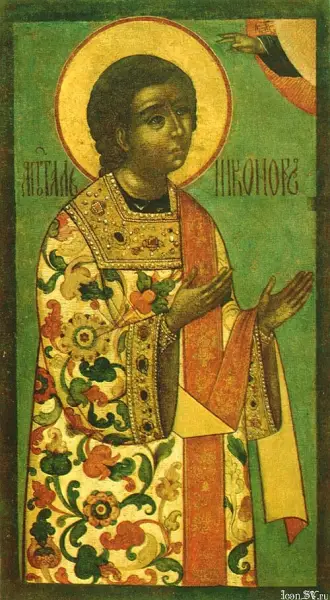
Nicanor's cult is as old as the Church's memory of the apostolic age, and he was never formally canonized by any pope or council; his title to veneration rests on unbroken tradition. Eastern Orthodoxy numbers him among the Apostles of the Seventy, the wider company of disciples sent out by Christ beyond the Twelve. The Orthodox calendar keeps him individually on December 28 and joins him with his fellow deacons Prochorus, Timon, Parmenas and Nicholas in a common feast on July 28, while Stephen, the seventh and greatest of their company, is honored separately as Protomartyr on December 26. In the West the Roman Martyrology enters his name on January 10. Both the Catholic Church and the Eastern Orthodox Church rank him as apostle, deacon and martyr, a rare triple confession that gathers in one title his discipleship, his ordered ministry and his blood. In iconography he appears in the vestments of his office, the sticharion and orarion of a deacon, holding the censer, so that even his painted image preaches the ministry of prayer and charity for which the Seven were set apart.
§ Death and veneration
Remembered Among the Seventy
Nicanor's memory passed into the Church's earliest catalogues of the disciples. He appears in several of the old lists of the Seventy, the missionary company that tradition counted from the Gospel account of those sent out ahead of Christ; the catalogue attributed to Dorotheus of Tyre, known as the Pseudo-Dorotheus list, expressly includes him among them, and the Pseudo-Hippolytus text preserves the manner of his death. Through these lists his name traveled with the memory of the Seven Deacons into the liturgical books of East and West alike, where his feasts have been kept for centuries beside those of Stephen, Prochorus, Timon, Parmenas and Nicholas. Later generations also honored him in sacred art. A noted icon of Nicanor the Deacon was painted in 1685 by the Russian master Fyodor Zubov and is preserved today in the Smolensky Cathedral of the Novodevichy Convent in Moscow, showing the first-century deacon of Jerusalem in the full dignity of his order. Thus a man whom the New Testament mentions only in a single verse lives on in catalogues, calendars and icons as a witness to the church's earliest conviction that serving the poor is service of Christ himself.
§ Legacy
The Record
- Symbols
- Deacon's vestments (sticharion and orarion)·Censer
- Canonization
- Pre-congregation; venerated as apostle, deacon and martyr from earliest Christian antiquity
Prayer
Bibliography
Show 6 sources
- Watkins, Basil (2015). The Book of Saints: A Comprehensive Biographical Dictionary. Bloomsbury Publishing. p. 593.
- Merkle, Benjamin L. (2021). "The Authority of Deacons in Pauline Churches". Journal of the Evangelical Theological Society. 64 (2): 309–325.
- Schnabel, Eckhard J. (2018). "The Persecution of Christians in the First Century". Journal of the Evangelical Theological Society. 61 (3): 526–528.
- "On the Apostles and Disciples (Pseudo-Hippolytus)". New Advent.
- "Apostle Nicanor the Deacon of the Seventy". Orthodox Church in America.
- "List of the Apostles and Disciples by Pseudo-Dorotheus of Tyre". North American Society for the Study of Christian Apocryphal Literature.
Profile text adapted from the Wikipedia article, licensed CC BY-SA 4.0.
Pray with this saint every day
Save St. Nicanor the Deacon to your favorites, read the full profile, and get feast-day reminders in the Saints app.
Get the Saints AppFree on the App Store for iPhone and iPad