
4th century·Feast March 20
St. Nicasius of Die
Bishop of Die and Father of Nicaea
Overview
Nicasius of Die, also called Nicaise, was a fourth-century bishop from Gaul whose name survives chiefly because of a single extraordinary distinction: he sat with the mere handful — five in all — of Catholic bishops from the empire's Latin West at the First Council of Nicaea in 325. As Bishop of Die, in the present-day French département of the Drôme, he led one of the smallest and most obscure sees in Gaul, yet at Nicaea he sat in the assembly that defined the faith of the whole Church against the Arian controversy. The Latin West was represented at the council by only four delegations — Die, Rome, Carthage and Córdoba — corresponding to the four western regions of Gaul, Italy, Africa and Spain, and it might have been expected that the Gauls would send the archbishop of Lyon, their primate, rather than the bishop of an insignificant town. Scholars have conjectured that the primate was prevented by age or ill health, and that Nicasius, the son of Greek parents, was chosen for his command of the Greek language in which the council's debates were conducted. He is honored as a saint by Catholics and Orthodox alike, and his relics were venerated in Die Cathedral by the eleventh century.
The Complete Life
Bishop of a Small See
Nicasius — in French Nicaise — served as the earliest attested bishop of Die, a modest city in the southeastern Gallic province that today lies in the Drôme. Later tradition embroidered his place in the episcopal roll: the seventeenth-century historian Polycarpe de la Rivière, whose claims historians have largely discredited, asserted that he succeeded St. Mars of Die, a bishop said to have held the see around 220, and after him a certain St. Higer. Neither of these supposed predecessors is known from any independent source, and the sober record begins with Nicasius himself. Polycarpe also claimed to have discovered, in a life of St. Marcel de Die, a letter from the Council of Nicaea entrusted to Nicaise for delivery to the bishops of the Gauls, but no trace of this document has ever been found. What can be said with confidence is that by the year of the great council he was already governing the see, and that his office carried him from his small Gallic city onto the stage of the whole Church. A statue of him stands in Die Cathedral, where his memory has been cherished for well over a thousand years.
§ Bishopric
The Voice of Gaul at Nicaea
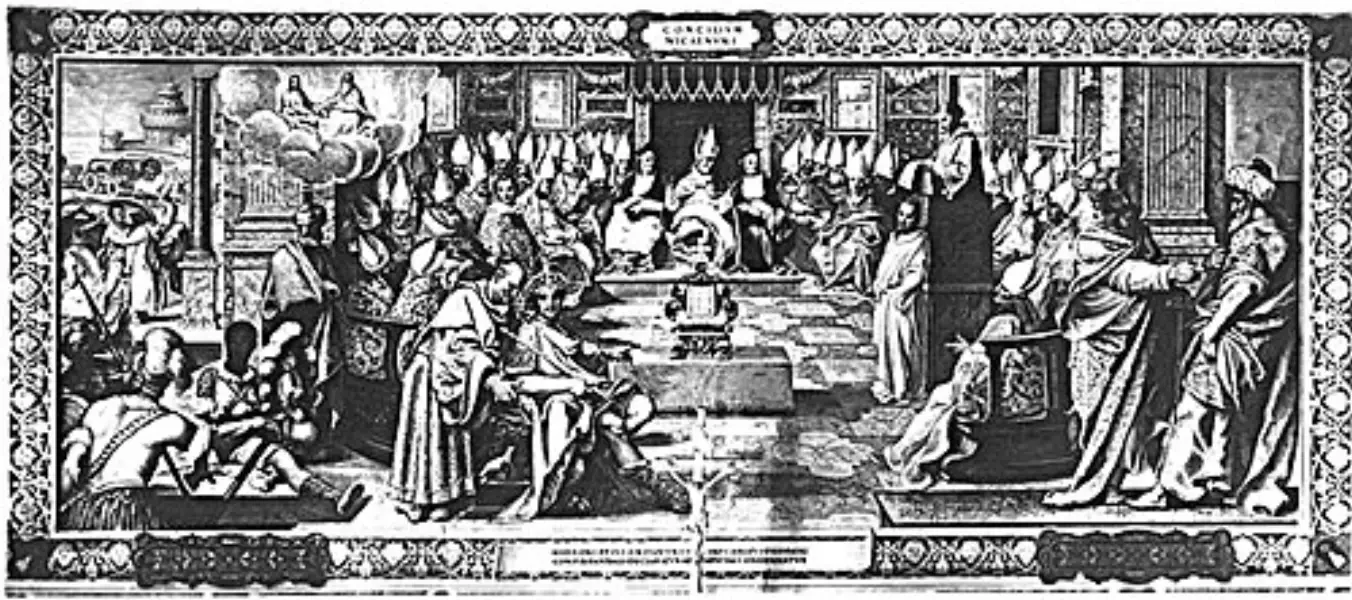
In 325 the Emperor Constantine summoned bishops from every part of the Christian world to Nicaea to settle the crisis raised by the teaching of Arius, and Nicasius of Die took his place among them as a member of the western Church's tiny five-man episcopal delegation. The Latin churches were represented by four delegations — those of Die, of Rome, of Carthage, and of Córdoba, whose bishop Hosius served as the emperor's adviser — and the choice of seats was no accident: they mirrored the Latin West's four regions — Gaul, Italy, Africa and Spain. Yet the Gallic choice of delegate was startling. The natural spokesman would have been Maxime (or Tetrad), archbishop of Lyon and primate of the Gauls; instead the province dispatched the pastor of a tiny, little-known see. Students of the council have conjectured an explanation: the primate may have been unavailable through age or ill health, and Nicasius, whose parents were Greek, was selected for his knowledge of the Greek tongue, the language in which the council's discussions were actually conducted. If so, a man chosen as interpreter became a father of the council that gave the Church the Nicene Creed.
§ Attendance at Nicaea
Saint of East and West
No formal act of canonization was ever needed to make a saint of Nicasius; his veneration belongs to the earliest and most organic stratum of the Church's memory. He is counted among the saints of the Roman Catholic Church, which keeps his feast on March 20, and he is also known by the French form of his name, Nicaise of Die. In the Eastern Orthodox Church he receives a distinctive and telling honor: the Orthodox keep a liturgical Sunday commemorating the Fathers of the First Council, and on that day they recall every bishop who confessed the Nicene faith. This commemoration places him exactly where his historical importance lies, among the company of bishops whose stand against Arianism preserved the Church's confession of the full divinity of Christ. Care must be taken, in reading his later cult, not to confuse him with another and quite different saint of the same name, the martyr Nicasius of Rheims, who died about eighty years after him in the cathedral city much farther north; the two have often been mixed together in popular devotion. Die itself keeps his memory in stone, with his statue in the cathedral of the town he served.
§ Sainthood
Relics and Remembrance in Die
Nicasius' afterlife in memory centered on the city of his see. According to the account preserved by the learned ecclesiastical historian Lenain de Tillemont, the cathedral of Die housed the relics of Nicaise by the eleventh century, so that the faithful of the town could venerate the remains of the bishop who had gone out from among them to the council of emperors and fathers. His name also entered the scholarly record of the Gallican Church: students of the early episcopate, from Duchesne's great survey of the ancient Gallic sees onward, have had to reckon with the bishop of Die as a witness to the organizational life of fourth-century Gaul, and the question of why such a small see supplied the council's sole Gallic delegate exercised commentators like G. Morin in the pages of the Revue Bénédictine. Later writers, notably Polycarpe de la Rivière in the seventeenth century, surrounded him with invented predecessors and documents, but the destruction of those fables has only made the historical core more precious: a Greek-speaking bishop of an obscure Gallic town, present at Nicaea in 325, honored in East and West, and sleeping in his own cathedral.
§ Burial
The Record
- Symbols
- Bishop's vestments·Statue in Die Cathedral
- Canonization
- Pre-congregation; venerated as a saint in the Roman Catholic Church from antiquity
Prayer
Bibliography
Show 7 sources
- Duchesne, L., Fastes Épiscopaux de l'Ancienne Gaule, tome I – Provinces du Sud-est.
- Dean Dudley, The History of the First Council of Nice: A World's Christian Convention, A.D. 325 with a Life of Constantine (Cosimo, Inc., 2007), p. 49.
- Philip Schaff, History of the Christian Church, Volume 3 (Library of Alexandria, 1966).
- Robert Payne, The Holy Fire: The Story of the Fathers of the Eastern Church (St Vladimir's Seminary Press, 1980), p. 79.
- W. A. Jurgens, The Faith of the Early Fathers: Pre-Nicene and Nicene Eras (Liturgical Press, 1970), p. 280.
- G. Morin, "D'où était évêque Nicaise, l'unique représentant des Gaules au Concile de Nicée ?", Revue Bénédictine, vol. XVI, 1899, p. 72.
- Lenain de Tillemont, Mémoires pour servir à l'histoire ecclésiastique des six premiers siècles, Vol. 6, troisième partie (1709), p. 687.
Profile text adapted from the Wikipedia article, licensed CC BY-SA 4.0.
Pray with this saint every day
Save St. Nicasius of Die to your favorites, read the full profile, and get feast-day reminders in the Saints app.
Get the Saints AppFree on the App Store for iPhone and iPad