
died c. 407 (or 451)·Feast December 14
St. Nicasius of Rheims
Martyr Bishop of Reims Against the Invaders
Overview
Nicasius of Rheims, in French Saint-Nicaise, was a bishop of Reims who died at the hands of barbarian invaders and became one of the most beloved martyrs of the Gallican Church. The sources disagree about the year and even the enemies of his last day: some place his death in 407, when the Vandals swept into Gaul, others in 451, during the ravages of Attila's Huns. In the older account he was credited with prophesying the Vandal invasion; he warned his people and told them to prepare, and when they asked whether they should fight he answered that they should await the mercy of God and pray for their enemies, declaring himself ready to give his life for his flock. As the barbarians reached the walls he tried to delay the enemy and buy time for more of his flock to flee; for this he was put to death at his church's altar — or, in other tellings, at its very threshold — along with Jucundus the lector, Florentius the deacon, and Eutropia, the sister who had consecrated herself to virginity. Legend made him one of the cephalophores, the head-carriers like St. Denis, reciting a psalm even after his beheading. He founded the first cathedral of Reims, where his shrine stands, and is invoked as the patron of smallpox victims.
The Complete Life
Bishop and Builder of the First Cathedral
Nicasius governed the church of Reims at a moment when the Roman west was beginning to break apart, and his first great work was one of stones rather than words: he founded the first cathedral of Reims, the mother church from which the successive cathedrals of that city descended, down to the Gothic masterpiece whose kings of France would one day be crowned above the site he consecrated. The episcopate he exercised was therefore both pastoral and architectural, gathering a Christian community in a great Gallic city and providing it with a worthy house of worship. Tradition remembered him afterward chiefly as a shepherd ready to die for his flock, but the cathedral shows the other half of that shepherd's care: a bishop who spent himself on the permanence of Christian worship in a city he must have known was exposed to the storm. His sister Eutropia, a consecrated virgin, shared his household and his faith, and with his lector Jucundus and his deacon Florentius he formed the small company of clergy and family that later shared his crown of martyrdom, giving the church of Reims a whole calendar of companions around its martyred bishop.
§ Nicasius of Rheims
The Warning and the Surrender to Mercy
In the tradition that dates his death to 407, Nicasius received a prophetic vision of the Vandal invasion of France and told his people of it, urging them to prepare. When they asked whether they should take up arms against the coming enemy, he gave the answer that fixed his character in the memory of the Church: they were to await God's mercy and to pray for those who came against them as foes, and he declared himself ready to give himself for his people. The words are those of a bishop who read the coming calamity not as an occasion for desperation but as a summons to trust. When the barbarians did appear at the gates of Reims, he put his promise into action: deciding that he could slow the invaders down, he moved toward them so that more of his people would have time to escape. The plan cost him his life, but it accomplished what he intended, for the killings of the bishop and his companions so frightened the Vandals that, in some accounts, they abandoned the district and even left behind the treasure they had already plundered. His death was itself a defense of the city, bought with the blood of its pastor.
§ Vandals
Martyrdom at the Altar
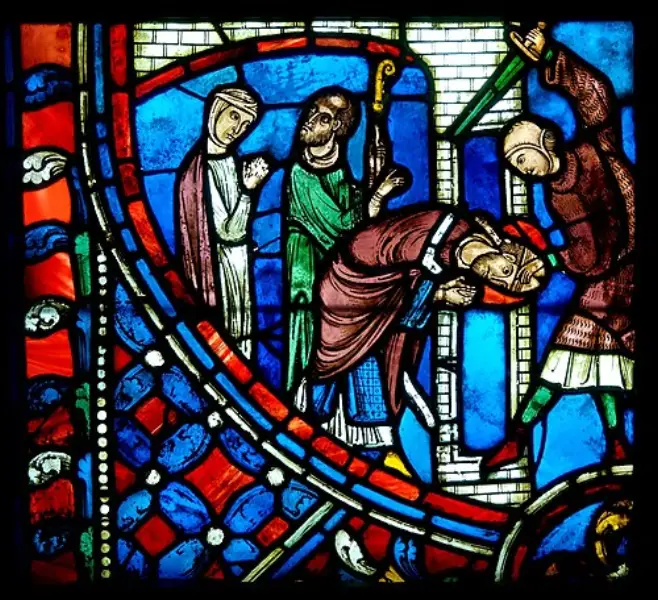
Nicasius met his death at the altar of his church — or, by another account, in its doorway — so that the place of his dying was the very threshold of the house he had built for God. He did not die alone. With him perished Jucundus, his lector, who read the Scriptures in the liturgy he served; Florentius, his deacon, his helper at the altar; and Eutropia, his virgin sister. The little community that had lived and prayed together died together, and the Church has always honored them as companions in martyrdom. Later imagination adorned their deaths with one of the most haunting legends of medieval hagiography: Nicasius, so the legend runs, was chanting the 119th psalm, and just as the executioner's blow fell he had reached the verse 'My soul is attached unto dust'; his head fell to the ground, yet his lips continued the psalm with the next verse, 'Revive me, Lord, with your words.' For this he was numbered among the cephalophores, the head-carriers, like St. Denis of Paris, and artists showed him striding forward with the top of his skull and its mitre held in his grip, a bishop who outlived his own beheading long enough to finish his song.
§ Vandals
A Martyr Honored in the Cathedral of Reims
Nicasius was canonized by the acclamation of the ancient Church, before any formal process existed; he belongs to the company of the Pre-Congregation saints whose cult arose at the places of their witness. Both the Catholic Church and the Eastern Orthodox Church number him among the martyrs, and his feast is kept on December 14. His major shrine is the cathedral of Reims itself, the church whose first foundation tradition ascribed to his own hands, so that the bishop who built the house of God became its most venerated resident. Medieval artists told his story in glass: a chapel of Soissons Cathedral preserved, from the early thirteenth century, a stained-glass window depicting his martyrdom among scenes from his life, evidence that his cult spread beyond his own city into the neighboring dioceses of the Frankish lands. The memory of the way he died — at the altar or in the doorway, in company of his clergy and his sister — made him a model for bishops of every age, and the shrine in Reims Cathedral stood for centuries as the place where the faithful of Champagne remembered their shepherd who had paid for their escape with his blood.
§ Nicasius of Rheims
Patron of Smallpox Victims
The strangest and most tender part of Nicasius' legacy grew from the alternative tradition of his death. The sources that place his martyrdom in 451, under the Huns rather than the Vandals, add a detail the others lack: that Nicasius had survived an attack of smallpox. Medieval research into the disease has lent the claim some plausibility, for smallpox had a long history in Egypt, evidence suggests its spread through the Roman Empire, and sixth-century outbreaks have been identified. From this supposed survival flowed the saint's second vocation: he became the patron saint of smallpox victims, invoked by the afflicted and their families throughout the Christian West. Prayers composed in his honor asked that those who carried his name inscribed might be preserved from the disease, and called on him as an illustrious bishop and martyr to defend the sick by his intercession. A Benedictine abbey in Reims was later named in his honor, keeping his memory in the monastic life of his own city. Thus the bishop who died at his altar lived on in the popular religion of Europe not only as a martyr of the invasions but as a protector of the plague-stricken poor.
§ Legacy
Timeline
- 407
Is killed by the Vandals at the altar or doorway of his church in Reims, together with his lector, deacon and sister
§ Vandals
- 451
Alternative tradition places his martyrdom in this year, at the hands of the Huns rather than the Vandals
§ Huns
In Their Own Words
Let us abide the mercy of God and pray for our enemies. I am ready to give myself for my people.
The Record
- Major works
- The first Reims Cathedral
- Patron of
- patron saint of smallpox victims
- Symbols
- Shown striding forward with the top of his head and its mitre held in his grip·Bishop's vestments
- Canonization
- Pre-congregation; venerated as a martyr since antiquity
Prayer
Bibliography
Show 5 sources
- Jameson, Anna. Sacred and Legendary Art. AMS Press (New York), 1970. Accessed 28 Jan 2013.
- Peters, Stephanie T. Smallpox in the New World. Marshall Cavendish, 2004. Accessed 28 Jan 2013.
- Moore, James C. The History of the Small Pox. Longman, Hurst, Rees, Orme, and Brown, 1815. Accessed 28 Jan 2013.
- "Patron Saints Index: Saint Nicasius". www.catholic-forum.com. Archived from the original on 2001-06-24.
- "Saint Nicasius and Companions, Martyrs".
Profile text adapted from the Wikipedia article, licensed CC BY-SA 4.0.
Pray with this saint every day
Save St. Nicasius of Rheims to your favorites, read the full profile, and get feast-day reminders in the Saints app.
Get the Saints AppFree on the App Store for iPhone and iPad