
died perhaps c. 260·Feast October 11
St. Nicasius of Rouen
Apostle of the Vexin and Martyr of the Epte
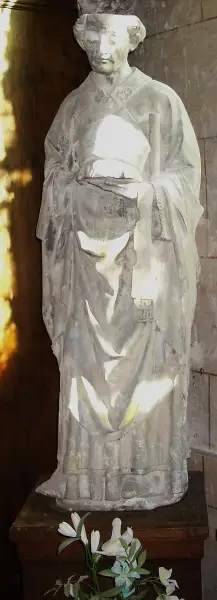
Overview
Nicasius of Rouen, in French Nicaise — the Apostle of the Vexin, as tradition hails him — was a martyr-saint of third-century Gaul whom some traditions honor as the first Bishop of Rouen. The earliest episcopal lists of the cathedral church are divided: the Liber Eburneus names St. Mellon as first bishop, while the Liber Niger of St. Ouen and the lists of the twelfth century place the episcopate of Nicasius before that of Mellon, who is traditionally called his disciple. Tradition pairs Nicasius with Denis of Paris as fellow laborers in the mission, and the ancient confusion of that Denis with Dionysius the Areopagite led some writers to suppose that Nicasius himself was born in Athens. Under the guidance of Hilduin's account he evangelized the Vexin, spending a year at Mousseaux and preaching at Rolleboise and at town after town on the river — Conflans, Andrésy, Triel, Vaux, Meulan, Mantes, even La Roche-Guyon — and working wonders as he traveled. His companion Quirinus is credited with delivering the people of Pontoise from a dragon. Before Nicasius could reach Rouen he and his two comrades were put to the sword on the banks of the Epte at Gasny; there, belief held, his body found its grave. The Roman Martyrology keeps his memory on October 11.
The Complete Life
First of the Bishops of Rouen?
The written memory of the church of Rouen preserves a quiet dispute about its first pastor, and Nicasius stands at the center of it. The Liber Eburneus of the cathedral names St. Mellon as the first Bishop of Rouen, but the Liber Niger of St. Ouen, together with the episcopal lists that circulated from the twelfth century onward, records the episcopate of a certain Nicasius as antedating that of Mellon. Tradition, in consequence, often speaks of him as the first bishop of the see, and it makes Mellon — possibly the next bishop — his disciple, so that the apostolic succession of Normandy's metropolis runs through him either as occupant or as forerunner of its throne. His name was also joined, from an early date, to the greatest mission of the Paris region: he was remembered as an associate of Denis of Paris. Because learned men of the early Middle Ages identified that Denis with Dionysius the Areopagite, the convert of St. Paul at Athens, the same confusion made Nicasius himself a supposed Athenian by birth, giving the Apostle of the Vexin a pedigree reaching back to the apostolic age, however legendary its basis.
§ Life
Evangelist of the Vexin
The substance of Nicasius' sanctity lay in his preaching career through the country between the Seine and the sea. Following the account of Hilduin of Saint-Denis, the tradition describes him evangelizing the Vexin, the old frontier land of northern Gaul. He spent a year at Mousseaux, making that village a base of his mission, and from there he preached in Rolleboise nearby. His apostolate followed the waterways: he carried the gospel up and down the river, and Conflans, Andrésy, Triel and Vaux, then Meulan, Mantes and La Roche-Guyon, all heard him preach, so that the river's whole course through the Vexin became the map of his ministry. The tradition credits him with several miracles worked in the course of this preaching, and it gives his companions their share in the work: Quirinus, who shared his missionary journeys, won — so the story runs — deliverance for Pontoise's people from a dragon, the legendary sign of the gospel's victory over the old powers of the land. His goal was Rouen, whose church he was in some sense to found, but the evangelical geography of the Seine preserved the memory that every village along the way had first heard the faith from him and his two companions.
§ Life
Martyrdom on the Banks of the Epte
Nicasius never completed his journey to Rouen. Before he could reach the city whose episcopal list would carry his name, he and his two companions were seized and beheaded on the banks of the Epte at Gasny, the small place where that frontier river joins the Seine country. The tradition thus gives him the crown of a missionary martyr, killed not in the cathedral city he served but on the road toward it, in the midst of the villages he had evangelized. He was believed to have been buried at Gasny itself, so that the place of his execution became the place of his rest, and the memory of his grave anchored the local devotion of the region. His companions shared his death and his cult: Quirinus, the dragon-slayer of Pontoise, belonged to the same company of martyrs, and early in the ninth century Quirinus' remains were carried away to Malmedy Abbey in the Ardennes, carrying the fame of the mission on the Epte into the monastic world far beyond it. The head of the new church of Rouen, in the old lists, remained the disciple of the martyr who had died on its threshold.
§ Life
In the Roman Martyrology
Nicasius' martyrdom placed him from the beginning among the saints of the Gallican Church, without any formal process; he belongs to the age of the Pre-Congregation martyrs whose cult was ratified by memory alone. His name is listed in the Roman Martyrology on October 11, which is observed as his feast day, so that the universal Church of the Roman rite keeps the anniversary of the Apostle of the Vexin each autumn. Christian art has preserved the manner of his death in its iconography: he is represented as a cephalophore, one of the saints shown carrying their own heads in witness to decapitation, and also in the vestments of a bishop, so that his two claims to memory — the episcopate of Rouen and the martyrdom of the Epte — are both visible in his image. In this he belongs to the same iconographic family as his supposed master Denis of Paris, another beheaded missionary of Gaul. A statue of the saint stands in the collegiate church of Écouis, in the heart of the Vexin he evangelized, a quiet testimony that the country which first heard his preaching has never ceased to remember its apostle.
§ Cultus
Disciples, Relics, and the Memory of Rouen
The legacy of Nicasius was carried forward first by the man whom tradition calls his disciple: St. Mellon, possibly the next bishop of Rouen, remembered as the heir of his mission and, in the lists that place Nicasius first, the second occupant of a throne his master had won at the price of his blood. Through Mellon the martyrdom on the Epte became the founding legend of the Norman metropolitanate, and the memory of Nicasius entered the cathedral archives of Rouen in the rival books — the Liber Eburneus and the Liber Niger of St. Ouen — whose disagreement about precedence has kept his name alive in every scholarly discussion of the see's origins. His companions also kept his company in veneration: the translation of Quirinus' relics to Malmedy Abbey at the beginning of the ninth century gave the missionary band of the Vexin a second center of devotion among the monks of the Ardennes, and medieval hagiographers of the eleventh century, such as the writer who retold the story of the relics for the monks, wove the martyr of Gasny into the sacred history of Normandy. The saint's feast of October 11 still gathers these scattered memories into a single day of remembrance.
§ Life
The Record
- Symbols
- Cephalophore carrying his head·Bishop's vestments
- Canonization
- Pre-congregation; listed in the Roman Martyrology as a martyr
Prayer
Bibliography
Show 5 sources
- Goyau, Georges. "Archdiocese of Rouen." The Catholic Encyclopedia Vol. 13. New York: Robert Appleton Company, 1912.
- Violette, Louis. "Nicaise, du martyr du Vexin au saint rouennais – Valorisation des reliques par l'hagiographie au XIe siècle", in Autour des Morts – Mémoire et Identité, Publications de l'université de Rouen, Mont-Saint-Aignan, 2001, no 296, p. 377-386.
- Kirsch, Johann Peter. "Sts. Quirinus." The Catholic Encyclopedia Vol. 12. New York: Robert Appleton Company, 1911.
- "Saint Nicaise et ses Compagnons". Sanctoral.com.
- "Roman Martyrology October, in English". Boston Catholic Journal.
Profile text adapted from the Wikipedia article, licensed CC BY-SA 4.0.
Pray with this saint every day
Save St. Nicasius of Rouen to your favorites, read the full profile, and get feast-day reminders in the Saints app.
Get the Saints AppFree on the App Store for iPhone and iPad